
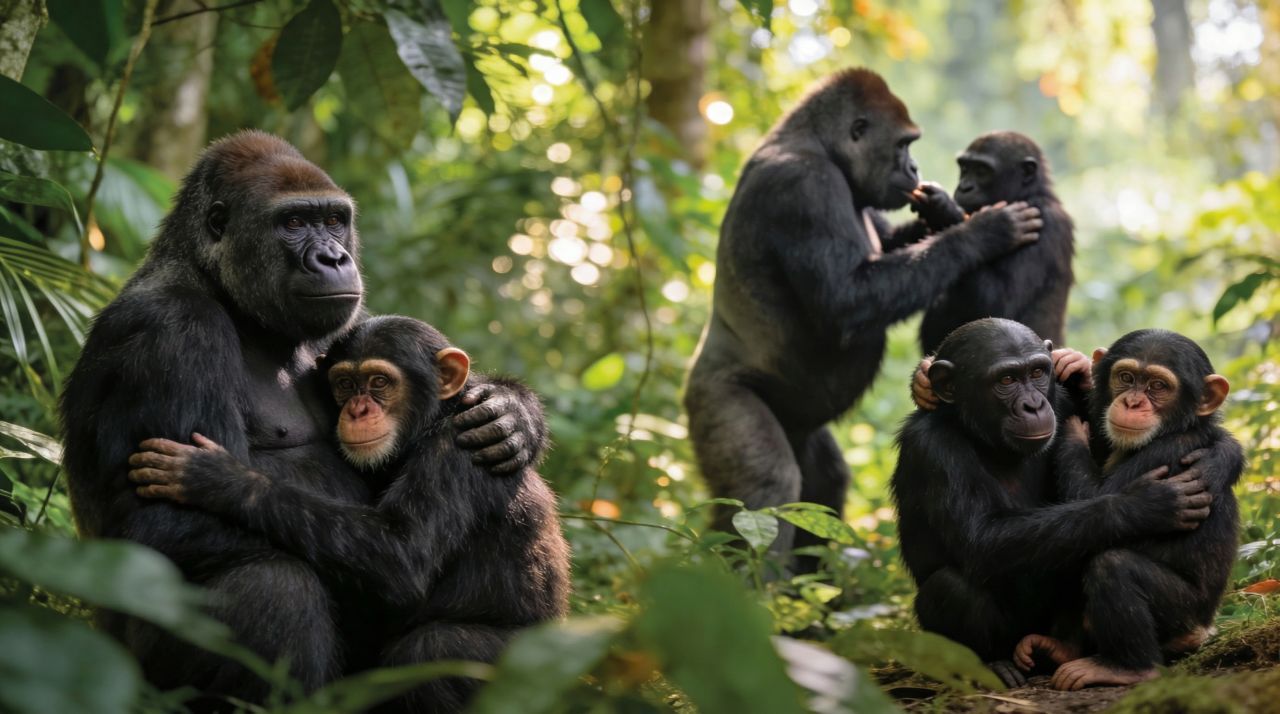
For decades, same-sex behavior in animals was dismissed as a “Darwinian paradox,” a biological glitch that made no evolutionary sense. A sweeping new study of nearly 500 primate species says that framing was wrong all along.
The research, published Monday in the journal Nature Ecology & Evolution, documents same-sex sexual behavior in 59 nonhuman primate species, from bonobos to macaques to lemurs. More importantly, it identifies clear patterns suggesting this behavior evolved as a survival strategy, not despite Darwin but because of him.
What Researchers Found
A team led by Imperial College London biologist Vincent Savolainen analyzed more than 1,700 previous research publications looking for documented instances of same-sex sexual behavior across 491 primate species. They found evidence in 59 species, with the behavior considered common in at least 23 of them.
The documented behaviors included mounting, genital touching, and fellatio, both male-male and female-female interactions. Nonsexual contact was excluded to avoid ambiguity.
“What we found shows that same-sex behavior is not something bizarre, aberrant or rare,” Savolainen told reporters. “It’s part of the normal social life of primates.”
That the behavior appeared across such a wide range of species, spanning the Americas, Africa, and Asia, indicates what the researchers call a “deep evolutionary root.” This isn’t a fluke. It’s been around for millions of years.
The Survival Connection
The most striking findings involve when and where same-sex behavior appears. The study found it was significantly more common in species facing what researchers call “high-stakes” environments.
Species living in harsh, dry conditions with limited access to food showed higher rates. So did species more likely to be hunted by predators. Vervet monkeys in Africa, which must constantly watch for big cats and snakes, exhibit the behavior more frequently than species with fewer threats.
The pattern suggests same-sex behavior helps primate groups manage tension during periods of stress. When survival gets harder, social bonds become more important, and sex appears to be one tool primates use to maintain those bonds.
“Sexual behavior is often about more than reproduction, and that’s certainly true in our species,” said Marlene Zuk, a University of Minnesota evolutionary biologist who was not involved in the study. “What’s really impressive is the breadth of data that they’ve pulled together here.”
Social Complexity Matters
The research also found same-sex behavior was more common in species with complex social hierarchies, particularly those where individuals must climb the social ladder to have a chance at reproducing.
Savolainen has been studying rhesus macaques in Puerto Rico for eight years. His team found that male macaques who mount each other form alliances that could give them access to more females, and therefore eventually more offspring. In 2023, they determined the macaques inherited same-sex behavior from their parents more than 6% of the time.
Species with greater sexual dimorphism, where males are much larger than females like mountain gorillas, were also more likely to exhibit the behavior. These species tend to live in larger groups with more intense social competition, creating more situations where sex might help manage relationships.
Female bonobos are frequently observed rubbing genitals amid social tension. The behavior appears to function as conflict resolution, social bonding, or both.
An Evolutionary Advantage
The old “Darwinian paradox” framing assumed that any behavior not directly tied to reproduction must be evolutionary noise. This study challenges that assumption head-on.
The researchers conclude that same-sex behavior “may function as a flexible social strategy, used to reinforce social bonds, manage conflict or build alliances, depending on the ecological and social pressures faced by different species.”
In other words, the behavior persists precisely because it helps primates survive and, ultimately, reproduce more successfully. It’s not a bug. It’s a feature.
“There was a time where people would think this is only happening when you put two baboons in a zoo that can’t do anything else,” Savolainen said. “So, yeah, things are changing.”
What This Doesn’t Mean
The researchers are careful, very careful, not to draw a straight line from macaque behavior to human sexual identity. The study published in Nature Ecology & Evolution explicitly warns against “misinterpretation or misuse” of the findings.
“We must be cautious when making direct comparisons with humans, as we consider same-sex sexual behavior as a biological behavior, whereas with humans it is important to consider sexuality, gender, and identity,” lead author Chloe Coxshall noted.
Human sexuality involves culture, psychology, and personal identity in ways that don’t apply to other primates. You can’t reduce the complexity of LGBTQ+ experiences to survival mechanisms, however complex.
That said, the researchers note that human ancestors faced the same environmental and social pressures that appear to drive the behavior in other primates. “Our ancestors certainly had to face the same environmental and social complexities,” Savolainen said.
A Growing Field
More than 1,500 animal species have been observed engaging in same-sex sexual behavior, with some observations dating back to Aristotle. But the scientific community largely dismissed these observations for generations, treating them as aberrations rather than data worth studying.
That’s changing. This study joins a growing body of academic research that’s taking animal behavior seriously on its own terms, rather than filtering it through assumptions about what “should” be natural.
The study was dedicated to the memory of Jane Goodall, whose pioneering work observing chimpanzees in the wild helped establish that our closest relatives have rich, complex social lives that deserve rigorous scientific attention.
Savolainen hopes the research will encourage more studies of how same-sex behaviors arise in primates and what role they play. The data is there. It just took scientists a while to decide to look.