
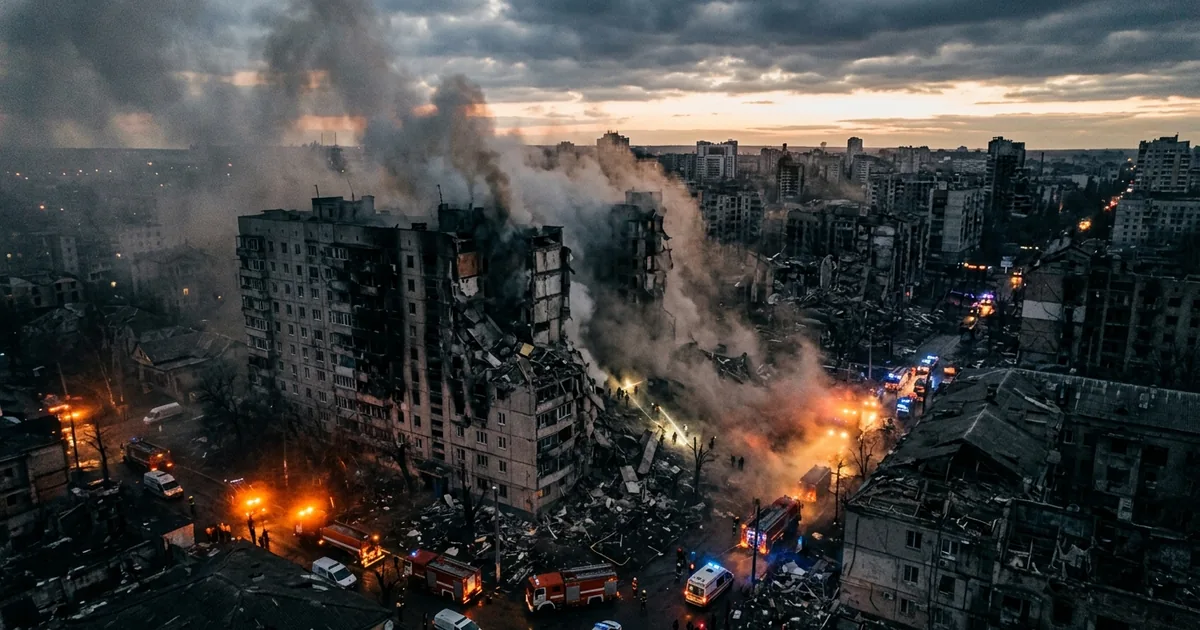
At least 22 people are dead and more than 130 wounded after Russia unleashed a massive overnight barrage of 656 drones and 73 missiles across Ukrainian cities on June 2, targeting Kyiv, Dnipro, Kharkiv, and several other regions in what Ukrainian officials are calling one of the most devastating aerial strikes since the full-scale invasion began.
This is what escalation looks like when the international community keeps equivocating on red lines.
The Scale of the Attack Defies Normalization
The numbers alone should stop anyone from treating this as routine. Ukrainian air defenses intercepted or suppressed 602 of the 656 drones and 40 of the 73 missiles, a success rate that sounds impressive until you count the ones that got through. In Dnipro, 16 people were killed, including two children, when strikes hit residential areas and toppled an apartment building. Six more died in Kyiv. In Kharkiv, 10 people were wounded, including a child.
Russia’s Defense Ministry framed the assault as a strike against “military-industrial,” fuel, and transport targets across the Kyiv, Zaporizhzhia, Kharkiv, Dnipro, Poltava, Khmelnytskyi, and Sumy regions. The ministry claimed the operation used “high-precision long-range air, land and sea-based weapons, including hypersonic aeroballistic missiles.” What the satellite imagery and first responder footage actually shows is collapsed apartment blocks, shattered residential neighborhoods, and rescue crews digging through rubble for survivors.
This distinction matters. Moscow routinely labels civilian infrastructure as military targets to provide a veneer of legality under international humanitarian law. The pattern is well documented: hospitals, schools, power stations, and apartment complexes bear the brunt while the Kremlin insists it only targets strategic military assets.
Why This Attack Is Different
Previous large-scale Russian aerial campaigns have targeted Ukraine’s energy grid, particularly during the winters of 2022-2023 and 2023-2024. This strike marks a shift in tempo and volume. The 656-drone count represents a significant escalation from the 556-drone barrage that made headlines earlier, and combining that drone volume with 73 missiles in a single overnight window suggests Russia is testing whether it can overwhelm Ukraine’s air defense capacity through sheer saturation.
The timing is also worth scrutiny. The attack came amid ongoing diplomatic discussions about potential ceasefire frameworks and just days after several Western nations signaled willingness to explore new negotiation tracks. Moscow has consistently used military escalation as a bargaining tactic, ratcheting up violence to strengthen its position at the table.
Ukraine’s air force reported that the intercept rate for drones exceeded 91 percent and the missile intercept rate was roughly 55 percent. Those percentages have improved dramatically since the early months of the invasion thanks to Western-supplied air defense systems, but the math is unforgiving: even a small percentage of 729 total projectiles translates to dozens of impacts across populated areas.
The Human Cost That Statistics Obscure
The 22 confirmed dead will almost certainly rise as rescue operations continue. First responders in Dnipro were still searching collapsed structures as of late June 2, and officials across multiple regions reported ongoing operations to locate people trapped under debris. The wounded, numbering over 130, include cases of severe trauma from building collapses, shrapnel injuries, and blast effects.
Children, as in every major Russian assault on Ukrainian cities, are among the casualties. Two children were killed in Dnipro. A child was among the 10 wounded in Kharkiv. These are not collateral damage in a precision military operation. They are the predictable result of firing hundreds of explosive projectiles into densely populated urban areas in the middle of the night.
What Comes Next
The uncomfortable question facing Western governments is straightforward: does the current level of air defense support match the threat environment Ukraine is operating in? The intercept rates suggest the systems work. The casualty figures suggest there aren’t enough of them.
Every month the war continues without a resolution, Russia refines its saturation tactics and Ukraine’s cities absorb the cost. The 656-drone, 73-missile attack of June 2 was not an aberration. It was a proof of concept for a strategy built on overwhelming volume, and the only viable counter is a defense posture that can absorb that volume without letting dozens of warheads reach apartment buildings where families are sleeping.