
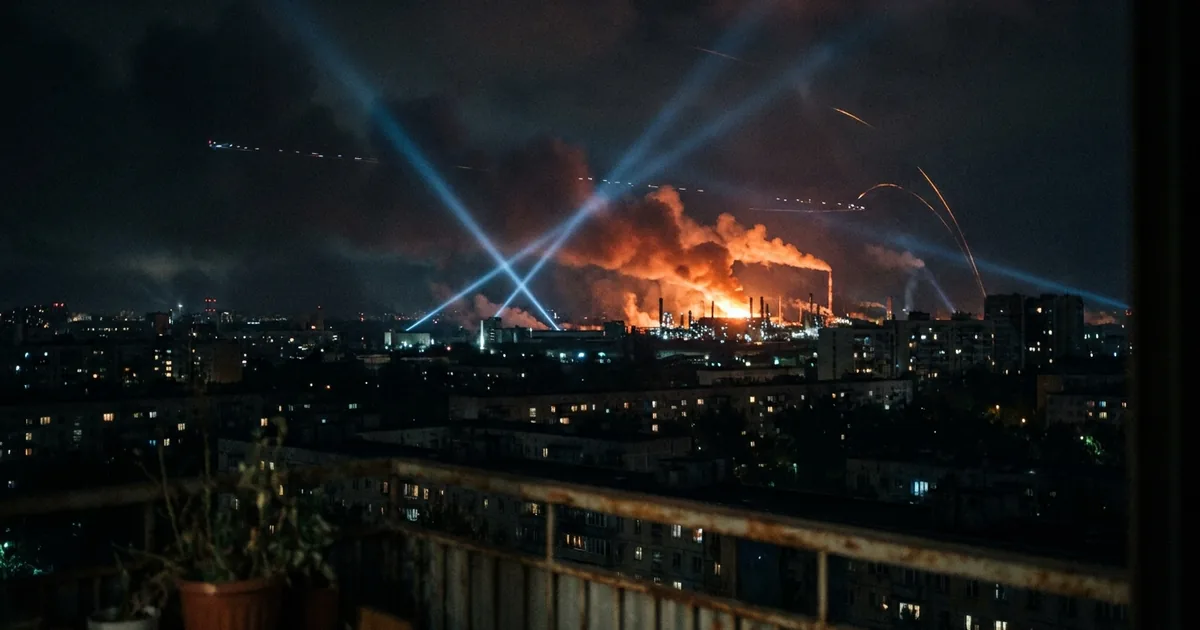
Ukraine sent more than 500 long-range drones into Russian airspace overnight on Saturday into Sunday, killing at least three people near Moscow and striking the city’s oil refinery for the first time in the war.
The Russian Ministry of Defence said its air defences intercepted 556 drones across 14 regions, an admission framed as a victory that doubled as a confession about how far Ukraine can now reach.
The mayor’s office in Moscow called it the largest attack on the capital in over a year. The Russian state news agency TASS, which is not in the habit of dramatizing military setbacks, used the same phrase. Independent coverage from CNN reported on Sunday that fires broke out in a residential village called Subbotino and that four people were wounded when debris damaged apartment blocks in Istra, a commuter town west of the capital. None of that is the kind of detail Russian state television usually airs. It aired this time because too many Russians had already seen it through their own windows.
The Distance That Used to Hold
For most of three and a half years, the Kremlin’s information machinery has worked to keep the war abstracted for the population that does not have a husband or son in Donbas. The footage has been Ukrainian villages, Ukrainian power grids, Ukrainian apartment buildings. The geography has been Avdiivka, Bakhmut, Kupiansk, Pokrovsk, places most Muscovites could not place on a map. The narrative has been controlled, victorious, distant.
The drones that lit up the Moscow region on May 17 collapsed that distance. The Moscow Oil Refinery, the Solnechnogorsk oil depot, and several microelectronics manufacturing facilities took hits that, per Ukraine’s Defense Ministry statement reported by Al Jazeera, were the first successful Ukrainian strikes on those particular targets. Ukraine’s security service framed the operation bluntly: even the heavily protected Moscow region is not safe. That is the message, in plain language, that domestic Russian audiences received whether or not the broadcasters used those exact words.
President Volodymyr Zelensky called the strikes “entirely justified” and pointed to the steady tempo of Russian missile and Shahed-drone attacks on Ukrainian cities as the prompt. Inside Russia, the framing was the opposite: a terrorist provocation, an act of desperation, an outrage. Both framings are political. The reality on the ground is that air-raid alerts, downed-drone debris, and damaged residential blocks are no longer something that happens only to other people in other countries.
What the Polls Were Already Saying
The attack landed in a Russian information environment that was already softening, quietly, under the surface. The independent pollster Levada Center, which the Kremlin has labeled a foreign agent but which still produces the most credible domestic survey data available, found in February 2026 polling reviewed by Russia Matters that 67.2% of Russians want peace negotiations to start, the highest figure since the question was first asked. Only 24.3% said military actions should continue. That is the lowest pro-war figure Levada has recorded.
Active support for the armed forces is also drifting, slowly but visibly. Levada had headline support for the army’s actions at 72.2% in February, down from 75.8% a month earlier and from a band that hovered in the mid-to-high seventies through most of 2023, 2024, and 2025. None of these numbers describe a country in revolt. They describe a country quietly tired of a war that has now stretched past four full years, that has eaten a generation of working-age men, that has not delivered the clean victory state TV kept promising.
The strike on the refinery feeds directly into that fatigue. Russians have been told the war is being prosecuted at a manageable cost. Smoke over the Moscow region is harder to manage when it is visible from a Saturday-night walk.
Inside the Kremlin’s Information Problem
Vladimir Putin’s regime has spent the past three years investing heavily in the idea that the war is being won, that sanctions failed, that the West is fracturing, and that Ukraine is exhausted. That story collides hard with a 556-drone barrage. The Kremlin’s available responses are limited and each one is bad.
It can escalate visibly, with more long-range strikes on Ukrainian civilian infrastructure, and watch the casualty numbers compound in a way that erodes whatever international leverage it has left. It can de-escalate quietly and pursue the talks-on-our-terms framing Putin has hinted at in recent weeks, including the Zelensky meeting that briefly took shape earlier this month before collapsing again. Or it can lean harder into the wartime-emergency framing at home, which is the only lever that reliably consolidates Russian public opinion, while accepting that the wartime emergency now includes apartment buildings in Istra.
There is no version of these options that does not narrow Putin’s room to maneuver. The Russian leader’s domestic legitimacy has always rested on a deal with the population that traded political freedom for stability, predictability, and a sense of national rebound. The drone strikes are an attack on the predictability half of that deal, and the polls suggest the population has been quietly noticing.
The Strategic Logic on the Ukrainian Side
For Kyiv, the calculation is more straightforward. The Moscow Oil Refinery is not symbolic. It is a working refinery whose output feeds the logistics tail of the Russian military, the consumer fuel market, and a regional revenue stream the federal budget needs. Ukraine has been working this strategy methodically: an earlier strike this month on Russia’s Orenburg gas facilities reported by Al Jazeera hit a target more than 1,500 kilometers from the Ukrainian border, a deliberate signal that distance is no longer a defense.
Two things are happening at once. Ukraine is degrading Russian war-economy infrastructure, which is the military goal. And Ukraine is forcing Russians to see the war, which is the political goal. The Ukrainian drone operator quoted in NPR’s reporting put the second piece bluntly: when Russian cities and plants are hit, Russian people acknowledge there is a war. That is a sentence aimed at Moscow’s information bubble, not at the front line.
Whether the political pressure converts into actual policy shift is a different question, and the honest answer is probably not soon. Authoritarian regimes are sticky precisely because they suppress the feedback loops democracies depend on. But the gap between what Russians are told and what Russians can see is widening, and a refinery on fire forty kilometers from the Kremlin is the kind of evidence the gap cannot easily absorb.
What to Watch Next
Three things will tell us how seriously the Kremlin reads this moment. First, whether internal Russian propaganda shifts from “we are winning” to “we are under siege,” because the second framing buys public unity but at the price of admitting vulnerability. Second, whether Russia’s diplomatic posture toward the United States and the on-and-off ceasefire process becomes more flexible or more brittle in the next two to three weeks. Third, whether Ukraine sustains the strike tempo or whether this was a one-off operational peak.
The drones over Moscow on May 17 did not end the war. They did something subtler. They told fifteen million people that the war was inside the ring road, and they told the Kremlin that the information firewall it spent three years building has cracks in it that can be seen from a kitchen window.