
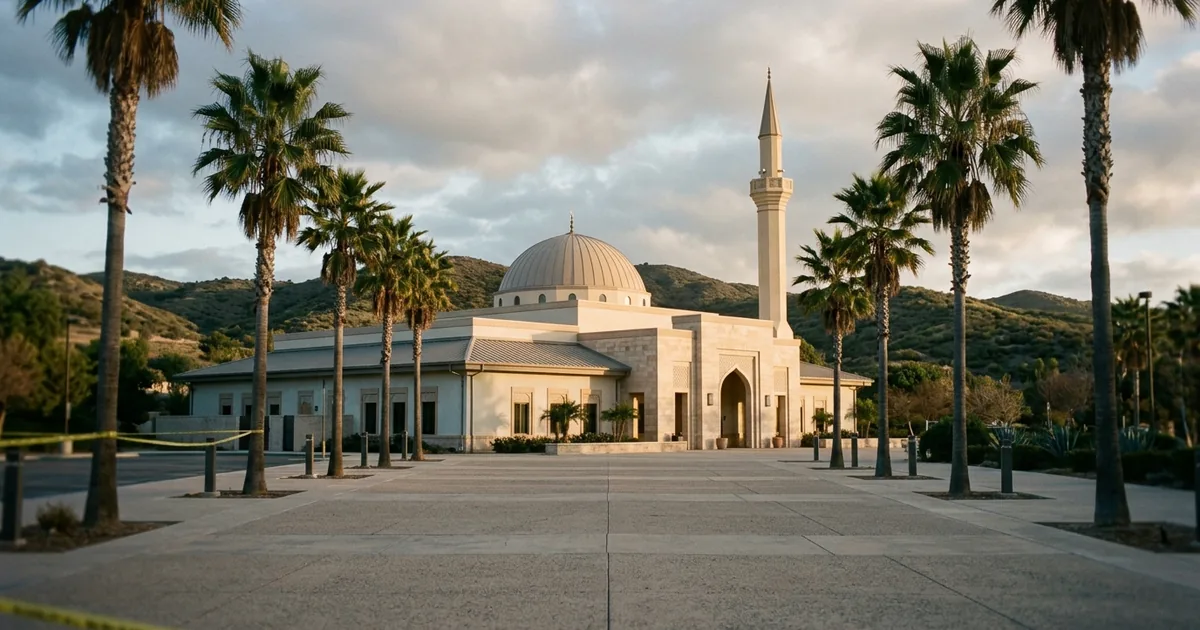
San Diego police neutralized two suspects in an attack on the Islamic Center of San Diego on Monday afternoon, with at least one person dead in what is shaping up as the deadliest assault on a US mosque in years.
The center, the largest mosque in San Diego County, sits in the same eight-mile radius where a Poway-based shooter set fire to an Escondido mosque in 2019 before opening fire on a synagogue and drawing a life-without-parole sentence.
What Police Have Confirmed So Far
The first 911 calls came in at 11:40 a.m. Pacific, per San Diego Police Department statements relayed in NBC News live coverage. A witness told reporters they heard roughly two dozen gunshots in distinct bursts. By 1 p.m., SDPD said the threat had been “neutralized.” Three high-level law-enforcement sources told NBC 7 San Diego that both suspects were dead.
CNN’s live coverage confirms at least one victim killed. The shooting unfolded outside the mosque at 7050 Eckstrom Avenue in Clairemont. Authorities shut down northbound Interstate 805 at Balboa Avenue. A reunification center opened at 4125 Hathaway Street. Bright Horizons Academy, the Islamic pre-K-through-12 school operated alongside the mosque, was placed on lockdown; staff and students were reported safe.
Mayor Todd Gloria acknowledged the unfolding response on social media. Governor Gavin Newsom’s office said it had been briefed and was coordinating with local agencies. CAIR’s San Diego executive director Tazheen Nizam said the organization “strongly condemns this horrifying act of violence at the Islamic Center of San Diego” and was “working to learn more about this incident.” The FBI’s San Diego field office has not yet publicly confirmed whether the bureau is treating this as a hate-crime investigation, though under federal practice, an attack on a house of worship triggers a near-automatic civil-rights division review.
A Pattern Civil-Rights Groups Have Been Documenting for Years
The number that should anchor any reading of what happened in Clairemont this afternoon comes from CAIR’s most recent civil-rights tally: 8,658 anti-Muslim and anti-Arab complaints in 2024, the highest single-year total since the organization began collecting data in 1996. The FBI’s separate 2024 hate-crime numbers, reported in detail by Axios, logged 11,679 hate incidents nationwide, the second-highest year on record, with the anti-Muslim subcategory still elevated even after the bureau’s well-documented under-reporting from agencies that decline to participate in voluntary reporting.
The deeper trend, captured in CBS News reporting on the surge of attacks on religious facilities, is that assaults and attacks on people at churches, synagogues, temples, and mosques climbed nearly 100% between 2021 and 2023. The Justice Department’s stated response in that window included a community-protection program tied to civil-rights enforcement, FBI tip-line outreach, and bias-incident training for local agencies.
Where that infrastructure stands in May 2026 is a different question. The civil-rights enforcement apparatus that scaled through the Biden years has been substantially restructured under the Trump administration’s second term. A federal-court fight is currently underway over the Justice Department’s indictment of the Southern Poverty Law Center on fraud charges, a move that SPLC and a coalition of civil-rights groups describe as a deliberate effort to defang one of the country’s most-cited hate-incident trackers at exactly the moment those trackers are most needed.
The Local Context Matters
San Diego County has its own history here. In 2019, a Poway-based shooter set fire to the Dar-ul-Arqam mosque in Escondido and then drove to the Chabad of Poway and opened fire during Passover services, killing one and wounding three. He drew a life-without-parole sentence in federal court and a separate state life term. Same county. Same eight-mile radius of religious-community targeting. Same operational profile in early reporting: a coordinated daytime attack on a house of worship, multiple attackers, mass-casualty intent.
The Islamic Center of San Diego is not an obscure target. It is the largest mosque in the county, hosts an attached K-12 Islamic academy, and runs a full schedule of community programming. A Monday-midday timing puts staff, schoolchildren, and worshippers all on premises at once. Whoever planned this understood what they were aiming at.
What to Watch in the Next 24 Hours
A few specific questions will shape how this story develops, and which of them get answered will tell us a lot about where federal civil-rights enforcement actually stands right now.
First: whether the FBI publicly confirms a hate-crime predicate, and how quickly. The bureau’s San Diego field office has the operational reach to do this within hours when the indicators are present. Speed signals priority.
Second: whether federal prosecutors charge any surviving subjects with civil-rights violations alongside state homicide charges. That joint posture has been the post-Tree of Life template for prosecuting attacks on US religious sites.
Third: what the surveillance and tip-line trail looked like before today. Most US attacks on houses of worship in the last decade have left a digital footprint, often months out, that someone saw and either acted on or did not. The fastest way to learn whether the FBI’s current leadership is operationally serious about anti-Muslim and antisemitic threat assessment is to ask what it knew, when, and what it did with it.
A fourth question, mostly for California: whether the state legislature treats this as a moment to harden California’s own hate-crime infrastructure even further, on the theory that the federal layer cannot be counted on. That is already the operating assumption in Sacramento on civil-rights enforcement more broadly. Today probably accelerates it.
The Islamic Center of San Diego will reopen, eventually. The deeper question is whether the United States in May 2026 is a country where the largest mosque in a major metropolitan county can hold morning programming without an armed-detail risk assessment built into every Monday. That answer has been drifting in one direction for years. Today is another data point on that drift.
This is a developing story. The LNC newsroom will update with confirmed victim counts, suspect identification, and federal-charging posture as authorities release them.