
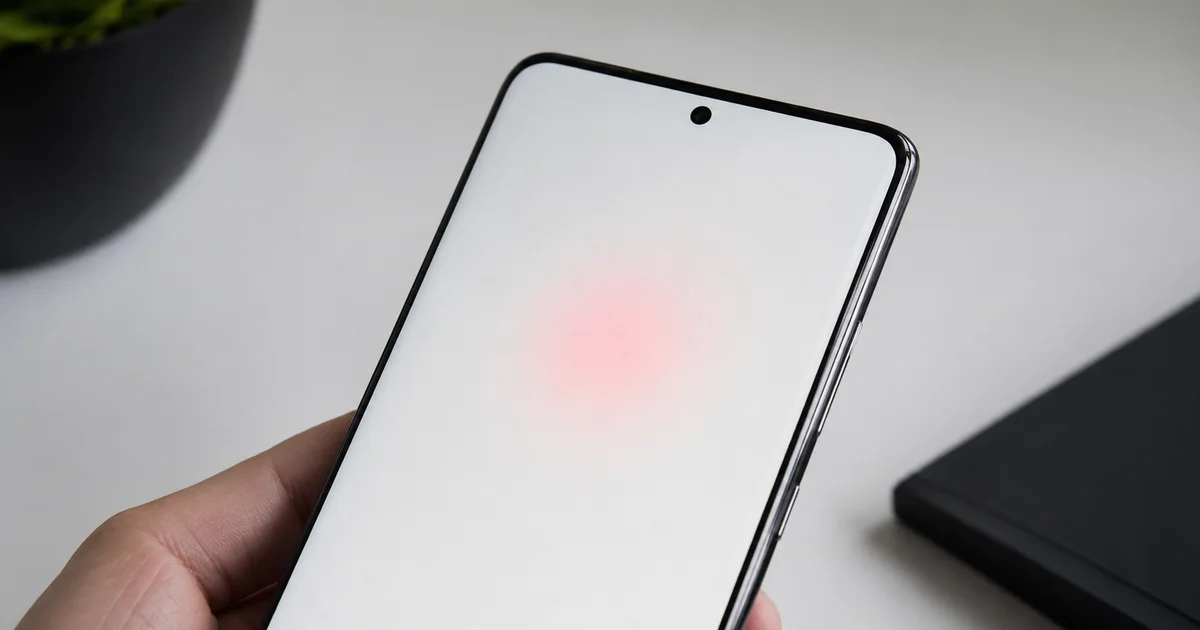
Samsung’s most expensive phone is developing an unsettling cosmetic defect that the company cannot yet explain.
A growing number of Galaxy S26 Ultra owners are reporting that their displays are slowly turning red, with a persistent pinkish-to-crimson patch appearing in the center of the screen that no software adjustment can fix. Samsung says it is investigating, but the trail of evidence points directly at the phone’s most ambitious hardware innovation.
What Users Are Seeing
The reports, which have been accumulating on Reddit and the Korean social media platform Naver since March, just weeks after the phone’s launch, describe a reddish discoloration that develops gradually over time. It is not a software glitch. The red mark stays centered on the display regardless of what is on screen, and adjusting brightness or color settings does nothing to remove it. Users who paid $1,300 or more for the device are understandably frustrated, and the problem appears to be getting worse as phones age.
The defect is subtle enough that it might not be immediately obvious in bright conditions, but it becomes unmistakable on white or light-colored backgrounds. For a phone that Samsung markets as having the best display in the smartphone industry, any visible discoloration is a problem. A persistent, growing one is a potential PR crisis.
The Privacy Display Suspicion
Industry analysts and display experts are zeroing in on the Galaxy S26 Ultra’s headline feature as the likely culprit: the Privacy Display. Built using Samsung’s specialized Flex Magic Pixel OLED technology, this hardware-level privacy filter restricts side-angle visibility so that nearby strangers cannot peek at your screen. Unlike older software-based privacy filters, this system is baked directly into the physical structure of the display panel itself.
The connection to the red tint is mechanical. To prevent side-angle viewing, the Privacy Display dims pixels on the edges while boosting luminance in the center. That center-heavy pixel stress is exactly where the discoloration is appearing. The working theory among display engineers is that the uneven power distribution may be causing differential OLED degradation, where the center pixels age faster than the edges, and that aging manifests as a red shift.
If this theory holds, Samsung faces a difficult design choice: the feature that distinguishes the S26 Ultra from every other flagship is the same feature that may be degrading its most important component.
Samsung’s Non-Answer
Samsung has acknowledged the reports but has not confirmed a defect, stating only that it is reviewing the issue internally to determine whether the problem is tied to the panel structure, the Privacy Display feature, or a limited number of affected devices. That careful phrasing leaves the door open to classifying this as a minor manufacturing variation rather than a systemic design flaw, which would let the company avoid a costly recall or warranty extension.
PhoneArena reported that Samsung “may turn a blind eye” to the issue if the number of affected units remains manageable. That is a risky bet. OLED degradation is progressive, and if the problem is structural rather than a manufacturing outlier, the number of affected devices will only grow as phones age. Six months from now, what is currently a niche complaint could become a class-action-sized headache.
The Bigger Picture for Samsung
Samsung has staked its flagship strategy on display innovation, and the Privacy Display was the centerpiece of the S26 Ultra’s marketing push. If the feature turns out to cause permanent screen damage, it undermines the company’s claim to display leadership at exactly the moment when Apple and Google are pushing their own display technologies forward.
For consumers, the takeaway is simpler: if you own an S26 Ultra, check your screen on a white background. And if you see red, you are not imagining things.