
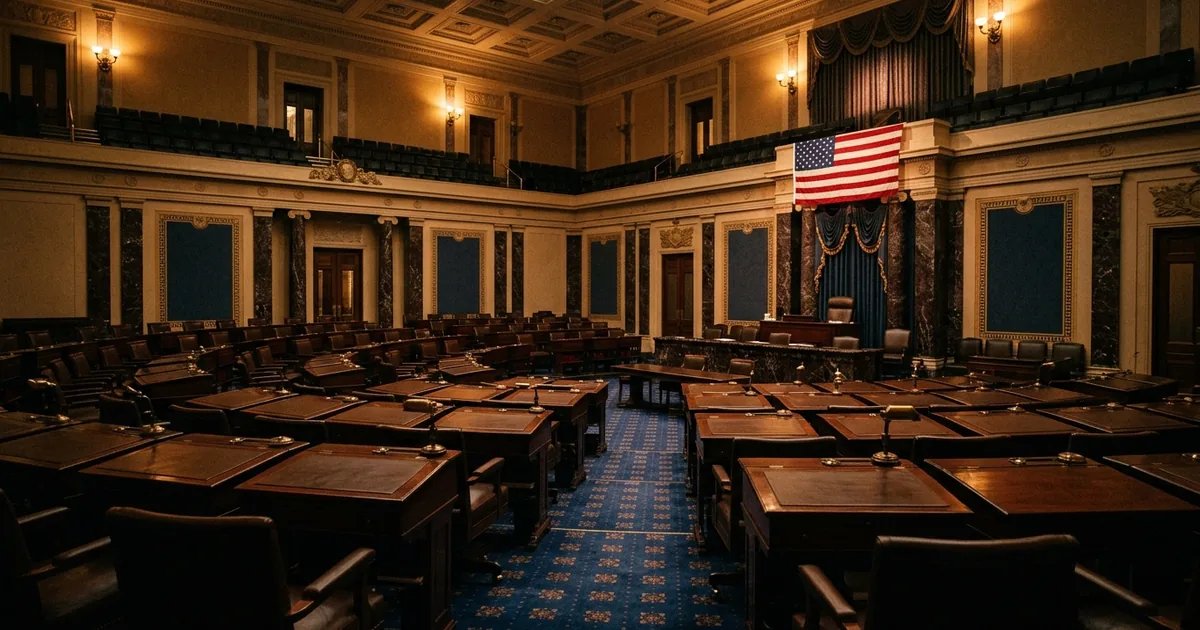
The Senate’s position on presidential war powers in Iran did a full 180 in less than 24 hours, and all it took was a furious president, a private lunch, and a handful of Republicans who apparently needed reminding of who runs their party.
What Happened in That Room
On Monday, the Senate handed President Trump a rare bipartisan rebuke, voting 50-48 to pass a resolution that would have required him to seek congressional authorization before escalating military operations against Iran. Four Republicans crossed the aisle to join Democrats: Lisa Murkowski of Alaska, Susan Collins of Maine, Rand Paul of Kentucky, and Bill Cassidy of Louisiana.
Trump did not take it well.
When Trump arrived at the Capitol on Wednesday for what was supposed to be a policy lunch about voter ID legislation, senators described him as visibly furious. He launched into an extended denunciation of the four Republicans who had voted against him, naming each one by name. Cassidy, who lost his primary earlier this year after Trump endorsed a challenger against him, stood up and fired back.
“You have not told the American people what’s going on,” Cassidy told the president, according to multiple senators in the room. The exchange escalated into a full shouting match that derailed the meeting’s original agenda entirely.
The Reversal That Followed
Hours later came the part that should concern anyone who thinks Congress still functions as a co-equal branch of government. The Senate took up a separate but related resolution aimed at restricting Trump’s authority to resume hostilities with Iran. This time, Cassidy voted with the Republican majority to block it, delivering Trump a 50-47 victory.
Cassidy said he changed his approach after receiving a classified briefing from Vice President JD Vance and Special Envoy Steve Witkoff on the status of Iran negotiations. Whether that briefing contained genuinely new information or simply gave Cassidy a face-saving exit ramp is a question only he can answer.
Trump, for his part, posted triumphantly on Truth Social: “Wow! The Senate just changed its vote on Iran from 50-48 against, to 50-47 for.” He later told reporters the initial vote was “meaningless.”
Why This Matters Beyond the Iran File
The institutional question here is bigger than Iran policy. Congress has spent decades ceding war powers authority to the executive branch. The War Powers Act exists precisely for moments like this, when a president is conducting military operations that lack a formal declaration of war. Monday’s vote was one of the rare instances where the Senate actually tried to reclaim that authority.
That it collapsed within 48 hours, under pressure from a presidential temper tantrum at a private lunch, tells you everything about the current balance of power between the branches. The four original dissenters included two of the Senate’s most independent voices in Murkowski and Collins, plus Rand Paul, whose opposition to executive war-making has been consistent across administrations. Even that coalition could not hold.
The Iran negotiations themselves remain in a precarious state. The U.S. and Iran have been engaged in indirect talks, but the IAEA chief recently told CBS News that the timing of nuclear inspections is “not essential” to the broader deal framework, a statement that raised eyebrows among nonproliferation experts.
Where the Iran Talks Stand
The military backdrop makes the institutional collapse harder to ignore. The U.S. has been conducting operations in and around Iran since early 2026, and the human and fiscal costs continue to mount. Congress authorized none of it through a formal declaration. The War Powers Resolution, passed in 1973 over Richard Nixon’s veto, was designed to prevent exactly this scenario: a president waging an open-ended military campaign without legislative buy-in.
The broader diplomatic picture remains murky. Israel’s defense minister said Wednesday that there has been “no American demand for Israel to withdraw from Lebanon,” complicating the already fragile negotiations between Washington and Tehran. Meanwhile, the House passed its own war powers resolution earlier this month directing Trump to end hostilities, but that measure faces the same Senate graveyard that swallowed Monday’s effort.
The Pattern Is the Point
This is not the first time Trump has used personal confrontation to whip Senate votes into line, and it will not be the last. The mechanism is reliable: apply public and private pressure, offer a face-saving off-ramp (in this case, a classified briefing), and let institutional loyalty do the rest.
What makes Wednesday’s episode notable is how naked the whole sequence was. The rebuke, the rage, the reversal, all played out within the same news cycle. No one even pretended the policy considerations had changed between Monday and Wednesday. The only thing that changed was Trump’s mood, and apparently that was enough.
The episode also crystallizes a deeper problem with the current Republican caucus. Senators who might privately share concerns about executive overreach on war powers now face a calculation that has nothing to do with constitutional principles: cross the president, and you get primaried. Cassidy already learned that lesson the hard way. His reversal on Wednesday was less a change of mind than an act of political survival.
For a body that styles itself the world’s greatest deliberative institution, the Senate’s war powers authority is looking increasingly decorative.