
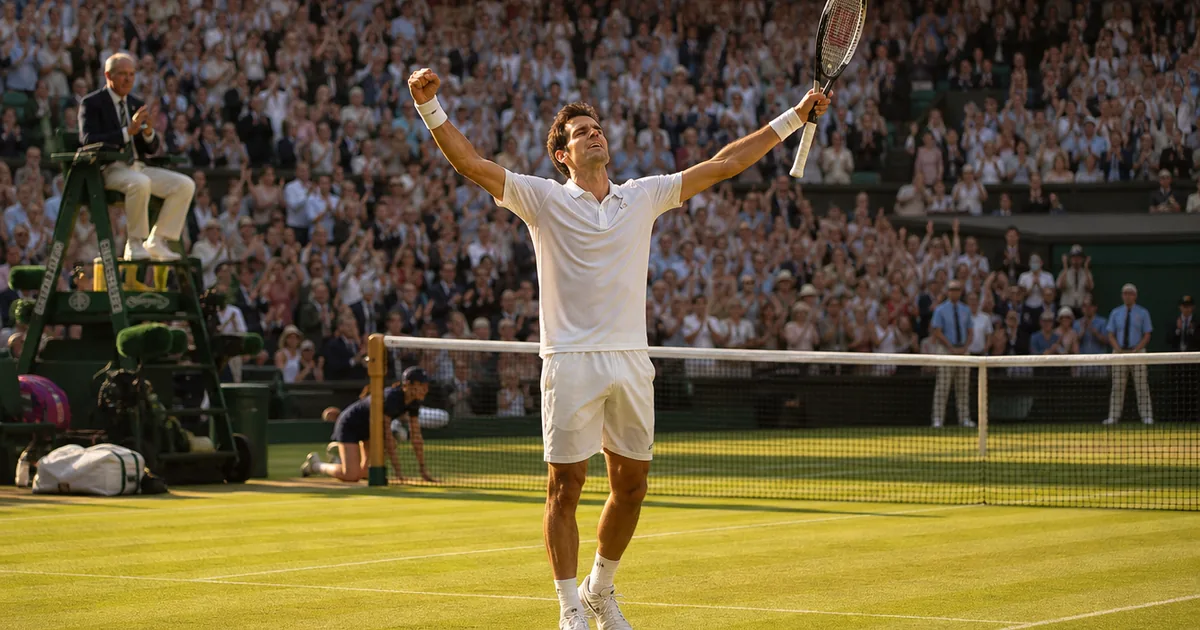
Jannik Sinner dropped the first set, shrugged it off, and then systematically dismantled Alexander Zverev over four sets to defend his Wimbledon crown on Sunday, winning 6-7, 7-6, 6-3, 6-4 in three hours and 46 minutes. It is the 24-year-old Italian’s fifth Grand Slam title and the clearest signal yet that men’s tennis has a new dominant force who is not going anywhere soon.
A First-Set Wobble, Then Total Control
Zverev, who reached his first Wimbledon final after an impressive fortnight that included a straight-sets demolition of wildcard Arthur Fery in the semis, came out swinging. He snatched the opening-set tiebreak 9-7, hitting his spots on serve and keeping Sinner pinned behind the baseline. For about 50 minutes, the German looked like a player capable of snatching the title from the world number one.
Then Sinner flipped a switch. He won the second-set tiebreak, found his range on the forehand, and gradually suffocated Zverev’s attacking game with relentless depth and court positioning. ESPN’s live coverage noted that Sinner finished with 57 winners to Zverev’s 44, including a staggering 34 forehand winners compared to Zverev’s 18. That forehand disparity tells the whole story: once Sinner locked in, he was playing a different sport.
Djokovic’s Shadow Fades
The semifinal was arguably the more significant match on Sinner’s path to the title. He beat seven-time Wimbledon champion Novak Djokovic 6-4, 6-4, 6-4, the kind of scoreline that reads almost dismissive against the greatest grass-court player of his generation. The win made clear that the torch-passing is no longer a narrative. It is a fact.
Djokovic, who turns 39 this year, is still competing at Grand Slams and still dangerous. But Sinner has beaten him in their last four meetings, each time more convincingly than the last. The question is no longer whether Sinner can beat the all-time greats. It is whether anyone in the current field can consistently challenge him.
What Five Slams at 24 Means
Sinner’s five Grand Slams by age 24 put him on a trajectory that only a handful of players in history have matched. The conversation about whether he can catch the all-time records of Djokovic (24), Nadal (22), and Federer (20) is still premature, but it is no longer absurd. He has won on hard courts, clay, and now back-to-back on grass. There are no surface weaknesses to exploit.
The women’s final earlier in the weekend provided its own memorable moments, with Linda Noskova claiming her first Wimbledon title. But the men’s final belonged entirely to Sinner, who played the kind of second-half tennis that makes opponents feel like the court is shrinking around them.
Zverev, for his part, has now lost in the finals of three different Grand Slams without a title. At 29, he remains one of the best players in the world and one of the unluckiest in the biggest moments. The gap between Zverev and the top tier is not about talent. It is about whatever intangible gear Sinner finds when a match reaches its hinge point, the ability to play his best tennis precisely when the pressure is highest.
The grass-court season is over. Sinner heads into the hard-court summer as the undisputed best player on the planet, the kind of dominant number one that the sport has not had since Djokovic’s peak years. The only real question left is how high the ceiling goes.