
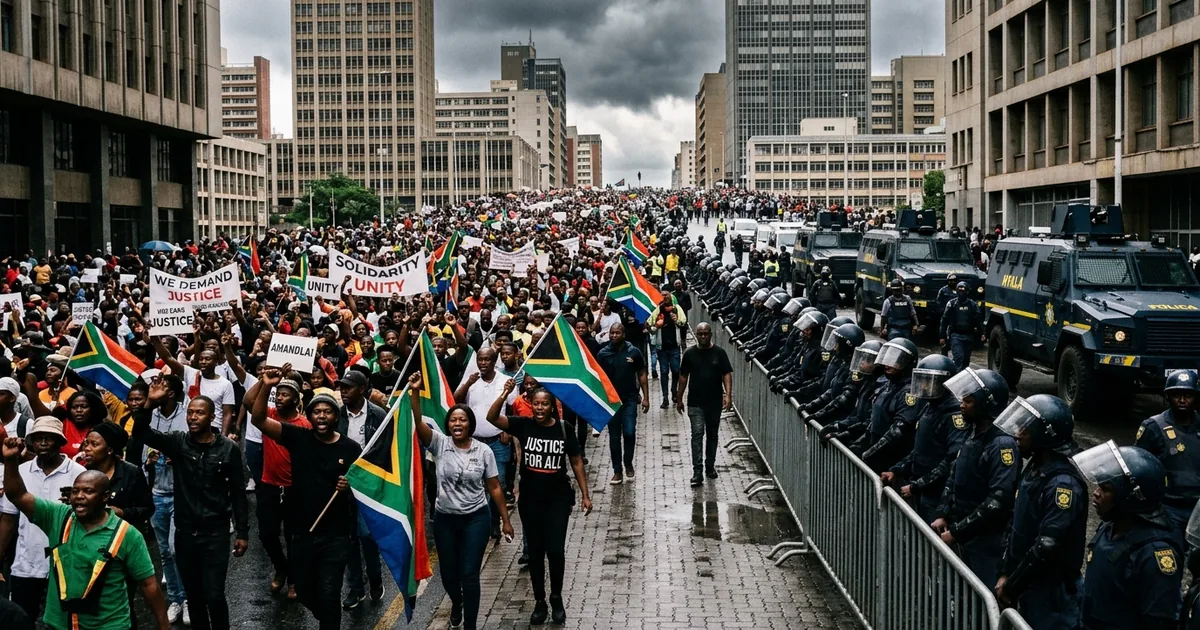
South African police arrested more than 900 people on Tuesday as nationwide anti-migrant protests marking a self-imposed “deadline” for undocumented foreigners to leave the country turned violent in several cities, with soldiers deployed to Johannesburg’s Hillbrow neighborhood and police reinforcements sent to five of the country’s nine provinces.
The protests represent the most acute flashpoint yet in a months-long anti-immigrant movement that has displaced thousands and drawn sharp international condemnation.
What Happened on the Ground
Of the 120 marches that took place across the country on July 1, police confirmed that 108 remained peaceful while 12 required law enforcement intervention due to unrest, looting, and public violence. In Thembisa, a suburb north of Johannesburg, rioters threw stones at police and suspected migrants, and sporadic gunfire was heard near the central business district, Al Jazeera reported on Tuesday.
Those arrested face a range of charges: some were undocumented migrants detained for violating immigration laws, while others were charged with public violence, harboring illegal immigrants, and robbery. The military was called in to support police in Johannesburg’s Hillbrow district, long a hub for immigrant communities, after crowds overwhelmed local officers.
The ‘Deadline’ That the Government Never Endorsed
The July 1 date was set not by the South African state but by an organized anti-immigrant movement that has spent months issuing ultimatums, vandalizing foreign-owned businesses, and driving migrants from their homes. The government has repeatedly stated that immigration enforcement is the sole responsibility of the state and must follow constitutional and legal procedures.
That distinction matters. When a vigilante movement sets a “deadline” and the government deploys thousands of police and the military to manage the fallout, the state is reacting to a crisis it failed to prevent, not enforcing policy it designed. South Africa’s constitution guarantees rights to all people within its borders, not just citizens, and the government’s own framing makes clear that the movement’s demands have no legal standing.
Yet the movement’s power is real. Thousands of African foreign nationals fled the country before Tuesday’s date, CNN reported late last week. Shops closed. Foreign workers stayed home. The “deadline” may have been legally meaningless, but it functioned as an effective threat.
Why This Is Happening: Economic Failure Finds a Scapegoat
The structural driver behind South Africa’s anti-migrant violence is not immigration itself but the country’s chronic economic failure. Official unemployment sits above 33%, with youth unemployment closer to 60%. The post-apartheid promise of broad economic inclusion never materialized for millions of Black South Africans who remain locked out of opportunity three decades after democratic transition.
Into that vacuum, anti-immigrant organizers have offered a simple, false answer: foreigners are taking jobs that belong to South Africans. It is the same playbook that fuels immigration crackdowns across the globe, from the United States to Europe, and it works because economic pain is real even when the diagnosis is wrong.
The movement has escalated from social media campaigns to physical displacement to setting national “deadlines,” with each step met by a government response that manages the symptoms without addressing the cause. There is no credible evidence that removing undocumented migrants would meaningfully reduce South Africa’s unemployment rate, which is driven by structural factors including a skills mismatch, failing state-owned enterprises, and chronic energy shortages that have hampered industrial growth for over a decade.
International Pressure Building
The African Union, the United Nations, and individual African governments have condemned the violence. Several countries, including Malawi, Nigeria, and Zimbabwe, have initiated emergency repatriation operations for their citizens. France 24 reported on Tuesday that diplomatic pressure is mounting on Pretoria to both protect foreign nationals and address the root economic grievances fueling the movement.
For South Africa’s government, the crisis exposes a painful contradiction: the country that built its post-apartheid identity on human rights, reconciliation, and pan-African solidarity is now the continent’s most visible source of anti-migrant violence.
What Comes Next
The question now is whether Tuesday’s “deadline” was a peak or a prologue. The anti-immigrant movement has shown it can mobilize nationally, set a public timetable, and force the state into a reactive posture. The 900-plus arrests will not address the economic conditions that feed the movement, and there is no indication the government has a plan that does.
South Africa’s leaders face a choice that political leaders across democracies are struggling with: address the structural economic failures that create the conditions for scapegoating, or continue managing each eruption as it comes and hope the next one is smaller. History suggests that hope is not a strategy.