
Elon Musk recently announced that SpaceX had shifted its main efforts from Mars colonies to building a self-sustaining city on the moon. According to him, they’re considering Mars as part of future plans, but Moon access provides a quicker method to achieve human spatial settlement, which the company has worked toward since 2002.
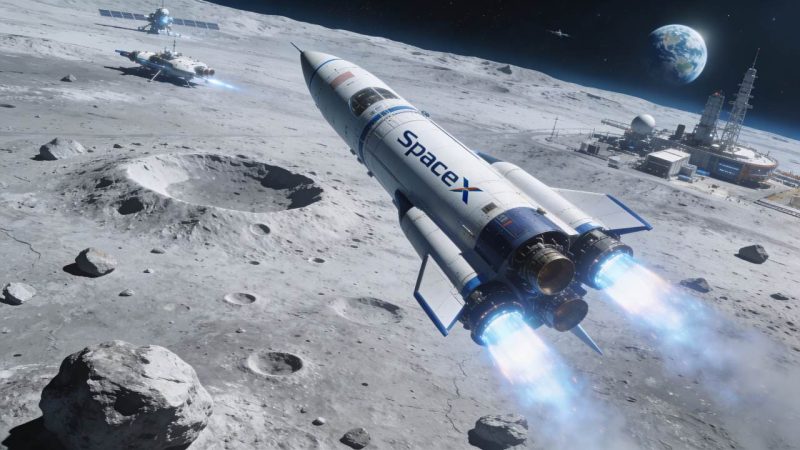
Musk took to X (formerly Twitter) to clarify SpaceX’s new priorities, explaining that a Moon city could be achievable in less than 10 years, whereas a Mars settlement could take “20+ years” due to logistical constraints.
The organization needs to shift its operational efforts to align with current requirements while maintaining its Mars commitment as its primary focus. This demonstrates economic realism, ensuring a strong start for SpaceX stock on the day of its upcoming IPO.
The following points explain how lunar missions provide better access than Martian missions.
- The lunar mission schedule enables launches every 10 days, while the space requirements for each mission take about 2 days to reach the destination. The mission schedule for Mars missions must correspond to the planetary alignment, which occurs every 26 months, in addition to the 6-month journey.
- More frequent missions translate into faster iteration cycles for technology, testing, and infrastructure development. Aerospace companies need quick feedback mechanisms to implement updates faster. These methods help minimize both risk and costs.
Musk confirmed that SpaceX’s main objective of making humanity a multi-planetary species has remained the same, but these new directives are relevant for operational purposes.
What Makes the Moon More Accessible?
The Moon’s proximity to Earth is the core factor driving this strategic shift. Astronomical measurements show that proximity to Earth results in three specific advantages for space travel:
- A shorter distance means faster travel, allowing missions to complete their work within days rather than over months.
- The frequent launch windows grant immediate evaluation of both successful and failed attempts.
- The system provides essential components for actual human assistance through its abilities to deliver fast communication and low recovery risk.
The Moon serves as an effective testing ground. Its advantages enable the assessment of technologies designed for Mars missions, which require multiple testing experiments to achieve complete operational readiness. The lunar surface also provides essential sunlight and vacuum conditions, and those are simulated environments for interplanetary outpost development.
Context: NASA, Artemis, and Global Competition
This strategy change is clearly linked to developments in the global market and geopolitical conditions. The company is a contractor for NASA’s Artemis program, the U.S. initiative to bring humans back to the moon — something that hasn’t happened since Apollo 17 in 1972. As the lunar lander for Artemis missions has been selected SpaceX’s Starship, underlining the strategic importance of lunar exploration within the modern space program.
The shift also occurs amid rising competition from other nations, particularly China, which has announced ambitions to land astronauts on the Moon by the end of the decade. This environment is driving a new global space race, making moon landing development a much more important target at the moment.
Although not a traditional macroeconomic indicator, a major Artemis launch can be monitored by traders much like an event on the economic calendar, as its outcome can influence market expectations and sentiment.
Technological and Economic Logic
The development of a lunar city better suits engineering and business needs: it offers low risk and supports continuous development. Moon launches require less fuel, enabling shorter, faster mission turnaround times and reduced operational expenses, simplifying mission execution.
The consistency of the missions will improve the learning process for Life Support Systems, habitation modules, and in-situ resource utilization technologies, which will later be vital for Mars operations.
Lunar missions create economic opportunities for emerging industries, including space fabrication, satellite deployment, and lunar resource extraction, potentially making related companies future market movers and premarket gainers. Musk has proposed using lunar resources to establish manufacturing facilities, thereby driving increased economic development in space-based industries.