
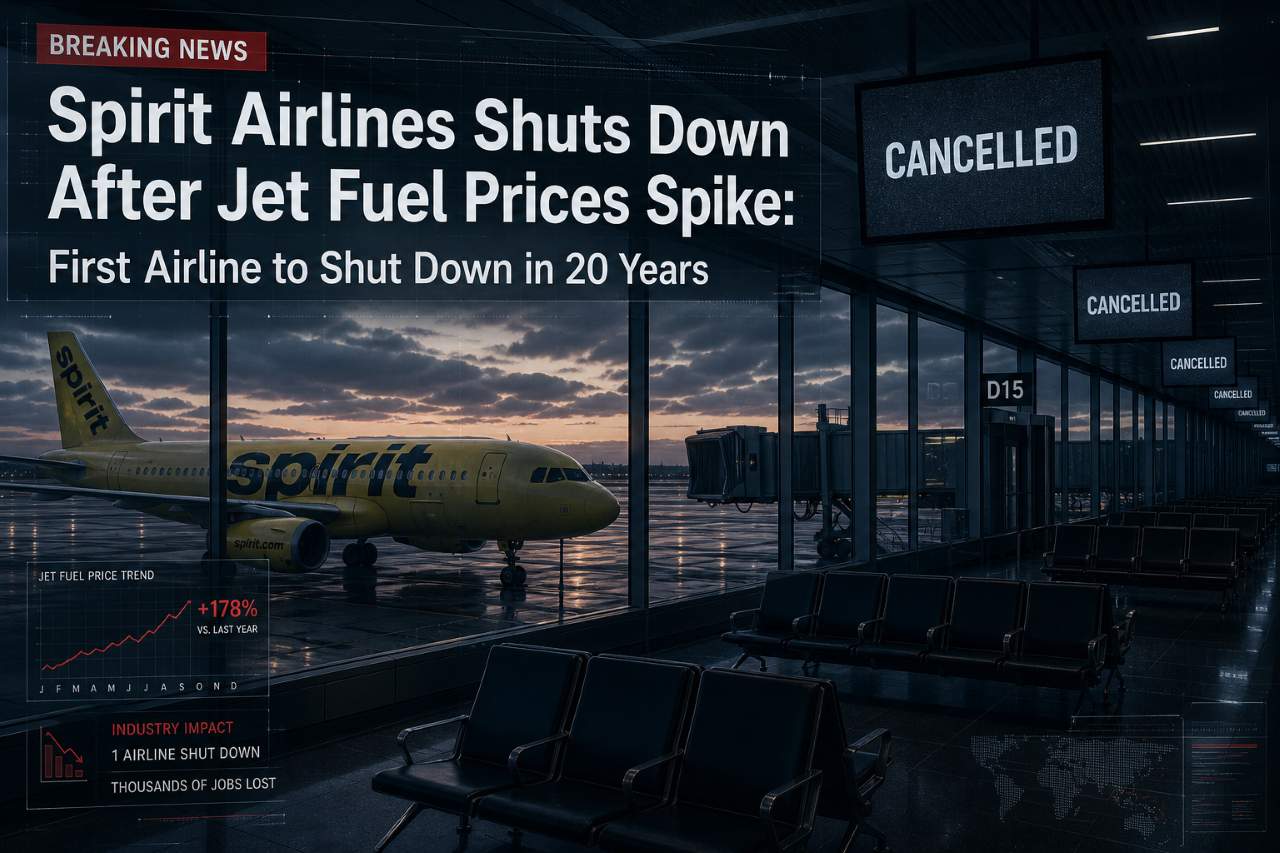
Spirit Airlines ceased all operations at 3:00 AM ET on May 2, 2026, marking the collapse of the first major U.S. carrier to fold in 25 years. The budget airline’s shutdown wasn’t caused by competitive failure or management incompetence in the traditional sense. It was killed by a perfect storm of geopolitical chaos, fuel market destruction, and a failed federal rescue that revealed just how fragile American aviation infrastructure really is when external shocks hit.
When Iran’s conflict escalated just two months ago, jet fuel prices spiked from $2.24 to $4.51 per gallon. For Spirit, an airline that built its entire business model on razor-thin margins and operational efficiency, this wasn’t a speed bump. It was an extinction event. The carrier canceled 4,119 flights and issued a message to passengers that was almost cruel in its directness: don’t go to the airport.
This wasn’t supposed to happen in 2026. Spirit had survived the pandemic, survived the financial crisis, survived decades of industry consolidation that crushed competitors and consolidated market power among the Big Three carriers. But Spirit existed in a perpetually precarious state, always one bad quarter away from crisis. When fuel costs doubled in eight weeks, there was no margin left. There was nowhere to cut.
The $500 Million Rescue That Wasn’t
The federal government moved quickly to offer a $500 million bailout. It was a rational decision from a policy perspective: letting a major airline dissolve creates immediate chaos for the flying public, damages the broader economy, and signals that the industry is vulnerable to energy shocks. But money alone couldn’t fix the structural problem. The bailout collapsed when creditors pulled out, unwilling to gamble that Spirit could actually survive if fuel remained at these price levels.
What’s instructive here is that the bailout failed not because Washington didn’t care or didn’t try. It failed because the underlying economics no longer made sense. Spirit’s business model, which depended on cost leadership in an industry where margins never got comfortable, couldn’t absorb a 100 percent fuel cost increase. No amount of emergency capital fixes that. You can’t manage your way out of a commodity price shock that doubles your biggest input cost.
This is what makes Spirit’s collapse different from past airline crises. It’s not really about Spirit. It’s about what happens when geopolitical shocks hit industries that were already operating on the edge of viability.
The Bigger Picture: Fragility In The System
The Federal Reserve and energy markets have been struggling to price the ongoing uncertainty around oil supplies and geopolitical risk. Spirit’s shutdown is a crystallization of that broader anxiety. When jet fuel doubles, airlines don’t just lose profit margins. They lose the ability to make rational business decisions. They can’t invest in new routes, they can’t negotiate competitive contracts with suppliers, they can’t offer competitive wages to retain workers.
For thousands of Spirit employees, the shutdown is immediate catastrophe. For the aviation industry more broadly, it’s a warning sign. The consolidation of American aviation around a handful of mega-carriers was supposed to create efficiency and stability. Instead, it created an industry where one fuel shock can kill a company that was still flying millions of passengers.
The bigger carriers have deeper pockets and more routes to spread costs across. But they’re not immune to $4.51 jet fuel either. The difference is they can raise ticket prices faster, they have more bargaining power with suppliers, and they have the balance sheet to absorb losses while waiting for fuel prices to normalize. Spirit never had those advantages.
What’s Next For The Flying Public
Spirit passengers are in a uniquely bad position. Unlike in previous airline bankruptcies where routes get inherited and passengers rebook on other carriers, Spirit’s shutdown happened so suddenly that no coherent rebooking plan exists. CNN’s reporting on Spirit halting all flights makes clear that passengers are simply left to find their own alternatives, which in many cases means paying premium prices on last-minute bookings with the Big Three carriers.
From a consumer perspective, this is terrible. From an industry perspective, it’s actually clarifying. The days of ultra-low-cost carriers operating on single-digit profit margins are over, at least while geopolitical risk remains elevated. Any airline trying to offer $50 flights while fuel costs $4.51 per gallon is doing accounting that doesn’t work.
NPR’s coverage of Spirit ceasing operations includes interviews with industry analysts who universally acknowledge that no other budget carrier faces the same existential pressure. That’s true for now. But if the Iran conflict remains unresolved, or escalates further, fuel prices could stay elevated indefinitely. That becomes a systematic problem, not just a Spirit problem.
The Real Lesson Here
Spirit Airlines’ failure is ultimately a lesson about fragility in complex systems. The airline was objectively well-managed for what it was trying to do. It had loyal customers, efficient operations, and a clear competitive position. But it existed in an ecosystem where one external shock could be fatal. That’s not an indictment of Spirit’s leadership. It’s a structural feature of being the lowest-cost player in an industry where your primary input is a commodity subject to geopolitical risk.
The real question is whether this crisis forces a reckoning in how we think about energy risk in transportation, or whether it gets absorbed and forgotten. Federal policymakers showed they were willing to intervene with capital. But the market said that capital couldn’t solve the fundamental problem. When those two forces collide, the market usually wins. Spirit’s shutdown proves it.