
Your exchange won’t let you withdraw. Maybe they’re “reviewing your account.” Maybe they want more verification. Maybe withdrawals are just “temporarily suspended.” Whatever the excuse, your crypto is stuck and you need it out.
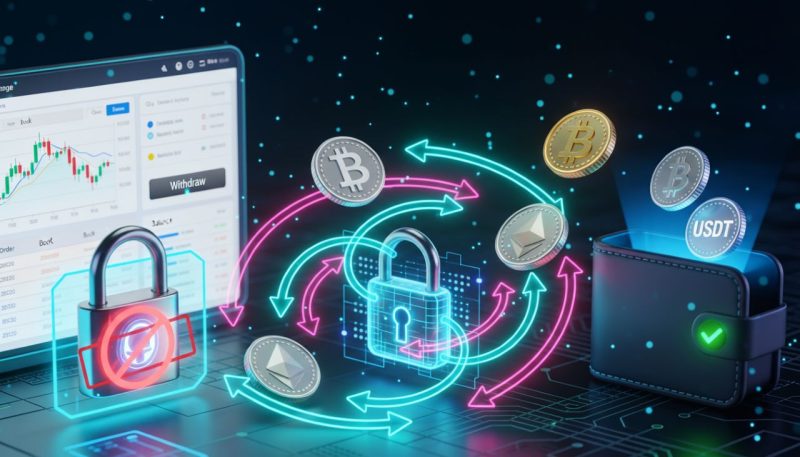
I’m going to share something most people don’t realize – there’s often a way to move your crypto even when direct withdrawals are blocked. It’s not magic, it’s not illegal, but for some reason nobody talks about it.
Let me explain.
Why Your Withdrawal Is Actually Blocked
First, understand what’s really happening. When exchanges block withdrawals, they’re usually blocking one specific thing: moving crypto OFF their platform.
But here’s what many people miss – they often don’t block trading. You can still swap between different cryptos on the platform. And that’s the loophole.
Think about it. If you can trade Crypto A for Crypto B on their platform, and you can find a way to get Crypto B out differently than Crypto A… you’ve just bypassed the block.
The Trading-to-Withdraw Strategy
This worked for my friend Sarah last year when Crypto.com locked her withdrawals for “verification” but let her keep trading.
Here’s what she did:
She had Bitcoin stuck on the exchange. Bitcoin withdrawals were blocked. But she noticed she could still trade Bitcoin for other coins, and some of those other coins had working withdrawals.
She converted her BTC to Litecoin (which had faster, working withdrawals at the time), withdrew the Litecoin to her wallet, then used an instant swap service to convert it back to Bitcoin.
Was it the most efficient route? No. She paid some extra fees. But she got her money out when the direct path was blocked.
How to Do This Yourself
1. Check which cryptos you CAN withdraw. Log into your exchange, go through different coins, see which ones let you withdraw. Sometimes obscure altcoins work when major ones don’t.
2. See if you can trade your stuck crypto for a withdrawable one. If your ETH is stuck but you can withdraw USDT, trade ETH for USDT.
3. Withdraw the new crypto to your personal wallet.
4. Use an instant swap platform to convert back to what you originally wanted.
This isn’t going to work in every situation. If the exchange has completely frozen your account – no trading, no withdrawals, nothing – this won’t help. But in many “partial” lockouts where trading still works, this can be your exit.
The Problem With This Strategy
Let’s be real – this is a workaround, not a solution. You’re paying extra fees, it takes time, and you’re depending on the exchange still allowing trades.
And here’s the bigger issue: you’re still trusting exchanges with custody of your crypto in the first place. The fact that you need workarounds to access your own money proves the system is broken.
This is why I stopped keeping crypto on exchanges entirely after my own lockout experience two years ago.
The Real Solution: Stop Using Custodial Exchanges
After dealing with lockouts and withdrawal limits and verification delays, I realized something obvious: if my crypto isn’t on an exchange, it can’t get stuck on an exchange.
Sounds simple, but it required changing how I operate.
Now I keep everything in my own wallets. When I need to swap between different cryptos – which I do fairly often for rebalancing – I don’t use traditional exchanges at all.
How This Actually Works in Practice
Let’s say I want to convert some Bitcoin to Ethereum. Old way: deposit BTC on exchange, wait for confirmations, trade, withdraw ETH, pay multiple fees.
New way: I use Changeum.io or similar instant swap platforms. Go to the site, select what I’m sending and what I want to receive, paste my receiving wallet address, send BTC from my wallet, get ETH back to my wallet. Done in about 20 minutes.
No account creation. No verification. No risk of withdrawal freezing. Because there’s no custody – they don’t hold my funds, they just facilitate the swap.
Why This Prevents The Whole Problem
The reason exchanges can block your withdrawals is because they have custody. Your crypto sits in their wallets, under their control. When you “withdraw,” you’re asking permission to move your own money.
With instant swap services like Changeum.io, there’s no custody. You send crypto from YOUR wallet, it gets swapped, and new crypto comes back to YOUR wallet. At no point does anyone else control it for longer than the swap transaction.
Can’t freeze withdrawals from an account that doesn’t exist.
Can’t require additional verification when there’s no verification to begin with.
Can’t lock your funds when they never leave your control except during the actual swap.
Real Numbers: What This Costs
I compared this approach to traditional exchanges for a month. Tracked every swap, every fee, everything.
Traditional exchange route (when it works):
• Trading fee: ~0.1-0.25%
• Withdrawal fee: $5-25 depending on the crypto
• Network fee: varies
• Time: 30-60 minutes including deposit confirmations
Instant swap route (Changeum.io specifically):
• Service fee: ~0.5-1%
• Network fee: varies (same as above)
• No withdrawal fees (goes straight to your wallet)
• Time: 15-25 minutes average
The instant swap route was actually cheaper overall because no withdrawal fees. And infinitely cheaper than having funds frozen for weeks.
When You Should Consider Making The Switch
This approach isn’t for everyone. If you’re a day trader making 50 trades a day, you need a traditional exchange. The tools, the speed, the order types – instant swaps don’t offer that.
But if you’re like most crypto holders – buying, holding, occasionally rebalancing or converting – you probably don’t need exchange accounts at all.
Consider switching if:
• You’ve had withdrawal issues before
• You don’t actively trade (just hold and occasionally swap)
• You’re tired of re-verification requests
• You value having full control of your assets
• You want to minimize exchange hack risk
• You’re concerned about exchange insolvency
How I Actually Use This System
My current setup is simple and has worked perfectly for 18 months:
Hardware wallet for long-term holds. Bitcoin and ETH I’m not touching for years goes here. Completely under my control, completely offline when not in use.
Software wallet for active crypto. Stuff I might want to swap or use goes in MetaMask. Still my keys, still my control, just more convenient for frequent use.
One exchange account for fiat only. When I need to buy crypto with dollars or sell crypto for dollars, I use an exchange. But I don’t keep funds there. Buy and withdraw immediately. Sell by sending from wallet, converting to fiat, withdrawing to bank. In and out.
Changeum.io for all crypto-to-crypto swaps. Need to rebalance? Convert between chains? Move from BTC to USDT? All happens wallet-to-wallet through instant swaps. Zero custody time.
This setup means the maximum amount ever at risk on an exchange is whatever’s in transit for a fiat conversion. Usually zero.
What People Get Wrong About Instant Swaps
When I tell people about this approach, I get the same concerns. Let me address them:
“But what if the instant swap platform steals my crypto?”
They don’t hold it long enough to steal it. It’s processed as a single transaction. Compare that to exchanges that hold millions in crypto for months or years – way bigger target, way more risk.
“What if I paste the wrong wallet address?”
Same risk exists with exchange withdrawals. You’re responsible for addresses either way. I always check first five characters, last five characters, sometimes middle ones. Never had an issue.
“Are the rates worse than exchanges?”
Sometimes yes, sometimes no. I’ve found them competitive, and the lack of withdrawal fees often makes the total cost lower. Plus you can check rates on multiple platforms before choosing.
“What if something goes wrong?”
You have transaction IDs and support. It’s not quite the same as having an account with full history, but I’ve never needed to use support. Everything has worked smoothly.
The First Test Swap
If you’re considering this approach, don’t start by moving your entire portfolio. Do a test first.
Pick a small amount – maybe $50-100 worth. Go to Changeum.io, pick your currencies, go through the process. See how it feels. Watch the transaction happen.
Once you see it work, you’ll understand why this is actually lower risk than keeping funds on exchanges. You’re in control the entire time except for the 20 minutes of swap processing.
I did exactly this two years ago. Started with a tiny test swap because I was skeptical. Now it’s how I handle all my crypto conversions.
Getting Your Currently-Stuck Crypto Out
Back to the immediate problem – if your crypto is stuck on an exchange right now, here’s your action plan:
Immediate term: Try the trading-to-withdraw strategy if possible. Convert to something you can withdraw, get it out, swap it back.
Medium term: Work through exchange support to unlock your account. Be patient, be persistent, provide whatever they ask for.
Long term: Once you get your crypto out, seriously consider not putting it back on exchanges. Move to a wallet-based approach with instant swaps.
The goal isn’t to never use exchanges – it’s to never store value on them unnecessarily.
Why This Matters More in 2026
Exchange regulations are tightening globally. More KYC requirements, more verification, more restrictions. The trend is toward exchanges having more control, users having less.
At the same time, alternative solutions are getting better. Instant swap platforms are faster, cheaper, more reliable than ever. The gap between custodial and non-custodial experiences is closing.
The question isn’t “can I live without exchange accounts?” It’s “why would I keep using them for things that don’t require them?”
Take Action
If you’re currently dealing with stuck crypto, I hope the trading-to-withdraw strategy helps you get unstuck.
But more importantly, I hope you’ll consider changing your approach so this never happens again.
Try an instant swap. See how it works. You might realize, like I did, that you don’t actually need exchange accounts for most of what you do with crypto.
Your crypto, your wallet, your control. That’s how it’s supposed to work.
Check out Changeum.io if you want to see what I’m talking about. No account required, no commitment, just see how the process works. Might change how you think about managing crypto entirely.