
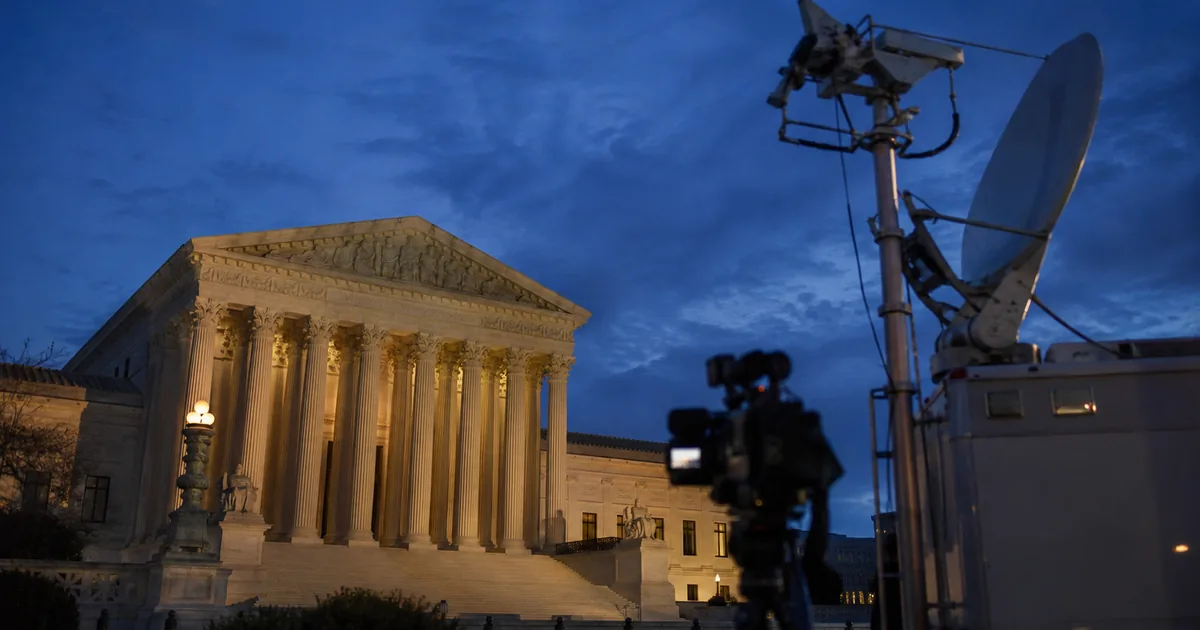
The Supreme Court on Friday restored a Federal Communications Commission policy that lets Republican party committees buy television time at the discount Congress wrote for candidates themselves, hours before the 60-day window governing those rates opened for the November midterms. The order decides nothing about whether that policy is lawful, and that is exactly why it settles the question for this election.
Most of today’s coverage is counting the win: the National Republican Congressional Committee and the National Republican Senatorial Committee asked for emergency relief, they got it, and Republicans will spend the fall buying airtime at candidate prices. What almost none of it says is what the order’s own language does. The stay runs until the Court disposes of a petition for certiorari that nobody has filed yet. Votes are counted on November 3. The merits of this dispute will not be resolved before then, and the justices did not have to resolve them to determine how the next two months of political advertising get paid for.
What the Court Actually Did
The order in National Republican Congressional Committee v. Brown is three sentences of housekeeping with the practical force of a ruling. It recalls and freezes the Fourth Circuit’s judgment, which means the appeals court decision that struck down the FCC policy stops operating immediately.
The application for stay presented to The Chief Justice and by him referred to the Court is granted. The mandate of the United States Court of Appeals for the Fourth Circuit in case No. 26-1785 is recalled and stayed pending the filing and disposition of a petition for a writ of certiorari, if such a writ is timely sought.
There is no reasoning attached. Unsigned emergency orders rarely carry any. Justice Ketanji Brown Jackson was the only member of the Court to note a dissent, and NBC News reported the vote as 8 to 1. Her written dissent had not been posted to the Court’s site as of Friday afternoon, so what persuaded eight justices, and what troubled the ninth, is not yet on the public record.
The Rule Everyone Is Fighting Over
Federal law requires broadcasters to sell political candidates airtime at the lowest unit charge, the same price the station’s best-negotiating commercial advertiser would pay for identical time. The protection is narrow on purpose. It applies for 45 days before a primary and 60 days before a general election, and it attaches to the candidate.
In March, the FCC’s Media Bureau issued a public notice reading that entitlement more broadly, extending the discount to party committees making expenditures coordinated with a candidate and to joint fundraising committees that include one. Four Democratic candidates for the House and Senate challenged it, among them Georgia Senator Jon Ossoff and Ohio’s Sherrod Brown, whose name leads the case. Their argument was straightforward arithmetic: a fixed pool of discounted inventory shared with well-funded party committees is a smaller pool for the candidates the statute names.
On August 25 a divided Fourth Circuit panel agreed and set the guidance aside, reading the statute to protect a candidate’s own use of airtime rather than a candidate’s blessing of someone else’s. The New York State Broadcasters Association told its member stations the decision meant neither political parties nor joint fundraising committees with non-candidate members could be entitled to the discounted rate, which is how a legal abstraction turned into stations repricing buys. The committees asked that court to pause its own decision while they appealed. It refused, 2 to 1, and ordered the mandate issued immediately, which left the Supreme Court as the only stop before the discount window opened. The FCC and the Justice Department backed the committees. The Campaign Legal Center filed against them.
Why a Temporary Order Is the Final Word Here
This is the part worth sitting with. A stay is supposed to preserve the status quo while a court decides something. Here the thing being preserved expires on its own before the deciding happens.
The lowest unit charge window closes when the election does. Whatever the Court eventually says about the FCC’s reading of the statute, whether it grants certiorari at all, whether it affirms the Fourth Circuit or reverses it in a signed opinion next June, the 2026 midterms will already have been advertised under a policy that a federal appeals court held unlawful ten days ago. The legal question is live. The practical question is closed.
Our view is that this is a bad way to run election law, and it would be a bad way to run it if the beneficiary were the Democratic committees. A court that can weigh the equities and grant emergency relief the day after the opposing briefs were due is a court that could have expedited argument and decided the actual statutory question on the same clock. It chose the disposition that requires no reasoning, no signature, and no accountability for the outcome, in a case whose outcome it effectively determined. The Fourth Circuit read the statute and explained itself. Eight justices overrode that in an unsigned paragraph, and the country gets to find out why, if ever, after the ballots are counted.
The Second Ruling Stacked on the First
The financial effect here is not modest, because it does not land alone. In late June the Court blew open the ceiling on coordinated party spending in National Republican Senatorial Committee v. FEC, freeing party committees to spend without limit in concert with their candidates. That decision determined how much the committees may spend together. Friday’s order determines what they pay per spot.
Take the cap off the volume and then hand the buyer a discount on the unit, and the two rulings multiply rather than add. The committees have more money to move than the individual campaigns do, which was the Democratic candidates’ complaint in the first place, and the party with the larger committee war chest gets the larger benefit from both. That is the NRCC and NRSC this cycle.
None of that makes the FCC’s reading wrong. The statutory text is genuinely contestable, the Fourth Circuit split, and there is a real First Amendment argument on the Republican side about treating coordinated speech as the candidate’s own. It makes the process wrong. Election-mechanics cases arrive on a deadline by their nature, every one of them will be styled an emergency, and a court that resolves them with unexplained orders timed to the electoral calendar is making durable law about democratic competition without ever writing it down.
The petition for certiorari has not been filed. When it is, the Court can take the case and answer the question properly. By then it will be answering it about the next election, not this one.