
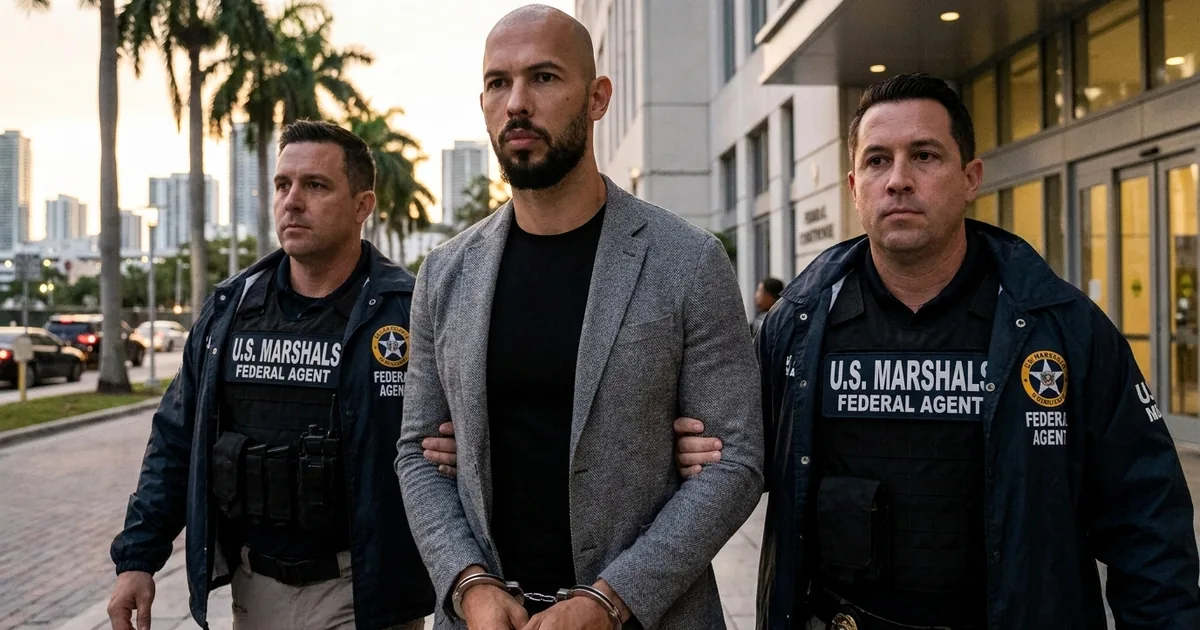
Andrew and Tristan Tate were taken into custody by the U.S.
Marshals Service in Miami on Saturday evening, arrested on a sealed warrant as British prosecutors announced they are seeking the brothers’ extradition on charges of rape and sex trafficking. The arrests mark a stunning turn for two men who returned to American soil just five months ago under what their supporters celebrated as diplomatic victory.
The Arrest and the Sealed Warrant
U.S. Marshals spokesperson Brady McCarron confirmed to the Associated Press that both brothers were “taken into custody on a sealed warrant,” though the agency did not immediately disclose the specific charges tied to that warrant. Andrew Tate is 39; his brother Tristan is 38. Both hold dual U.S. and British citizenship.
The timing was no coincidence. British prosecutors announced their extradition request the same day, alleging that the Tate brothers committed rape and sex trafficking offenses against women in the London area between 2010 and 2017, the years before they relocated to Romania. The sealed warrant strongly suggests coordination between U.S. and UK authorities to ensure the brothers could not flee once the British charges became public.
Why Now: The Romania Case Collapsed, and the UK Built Its Own
The structural explanation for Saturday’s arrest traces back to the unraveling of a Romanian prosecution that once seemed poised to deliver accountability. The Tate brothers moved to Romania in 2016 and were arrested there in December 2022 on accusations of operating sexual exploitation schemes targeting vulnerable women. That case, however, stalled due to what Romanian courts described as legal and procedural irregularities, leaving victims without a path to justice through Bucharest.
While Romania’s prosecution foundered, Britain’s Crown Prosecution Service was quietly building a parallel case rooted in offenses that allegedly occurred on UK soil. The brothers’ return to the United States in February 2026, reportedly facilitated by diplomatic pressure from the Trump administration, placed them within the jurisdiction of U.S.-UK extradition treaties. Where Romania’s system failed to hold, the transatlantic legal architecture may now succeed.
A Pattern of Allegations Across Three Countries
The London-era charges add a third jurisdiction to the Tate brothers’ legal entanglements. In Romania, they faced accusations of human trafficking and forming an organized criminal group to sexually exploit women. In the UK, prosecutors allege rape and sex trafficking. The sealed U.S. warrant adds yet another layer of legal exposure whose contours remain hidden.
What connects these cases is a consistent pattern alleged by prosecutors across borders: the exploitation of women by men who built enormous online followings partly by broadcasting contempt for women’s autonomy. Andrew Tate amassed tens of millions of social media followers by promoting what he called “traditional masculinity,” content that critics and researchers identified as misogynistic radicalization targeting young men.
The Extradition Question
Extradition proceedings will now determine whether the Tate brothers are transferred to UK custody to face the British charges. The U.S.-UK extradition treaty is one of the most well-established bilateral agreements in international law, and historically favors extradition absent extraordinary circumstances.
The brothers’ legal team has not yet made a public statement following Saturday’s arrest. In previous legal battles, both Andrew and Tristan Tate maintained their innocence and characterized the Romanian charges as politically motivated persecution. Whether that defense translates to contesting a UK extradition request from U.S. custody remains to be seen.
The case also raises uncomfortable questions about the five-month window between the brothers’ arrival in the United States and their arrest. If British prosecutors were building this case throughout that period, the diplomatic effort to bring the Tates stateside may have inadvertently delivered them into a more efficient legal system than the one they left behind in Bucharest.
What Comes Next
Saturday’s arrest does not resolve the Romanian charges, which remain technically active even as that prosecution has stalled. The UK extradition request takes priority in the immediate term. If extradited, the brothers would face trial in a British court system with strong procedural protections for sexual assault complainants, including anonymity provisions and specialist judges, that differ significantly from the Romanian proceedings that collapsed under their own procedural weight.
The immediate next step is a detention hearing, likely within 48 hours, where a federal magistrate will determine whether to hold the brothers pending the extradition proceedings or set bail conditions. Given the flight risk posed by dual nationals facing serious charges in a foreign jurisdiction, detention without bail is the probable outcome.
For the millions of young men who followed Andrew Tate’s content empire, Saturday’s arrest forces a reckoning with the gap between the persona and the person. The man who built a brand on invulnerability is now in U.S. Marshals custody, facing extradition on charges that allege a decade of predation against women in his own country. The legal systems he spent years mocking have finally coordinated across borders to catch up with him.