
Tiger Woods rolled a Land Rover on a residential road in Jupiter Island, Florida, on Friday afternoon. He blew triple zeros on a breathalyzer. Then he refused to take a urine test. Then he was arrested, booked into the Martin County Jail, and released on bail.
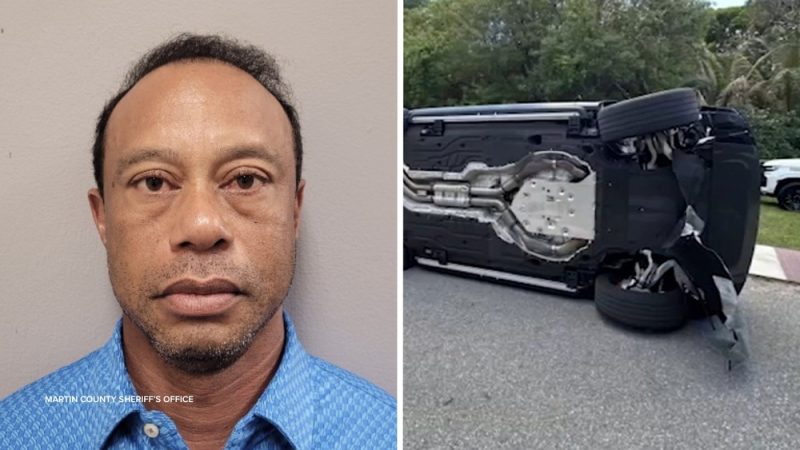
And now, nine days before the Masters is scheduled to tee off at Augusta National, the most commercially valuable golfer in history is facing misdemeanor criminal charges, another round of sponsor anxiety, and the increasingly uncomfortable question of whether a $1.5 billion career has outgrown the man at the center of it.
This is the third time in 17 years that Tiger Woods has been at the center of a serious driving incident. Each time, the business machinery around him has absorbed the blow and moved on. The question now is whether that machinery is protecting a person or preserving a product.
What Actually Happened on Jupiter Island
The facts, as reported by the Martin County Sheriff’s Office, are not complicated. Just after 2 p.m. ET on March 27, Woods was driving his Range Rover at high speed on a two-lane road near his home. He attempted to pass a truck hauling a pressure washer, swerved to avoid a collision, clipped the back of the trailer, and rolled the SUV onto its driver’s side. The vehicle skidded to a stop. Woods pulled himself out through the passenger side. Neither he nor the truck driver was injured.
When deputies arrived, they found Woods “lethargic,” according to WPTV’s exclusive report. He agreed to a breathalyzer, which came back at 0.000. No alcohol. But investigators suspected medication or drug impairment and requested a urine sample. Woods refused. That refusal, under a recently updated Florida statute, is no longer just an administrative headache that costs you your license. It is a separate criminal charge.
Woods was charged with three misdemeanors: driving under the influence, property damage, and refusal to submit to a lawful test. He was booked, photographed with bloodshot eyes in a booking photo that immediately went viral, and released from jail late Friday night in the passenger seat of a black SUV. He has not spoken publicly since.
The Test Refusal Changes Everything
The breathalyzer reading is the detail Woods’ legal team will lean on. Triple zeros means no alcohol, full stop. In most DUI cases, that would be the end of the conversation. But the urine test refusal transforms a defensible situation into a legal problem that is significantly harder to manage.
Under Florida’s updated implied consent law, refusing a chemical test after a DUI arrest is now a standalone criminal offense, not merely grounds for a license suspension. Legal analysts have noted that prosecutors can argue the refusal itself demonstrates consciousness of guilt: if there was nothing to hide, why refuse the test? The fact that no substances were found in the vehicle does not resolve the question. It simply means investigators do not yet know what, if anything, Woods had in his system.
For context, this is the same pattern that emerged in 2017 when Woods was found asleep at the wheel of his Mercedes on the side of a Florida road. Toxicology in that case revealed five drugs in his system: Vicodin, Dilaudid, Xanax, Ambien, and THC. Woods pleaded guilty to reckless driving, completed a first-offender program, and served a year of probation. That episode was treated as an isolated incident tied to pain management after back surgery. This time, the “isolated incident” framing is harder to sustain.
The Masters Question
Augusta National updated its Masters field on Monday. Tiger Woods remains listed. The club has made no public comment about the arrest, and there is no indication that Woods has been asked to withdraw. Sources indicate Woods has continued practicing since the crash and has not made a final decision about his status for the tournament, which begins April 9.
The silence from Augusta is predictable but notable. This is a club that has historically exercised enormous discretion over its invitation list and has never been shy about protecting its brand. The calculation here is obvious: Tiger Woods at the Masters generates more television viewers, more sponsor revenue, and more cultural relevance than any other player in the field. Removing him over misdemeanor charges that have not been adjudicated would cost Augusta far more than keeping him.
CBS, which broadcasts the Masters, is already navigating the coverage question. Golf Digest reported that the network is weighing how to handle Woods’ latest travails during its broadcast, a delicate exercise in acknowledging reality without alienating the audience that tunes in specifically to watch him play.
The Sponsor Math: Why Nobody Is Walking Away
Nike’s response was immediate and familiar: “No change to the relationship.” Bridgestone Golf said it was “monitoring the situation.” Rolex and TaylorMade declined to comment. This is the corporate playbook for Tiger Woods incidents, and it has not changed since 2009, when the infidelity scandal cost him Accenture, AT&T, Gatorade, and Tag Heuer but not Nike, which stood by him and was eventually rewarded with one of the greatest comeback narratives in sports history.
The math explains why. Woods’ lifetime endorsement earnings are estimated at over $1.5 billion, making him the highest-earning endorser in golf history and one of the most valuable athlete brands ever constructed. Even at 50, unable to compete at the level that defined his prime, Woods remains the single largest draw in professional golf. His presence at a tournament moves television ratings, ticket sales, and merchandise revenue in ways that no other golfer can replicate.
For Nike specifically, the calculus is simpler than it looks. The company already weathered the worst of its Tiger risk in 2009 and emerged with a stronger brand partnership on the other side. Cutting ties over a misdemeanor DUI, especially one where the breathalyzer was clean, would generate more negative attention than standing pat. The brand protection strategy is not to distance from Woods. It is to wait, say nothing of substance, and let the news cycle move on.
Three Incidents, One Pattern
The uncomfortable reality is that Tiger Woods has a documented history of dangerous driving, and the business ecosystem around him has consistently treated each incident as a standalone event rather than a pattern that warrants structural concern.
In 2009, he crashed his Cadillac Escalade into a fire hydrant and a tree outside his home at 2:25 a.m. That incident unraveled into the infidelity scandal that temporarily dismantled his public image. In 2017, he was found unconscious behind the wheel with five drugs in his system. He pleaded to reckless driving and entered a diversion program. In 2021, he suffered serious leg injuries in a high-speed rollover crash in Los Angeles. The LA County Sheriff said Woods was driving at roughly 85 mph in a 45 mph zone. No charges were filed. In 2026, he rolled a Range Rover on a residential street, appeared lethargic to investigators, and refused a urine test.
A prosecutor could, and likely will, introduce this history when arguing for sentencing. The question of whether Woods “presents a continuing danger on the road,” as legal experts have suggested, is no longer hypothetical. It is a matter of public record spread across four incidents in less than two decades.
The Legacy Calculation
Golf365 published a piece this week with a headline that cut to the core of the situation: “Watching Tiger Woods like this just doesn’t feel right anymore.” That sentiment is increasingly common among golf writers and fans who grew up watching Woods redefine what a golfer could be and are now watching a 50-year-old with a surgically rebuilt body cycle through incidents that have nothing to do with the game.
Woods’ competitive legacy is secure. Fifteen major championships. Eighty-two PGA Tour victories. The 2019 Masters comeback that remains one of the most emotionally resonant moments in modern sports. Nothing that happens off the course can erase what he accomplished on it. But legacy is not just a stat sheet. It is the full picture of how a public figure navigated fame, pressure, money, and the responsibilities that come with being the most recognizable athlete on the planet.
The business side of that legacy is what makes the current moment so revealing. The sponsors are staying. Augusta is staying. CBS is staying. The PGA Tour has said nothing. The entire commercial infrastructure around Tiger Woods is designed to absorb exactly this kind of event and keep generating revenue. Whether that infrastructure is serving Woods the person, or simply protecting Woods the brand, is a question that nobody with a financial stake in the answer has any incentive to ask.
What Comes Next
Woods’ legal team will almost certainly challenge the DUI charge on the grounds that the breathalyzer was clean and no substances were found at the scene. The test refusal charge is harder to contest because it is a matter of factual record: he was asked, he said no. Florida’s updated statute makes that refusal a criminal offense regardless of whether the underlying DUI charge sticks.
The Masters will proceed as scheduled. If Woods plays, every camera on the grounds will follow him, and every broadcast will navigate the tension between celebrating the greatest golfer of his generation and acknowledging that he was in a jail booking photo four days earlier. If he withdraws, the story becomes about whether the withdrawal was voluntary or encouraged, and Augusta will face questions about its decision-making process either way.
The sponsors will stay quiet. The money will keep flowing. And Tiger Woods, who has survived more career-threatening moments than any athlete of his era, will once again test whether the brand is bigger than the crisis. History suggests it is. But history also suggests the margin for error gets thinner every time.