

Academic papers written with the help of AI often create a new challenge: the text may sound correct, but it can feel mechanical or stylistically uneven. AI essay humanizers aim to address this gap, but it’s hard to choose the right tool. And that’s exactly what we’re here to help you with today.
We’ve gathered the 12 best AI essay humanizers based on hands-on testing with full-length academic texts. You’ll likely find an option here that fits your academic needs and writing style.
Why It is Important to Know How to Humanize AI Essays and Academic Texts
We all know that AI tools help speed up research and drafting, but academic writing follows very strict standards that are more than just correct grammar.
Today, many universities and colleges routinely check submissions with AI detection systems, and in some cases also review how text behaves after rewriting or humanization. As reported by The Markup’s investigation into AI detectors in California colleges, institutions spend millions on tools like Turnitin despite documented accuracy issues, privacy concerns, and the permanent retention of student papers in company databases.
The report shows that even flawed detection systems continue to shape grading decisions and academic policies. As a result, assignments that rely heavily on unedited AI output face a higher risk of scrutiny. Penalties for AI-generated content are becoming more explicit – depending on the institution, consequences can range from grade reductions and mandatory rewrites to formal academic misconduct records.
If you want to learn how to humanize an AI-assisted essay, it can significantly reduce these risks. Humanized text typically shows natural sentence variation and a writing rhythm closer to standard academic prose. These qualities matter because detection systems often flag patterns rather than ideas.
How We Tested Essay Humanizers
To build this list of the Top 12 Essay Humanizers, we followed a controlled testing process focused on real academic and editorial use cases, not marketing claims. For our testing, we analyzed 30 different AI humanizers, from the most popular to more niche tools.
We prepared three 100% AI-generated essays on different topics and ran each text through every tool on the list using default settings. No manual edits, no retries, and no prompt tuning were allowed. Each tool processed the same input to keep conditions equal.
We evaluated results across four core criteria:
- Each humanized essay was checked with top AI detector tools: GPTZero and ZeroGPT. We recorded detection percentages and calculated an average score to see how consistently a tool reduced AI signals.
- We reviewed outputs with QuillBot Grammar and manual checks. The focus stayed on sentence flow, punctuation, tense consistency, and clarity, not stylistic rewriting.
- We checked whether tools preserved meaning, avoided broken sentences, and did not introduce factual drift or awkward phrasing that would raise red flags in essays.
- We compared word limits, pricing tiers, and paywalls in the cheapest available plans, since these factors directly affect real-world usability.
Final placement reflects overall balance, not a single metric. Tools that bypass detection but damage readability ranked lower than those with slightly higher detection scores but stable, clean writing. We prioritized consistency.
Quick Verdict
If you’re short on time, these are the three strongest performers from our full testing. We selected them based on writing quality, grammar score, AI detection results, pricing, and limits.
| Tool | Grammar Score (Avg.) | AI Detection Range | Pricing | Best For |
| Clever AI Humanizer | 92.6 | 0–4% | 100% Free. Up to 200,000 words/month, 7,000 words/run. No paywall. | Best overall free option with the lowest AI detection levels |
| Grammarly AI Humanizer | 100 | 59–70% | Free version available. Grammarly Premium: $30/month, $60/quarter,$144/year (~$12/month billed annually). | Academic and professional writing with perfect grammar |
| UnAIMyText Humanizer | 90.3 | 54.2% | Free daily usage. Paid plans increase word limits (exact pricing varies by tier). | Balanced rewriting with moderate structural changes |
Top 12 Essay Humanizers
Now, we will show you the results and present twelve AI essay humanizer options that are commonly used to refine academic drafts created with AI assistance.
Each tool approaches humanization differently, with its own balance of rewriting depth, language control, and practical limits.
1. Clever AI Humanizer
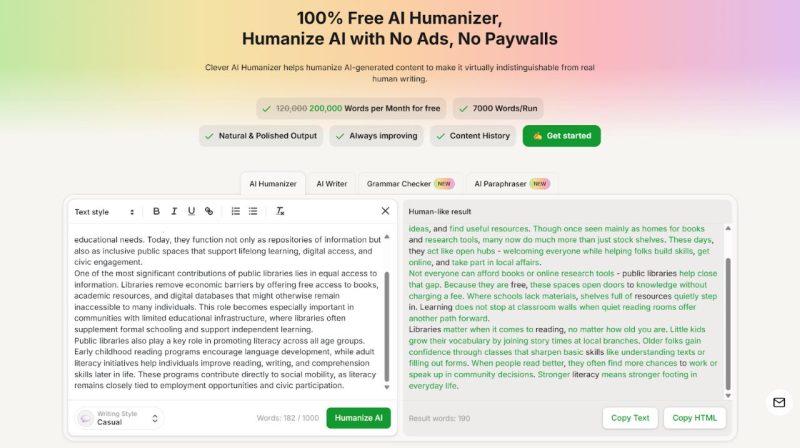
Clever AI Humanizer runs as a browser tool with a genuinely detailed feature list on its site. It is a 100% free AI humanizer with no ads and no paywalls. It offers usage limits of up to 200,000 words per month and 7,000 words per run.
The tool supports three rewriting styles, Casual, Simple Formal, and Simple Academic, which makes it flexible enough for essays, blog content, and more structured academic text.
It also includes extras like Content History, an AI Writer, a Grammar Checker, and an AI Paraphraser.
In our controlled writing-quality checks, Clever produced clean output with an average grammar score of 92.6 across the three essay texts we used. It also helped make AI-generated content sound more human through noticeable structural variation. AI detection levels fell between 0–4%, which marked the lowest range in our entire dataset and makes it the best free AI humanizer tool we analyzed.
2. Grammarly AI Humanizer
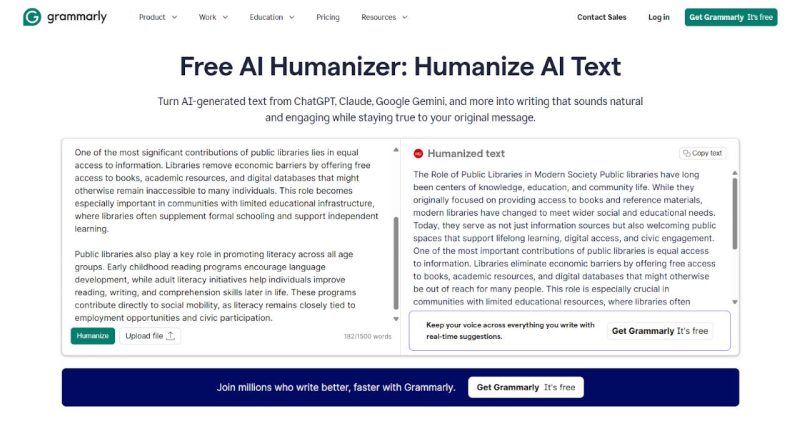
Grammarly AI Humanizer is an AI-generated text humanizer, integrated into Grammarly’s broader writing assistant, and focuses on improving clarity and correctness rather than altering structure aggressively. It works alongside Grammarly’s grammar engine, tone adjustment, and style consistency tools, with access levels depending on whether the user is on a free or paid Grammarly plan.
The humanizer rewrites text to sound more natural while keeping sentence logic intact, which makes it suitable for academic and professional writing.
In our evaluation, Grammarly delivered perfect language quality with a 100 average grammar score. However, the rewritten essays retained clear structural AI patterns, resulting in an average detection score of 59-70% across tested texts.
3. UnAIMyText Humanizer
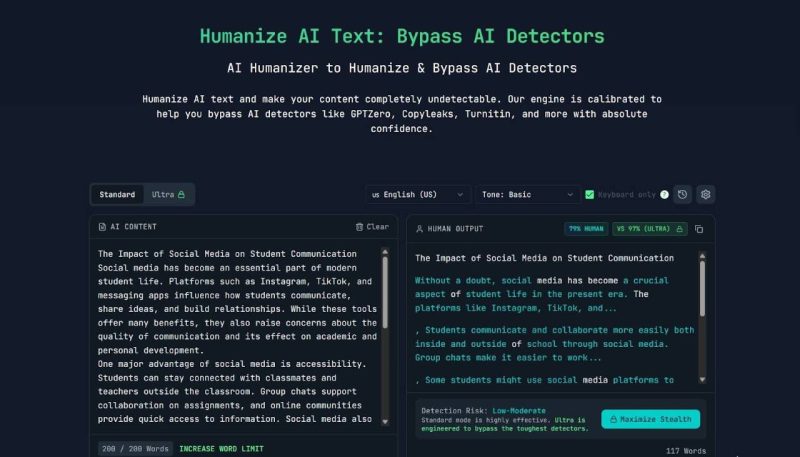
UnAIMyText Humanizer is a simple AI-to-human rewriting tool with multiple writing modes and support for long-form content. It allows daily free usage and scales to higher monthly word limits on paid tiers, with features such as style selection, multi-language support, and optional file uploads for documents like DOC and PDF.
The rewriting approach is moderate rather than aggressive, aiming to smooth phrasing while preserving meaning. In our tests, UnAIMyText achieved an average grammar score of 90.3. The output read naturally in most cases, though sentence patterns sometimes remained predictable in longer essays. AI detection levels averaged 54.2% with moderate structural changes that reduced signals compared to raw AI text but did not eliminate them.
4. Stealth Writer AI
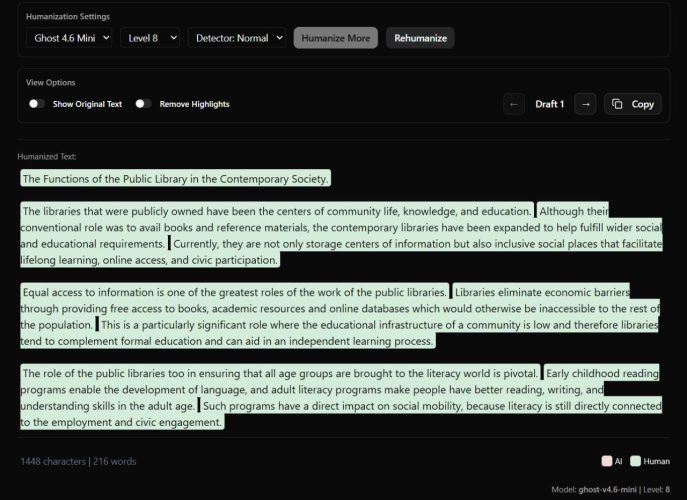
Stealth Writer AI is a top AI humanizer that provides deeper rewriting through adjustable rewrite strength and multiple internal modes that alter sentence structure more noticeably. Usage limits depend on plan level, with free access restricted to short inputs and paid tiers increasing per-request and monthly word caps. The tool tends to reshuffle phrasing more heavily than basic paraphrasers, which can help reduce repetition but may introduce stiffness.
In our dataset, Stealth Writer AI averaged 89.3 in grammar quality, with output quality varying by essay length. It performed better on shorter argumentative texts than on longer analytical ones. AI detection averaged 51.9%, showing noticeable reduction compared to original AI drafts but with inconsistent performance across longer essays.
5. Walter Writes AI
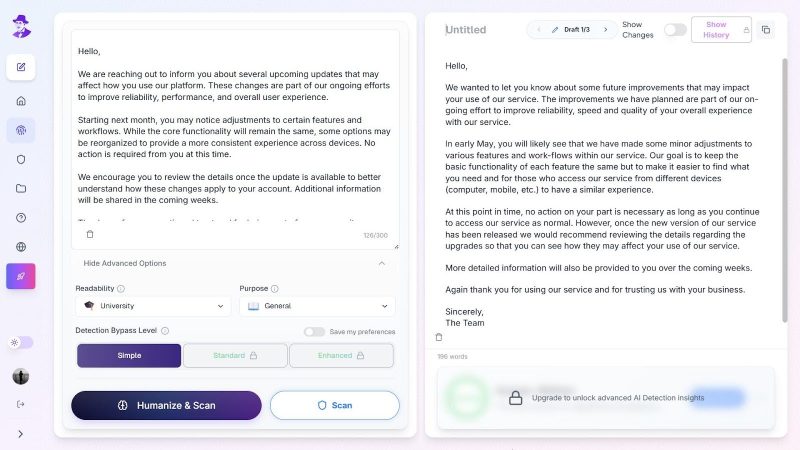
Walter Writes AI is AI to human text converter that combines humanization with built-in analysis tools and clear usage boundaries. Plans are defined by both monthly word limits and per-request caps, ranging from a few hundred words per request on lower tiers up to several thousand on higher ones. It supports 80+ languages, includes an internal AI detection preview, and keeps a processing history for review.
In our testing, Walter Writes produced balanced results, with an average grammar score of 86.3. The text usually read natural but occasionally required cleanup for academic tone consistency, especially in citations and formal transitions.
Its AI detection level ranged between 40% and 47% across the tested essays, placing it among the stronger structural rewriting tools in our comparison.
6. Undetectable AI Humanizer
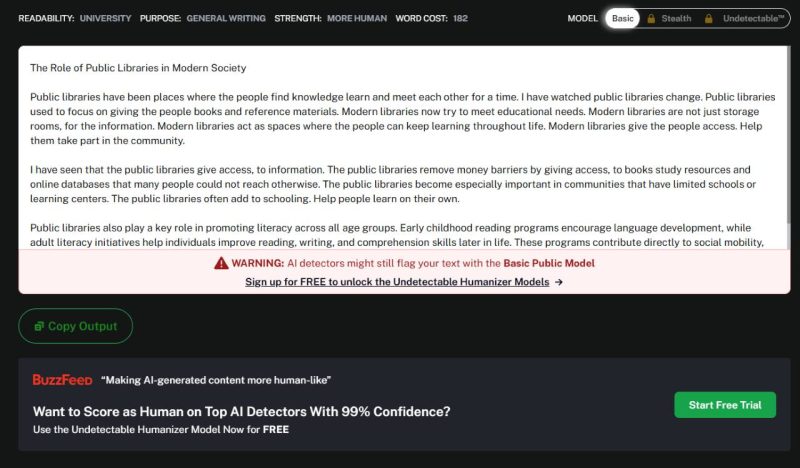
Undetectable AI Humanizer operates as a combined rewriting and analysis tool. It allows users to process text in batches and review rewriting strength. Word limits vary by plan, with monthly caps clearly enforced. The tool emphasizes restructuring rather than light paraphrasing, which can alter sentence rhythm noticeably.
In our tests, the output averaged 87.6 in grammar quality, indicating readable but not polished prose. It worked best on technical or neutral content where stylistic nuance mattered less than structural variation. AI detection ranged between 30% and 38% and it is one of the more aggressive structural rewriters in the group.
7. Phrasly AI Humanizer
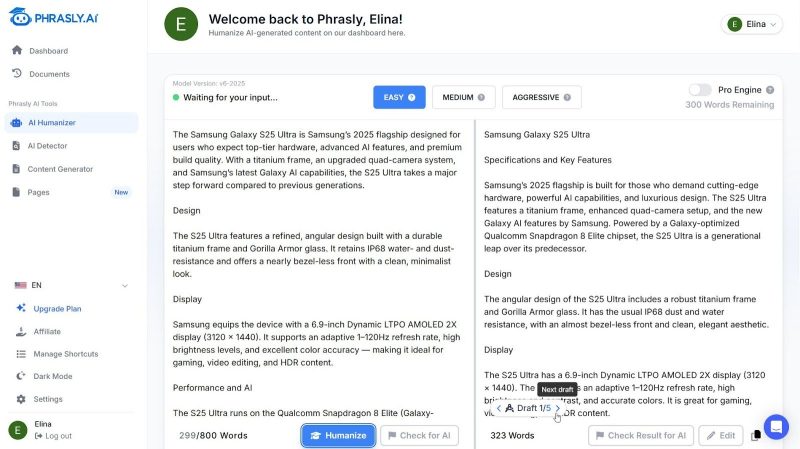
Phrasly AI Humanizer is part of a broader writing platform that includes drafting, rewriting, and checking tools in one interface. Humanization is limited by per-process word caps rather than daily usage, with the free tier allowing a small number of words and paid tiers removing most restrictions. It also integrates document exports and supports longer academic formats.
In our dataset, Phrasly delivered a very clean language with an average grammar score of 97.0, but its rewriting style stayed close to the original structure, which makes it more suitable for refinement than transformation. However, its structural changes stayed limited, which led to AI detection levels in the 85–92% range.
8. GPTinf Humanizer
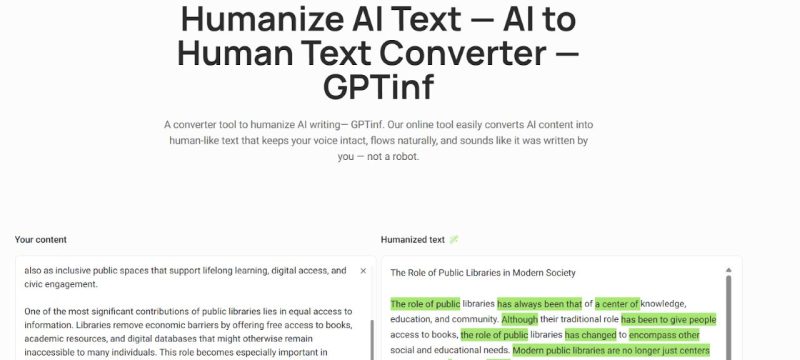
GPTinf Humanizer focuses on controlled rewriting with features such as keyword freezing, selective rephrasing, and multiple rewrite modes. Monthly word allowances vary by plan, from small starter limits to unlimited tiers, and the tool includes plagiarism checks and internal analysis utilities.
In practice, GPTinf produced highly readable output, reflected in its 98.0 average grammar score. The rewriting favored fluency and sentence smoothness, which works well for essays that already have a strong structure. Detection levels remained high, averaging 93.2%.
9. BypassGPT AI Humanizer
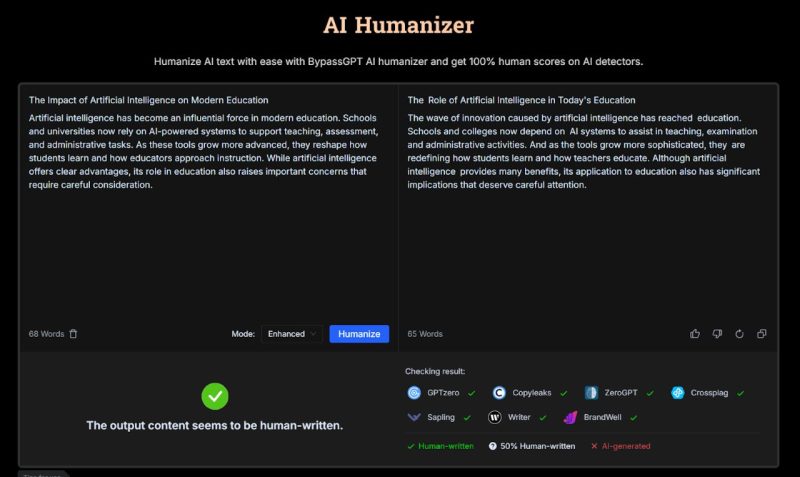
BypassGPT AI Humanizer is built around fast, one-step rewriting with clear input size limits per request and optional API access for bulk processing. It supports common academic and web formats and focuses on rewriting entire passages at once rather than sentence-level tuning.
In our tests, it achieved an average grammar score of 91.0, producing readable output with occasional synonym overuse. It handled short and medium essays better than very long texts. AI detection averaged 51.7%, placing it in the mid-range among restructuring tools.
10. JustDone AI Humanizer
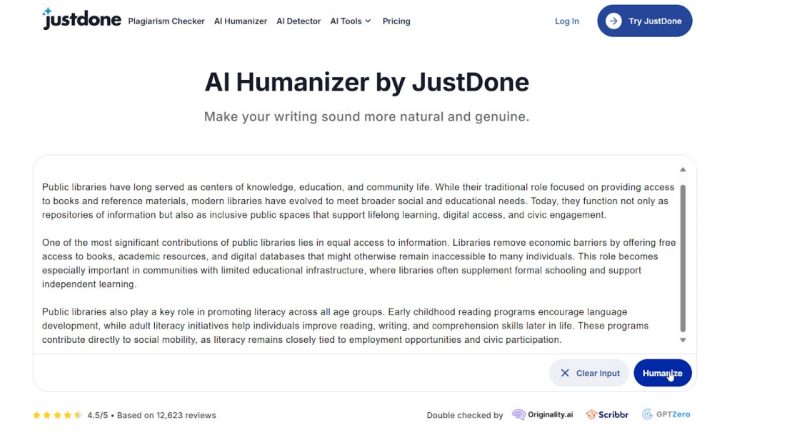
JustDone AI Humanizer is included as part of a large multi-tool writing environment rather than a standalone rewriter. It comes bundled with dozens of utilities such as a grammar checker, plagiarism checker, AI detector, citation tools, and research helpers, all under one subscription.
Across all samples, the output remained readable and coherent, with an average grammar score of 91. Sentence flow stayed solid, and mechanics remained correct. AI detection signals dropped compared to the original AI-generated text but stayed noticeable due to conservative restructuring, which placed the average detection level in the 55–65% range.
11. Decopy AI Humanizer
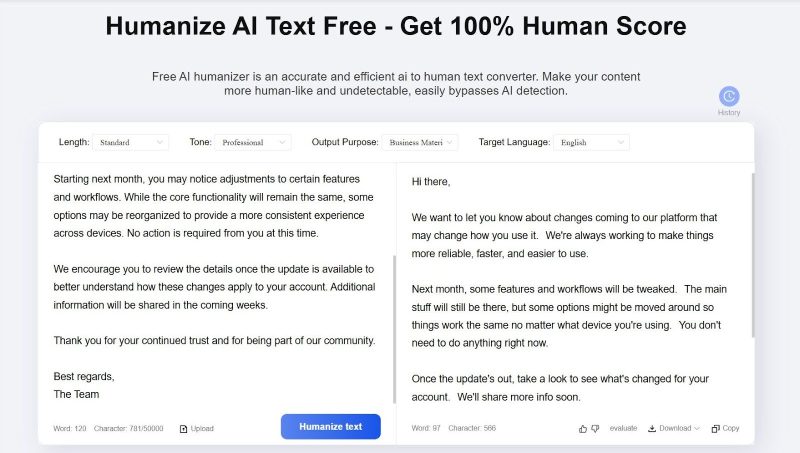
Decopy AI Humanizer uses a quota-based system rather than simple word counts, allocating monthly usage through credits and rewrite quotas depending on plan level. It supports multiple rewrite intensities and focuses on originality and phrasing variation.
In our testing, Decopy produced polished language with an average grammar score of 97.3, but its rewriting stayed conservative, favoring clarity over structural change. It works best as an advanced paraphrasing tool within an editing pipeline. AI detection ranged around 70–75%, which shows limited structural change despite polished output.
12. My Detector AI Humanizer
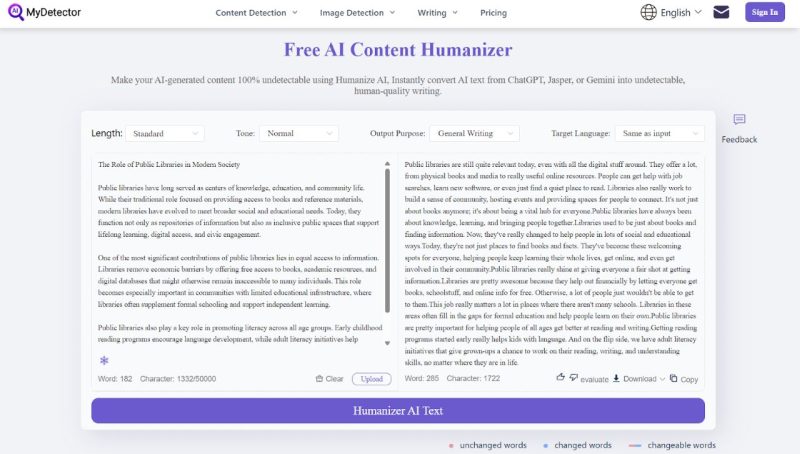
The last in our list is My Detector AI Humanizer. It combines rewriting with fine-grained controls over output behavior. It allows large inputs, supports tone and length adjustments, and includes the ability to freeze specific words or sentences so they remain unchanged during rewriting. File uploads and multi-language output are supported.
My Detector AI Humanizer produced flexible results due to granular controls such as sentence freeze, tone selection, length control, and language targeting. Selective rewrite strength created clearer structural variation than bundle-style tools while preserving key terminology. The output reached an average grammar score of 93 and stayed readable, though some transitions softened at higher settings. AI detection levels fell below most mid-tier tools, settling in the 45–55% range across tested essays.
Final Verdict
For students and researchers who want a reliable free AI essay humanizer, Clever AI Humanizer showed the strongest overall balance in our tests: 92.6 average grammar score, 0–4% detection, and up to 200,000 words per month at no cost. No other tool matched that combination. Based on those results, Clever AI Humanizer stands out as the best AI humanizer in this comparison.
Grammarly AI Humanizer delivered a perfect 100 grammar score, but detection stayed higher at 59–70%, which makes it better for clarity than heavy structural rewriting.
Tools like Phrasly, GPTinf, Walter Writes, or Undetectable AI may suit specific needs, especially when deeper restructuring is required.
Overall, our results show that grammar quality and detection resistance are not the same metric. The best AI humanizer really depends on how much rewriting your essay actually needs.