
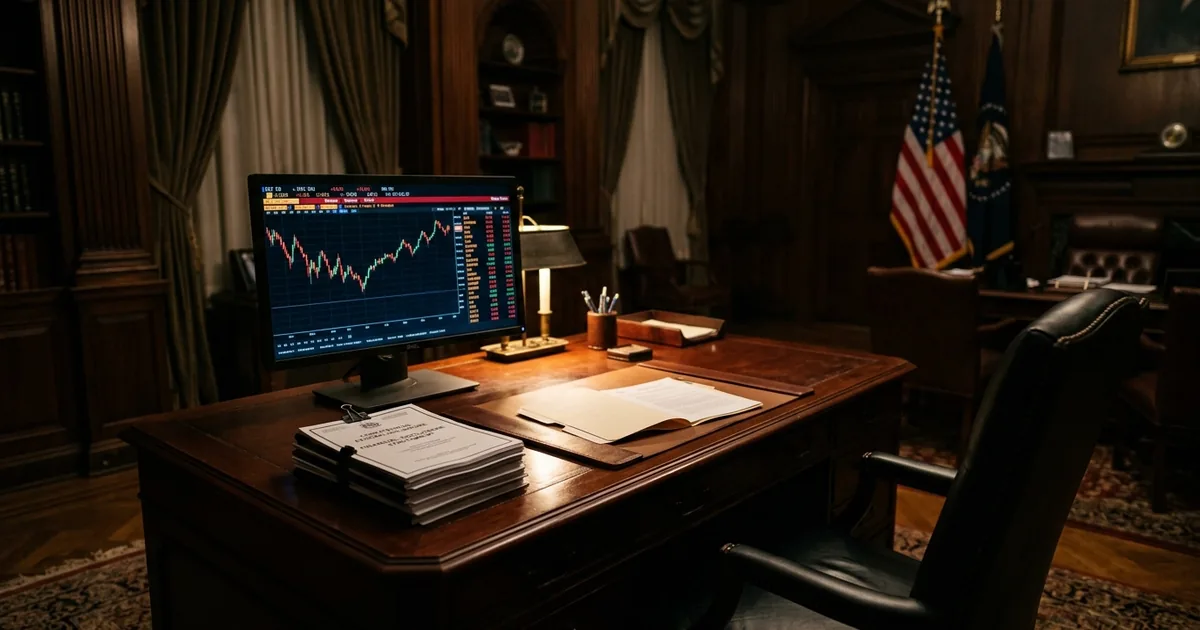
The Office of Government Ethics released two Form 278-T disclosures last week showing roughly 3,642 securities transactions executed in President Donald Trump’s name during the first quarter of 2026, with a cumulative value somewhere between $220 million and $750 million.
That is not a wealth-management footprint; it is a trading desk running while the desk owner sets policy that moves the stocks it is trading.
A Trading Pace That Doesn’t Match the Cover Story
About 60 transactions per market day. That is the pace NBC News calculated from the filings, and it is the first number worth sitting with, because it forecloses the official explanation almost on its own. Eric Trump told followers in May that the family’s assets sit in a “blind trust” of “broad market indexes” like the Schwab 1000. A blind trust, by federal definition, is one whose holdings the beneficiary cannot see and cannot direct. Trump’s own certification lists thousands of individual single-stock trades, not index funds. Both statements can be a lot of things. They cannot both be true.
The Trump Organization’s own line is that the brokerage is “independently administered by a third-party financial institution with exclusive authority.” White House spokesperson Davis Ingle described the structure differently, saying assets sit in a trust “managed by his children.” Same question, two answers, neither of them congruent with what is in the OGE filing.
What the Trades Actually Look Like
The pattern is the part that is hard to wave away. NOTUS reconstructed the filings and found the account purchased $500,000 to $1 million of Nvidia on January 6. On January 13, the Commerce Department authorized Nvidia chip sales to Chinese customers. The account bought another $1 million to $5 million slice of Nvidia on February 10. The week after, Meta announced a new infrastructure deal with the company.
The account also bought $50,000 to $100,000 of AMD on January 6, days before the same January 13 Commerce action that swept up AMD’s China sales. It bought between $1 million and $5 million of Axon, the maker of Tasers and ICE-issued body cameras, on February 10. On February 24, ICE announced a $220 million, five-year Taser purchase plan. The pattern continues with Palantir: $65,000 to $150,000 bought in January, a sale in February at $1.1 million to $5.3 million, then a fresh purchase of $200,000 to $500,000 in March. Palantir signed a roughly $1 billion contract with the Department of Homeland Security in February for deportation software.
Then there is the geopolitical layer. The cleanest example sits in Fortune’s reconstruction of trades around the Iran war. On January 12, the day before tariff announcements moved markets, the account sold $5 million to $25 million of a Vanguard dividend ETF. On March 4, the day the Strait of Hormuz closed, the account bought Treasury bond ETFs. On March 23, before a public deescalation announcement and the resulting 11% drop in oil, the account bought Phillips 66, Exxon Mobil, and Chevron. Anyone who has spent five minutes in compliance training at a brokerage knows what that sequence looks like when an ordinary employee runs it. It is not subtle.
Ethics Experts Are Saying It Out Loud
Two of the most credible voices in federal ethics law have put names on this. Richard Painter, the University of Minnesota securities-law professor who served as chief ethics counsel to George W. Bush, told Fortune the account is in “an unusual position for a president” and is trading in ways “a president shouldn’t do” because of the confidential information a president can access. Walter Shaub, the former director of the Office of Government Ethics, has called the arrangement “not even halfway blind.”
That is not partisan boilerplate. Painter has been one of the more credible Republican voices warning about institutional damage from this kind of behavior. When he says a sitting president shouldn’t trade like this, the relevant question is whether anything in the federal architecture is structured to stop it, and the answer right now appears to be no. Trump did breach the Stop Trading on Congressional Knowledge Act by failing to file within the required 45-day window, but the penalty for that violation was a $200 fine. Two hundred dollars, against a quarter where the trades cleared somewhere between $220 million and three quarters of a billion. The math on deterrence is not difficult.
The Institutional Cost Is the Real Story
The narrow legal question, whether any specific trade meets the bar for criminal insider-trading prosecution, is not where the damage lives. The damage lives in the precedent. The United States is sliding down Transparency International’s Corruption Perceptions Index at a clip last seen during the late-Soviet transition, a slide we covered earlier this year when the latest CPI rankings dropped. When the head of state’s brokerage is trading semiconductor exposure days before his Commerce Department clears semiconductor exports, every other executive-branch agency operates under a permission structure that says this is what the role looks like now. Ethics offices do not enforce against the example set at the top. Career staff calibrate their own compliance posture to what the principal does. Foreign counterparts price in the same risk into negotiation positions.
The other piece worth naming, because tech accountability lives inside this story too, is who shows up on the buy list. Nvidia, Palantir, Axon, AMD, Microsoft. These are the companies whose business is downstream of federal contracts, regulatory clearances, and surveillance posture. Treating them as a personal trading universe while sitting in the chair that signs the contracts is not a gray area. It is the textbook definition of the conflict the ethics statute was built to prevent.
Where This Goes
Congressional Democrats have called the filings a “national security catastrophe” and are pushing for a House Oversight investigation. The Senate Finance Committee has not yet indicated whether it will take up the structure of the brokerage account itself. Outside the Beltway, the more consequential pressure point will be the Office of Government Ethics, whose Form 278-T regime was built for occasional transactions in family holdings, not a 3,600-trade quarter on the President’s own name. If OGE issues a follow-on advisory clarifying what “blind trust” means when the certified holdings include individual single-name equities, that is the procedural inflection point.
What is harder to recover, regardless of what OGE or Oversight does, is the norm. The norm is the part that protects the system when statutes are vague and prosecutors are unwilling. The norm is what made every modern president before this one route personal finances through a structure that genuinely insulated them from their own policy decisions. Three thousand seven hundred trades in 90 days, traded around the policy calendar of the desk that authorized them, is what takes that norm down with it.