
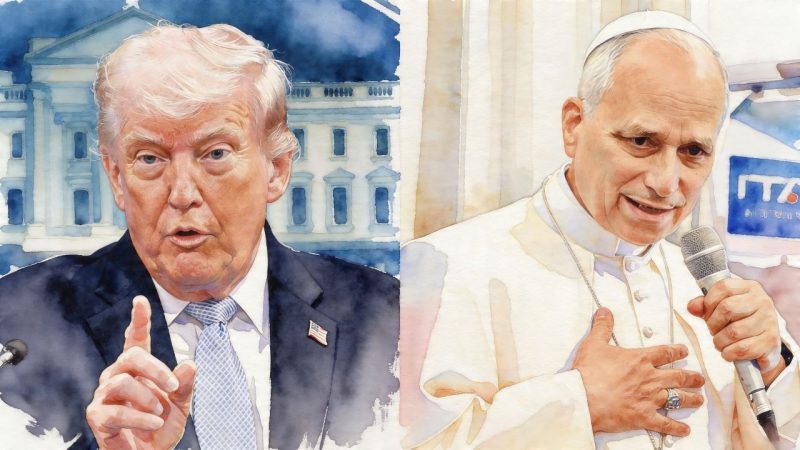
The President of the United States called the Pope “WEAK on Crime, and terrible for Foreign Policy.” He posted an AI-generated image of himself as Jesus Christ, then deleted it. He accused the leader of 1.4 billion Catholics of supporting Iran’s nuclear ambitions.
And now, on Easter weekend, Donald Trump will read a Bible verse from the Oval Office in what can only be described as the most transparent piece of counterprogramming in the history of church-state relations.
On the other side of the world, Pope Leo XIV is touring Africa, telling reporters with striking calm: “I have no fear of neither the Trump administration nor of speaking out loudly about the message in the Gospel.” The first American pope, born Robert Francis Prevost in Chicago, is not backing down. And in the gap between these two men, something genuinely new and dangerous is taking shape in American politics.
How We Got Here
The roots of this feud are in the skies over Iran. Operation Epic Fury began on February 28 with joint U.S. and Israeli airstrikes. The day after the bombing started, Pope Leo expressed “deep concern” and urged all parties to “stop the spiral of violence before it becomes an irreparable abyss.” It was the kind of statement popes have made about wars for centuries: measured, pastoral, rooted in Catholic social teaching about the sanctity of human life.
Trump did not take it that way. Within hours, the president was on Truth Social attacking the pontiff by name. The posts escalated rapidly. Leo was “weak.” Leo was “terrible.” Leo should “stay out of politics.” And then came the most extraordinary moment: Trump shared an AI-generated image depicting himself as Christ, a provocation so brazen that even allies winced. He deleted it, but the internet is forever, and the screenshot circulated to millions.
Vice President JD Vance, himself a Catholic convert, weighed in with his own warning to the pope: “Be careful when he talks about matters of theology.” A sitting vice president instructing the Bishop of Rome on theological caution. The irony would be comic if the stakes were not so serious.
Why This Is Different From Every Previous Presidential-Papal Tension
Presidents and popes have disagreed before. John F. Kennedy spent his entire 1960 campaign trying to convince Protestant America that the Vatican would not dictate his policies. Ronald Reagan clashed quietly with John Paul II over Central American policy even while they cooperated on undermining Soviet communism. Barack Obama and Benedict XVI had sharp differences on abortion and contraception.
But none of those disagreements looked like this. None involved a president publicly insulting a pope by name on social media. None involved AI-generated religious imagery. None featured a vice president warning the pope to watch his mouth. Religious experts told NPR that the direct, personal nature of Trump’s attacks on Pope Leo is “without precedent” in the relationship between any American president and any sitting pope.
There is also the matter of Leo being American. Previous popes could be dismissed, however unfairly, as European figures commenting on American affairs from a comfortable distance. Leo grew up in Chicago. He studied at Jesuit institutions in the United States. He understands American politics from the inside, and he speaks about it with the fluency of someone who has lived it. That makes him harder to wave off, and it makes the confrontation more personal on both sides.
The Catholic Vote Problem
Here is where this stops being a culture war sideshow and starts being a political problem with real consequences. Trump won Catholic voters in 2024. Not by a huge margin, but by enough to matter in swing states with large Catholic populations: Pennsylvania, Wisconsin, Michigan, Arizona. The Catholic vote has been a bellwether in American elections for decades, swinging between parties and often landing with the winner.
Picking a public fight with the pope is not a strategy designed to hold that coalition together. Catholic leaders across the country have begun siding with Leo. Bishops who had remained carefully neutral through Trump’s first and second terms are now issuing statements that, while stopping short of directly criticizing the president, make clear where their sympathies lie. The language of those statements echoes Leo’s: calls for peace, warnings against the dehumanization of enemies, reminders that the Gospel demands mercy.
Fortune reported that Catholic leaders are increasingly vocal in their support for the pope during the spat. This is not the kind of coverage the White House wants heading into Easter, the most important weekend on the Christian calendar, when millions of Catholic families will be sitting in pews listening to homilies that may well reference the pope’s call for peace.
The Bible Reading Gambit
Trump’s announced plan to read a Bible verse from the Oval Office is a response to all of this, and it reveals both the administration’s awareness of the problem and the limits of its playbook. The move is designed to reclaim religious authority from the pope, to say: I am a man of faith too, and my faith supports what I am doing.
It is also connected to a broader initiative called “America Reads the Bible,” which has been promoted in conservative religious circles. The event positions Trump not as someone fighting with the church, but as someone championing scripture directly, cutting out the institutional middleman. It is, in religious terms, a very Protestant move from a president courting Catholic voters, an irony that is probably lost on its architects.
“Bible” is currently one of the top trending searches on Google in the United States, which tells you the cultural resonance of this moment even if you do not follow politics closely. Americans are searching for answers, or at least for context, as the leader of their country and the leader of the world’s largest Christian denomination engage in an open confrontation over the morality of war.
What Leo Understands That Trump Does Not
Pope Leo’s strategy has been remarkably disciplined. He does not match Trump’s tone. He does not respond to personal insults with personal insults. He speaks in the language of the Gospel and lets the contrast do the work. When he told reporters he has “no fear” of the Trump administration, it was not a threat. It was a statement of position. He is operating on a different playing field entirely, one where moral authority comes from willingness to suffer for principle rather than from dominance.
His Africa tour is itself a statement. While Trump reads a Bible verse from the Oval Office, Leo is visiting communities in Algeria and across the continent, meeting with the poor, the displaced, the people who bear the consequences of wars they did not start. The optics are not subtle, and they do not need to be.
In his most pointed public remarks, Leo referred to “a handful of tyrants spending billions on war,” a phrase that does not name Trump but does not need to. The Vatican has centuries of experience in saying exactly what it means without saying it directly, and Leo is proving himself a worthy inheritor of that tradition.
Where This Goes From Here
The feud will carry through Easter and likely beyond. It will intensify if the Iran conflict escalates or if ceasefire talks collapse again. It will become a recurring theme of the 2026 midterm cycle if Catholic voters begin to visibly peel away from Republican candidates.
But the deeper significance is not political. It is about what happens when the most powerful government on Earth is publicly challenged by the most enduring moral institution in Western civilization, and the government responds not with engagement but with insult. That dynamic has played out before in history. It has rarely ended well for the government.
Trump will read his Bible verse. Leo will continue his tour. The war in Iran will grind on. And somewhere in between, millions of American Catholics will be making quiet calculations about where their loyalties lie: with a president who calls the pope weak, or with a pope who says he has no fear. Easter has always been about choosing. This year, the choice is unusually stark.