
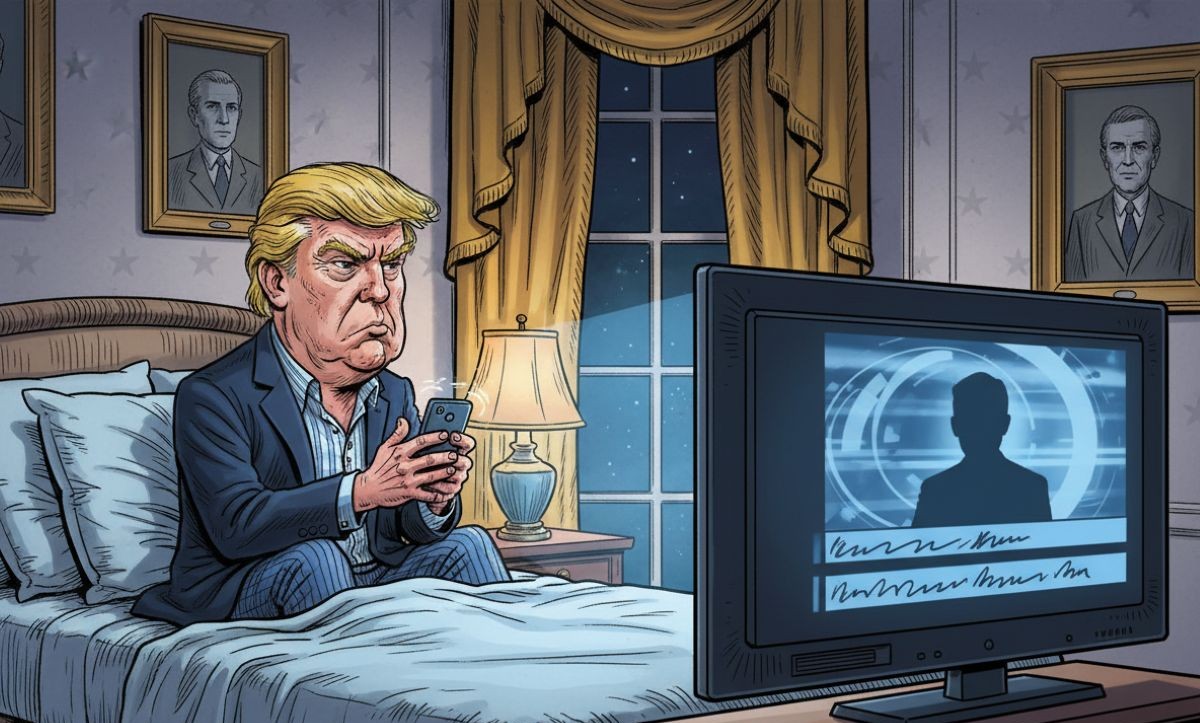
President Donald Trump on Friday refused to apologize for posting a racist video that depicted Barack and Michelle Obama as apes, telling reporters aboard Air Force One, “No, I didn’t make a mistake.”
The video, which Trump shared to his Truth Social account late Thursday night, remained online for nearly 12 hours before the White House removed it amid bipartisan condemnation. Despite the deletion and widespread outrage from both Democrats and members of his own party, Trump maintained he bore no responsibility for the content.
“I look at thousands of things,” Trump told reporters. “I looked at the beginning of it. It was fine.”
The roughly one-minute video promoted debunked claims about voting machines and the 2020 election. But in its final seconds, it abruptly cut to footage of the Obamas’ faces superimposed onto cartoon apes in a jungle setting, accompanied by “The Lion Sleeps Tonight” by The Tokens.
The imagery invoked one of the most pervasive and dehumanizing racist tropes in American history, one used for centuries to justify slavery, lynching, and Jim Crow segregation. That the video targeted the nation’s first Black president and first lady during the first week of Black History Month only amplified the offense.
“The Most Racist Thing I’ve Seen”
The backlash was swift and, notably, bipartisan. Senator Tim Scott of South Carolina, the only Black Republican in the Senate and a close Trump ally who chairs the National Republican Senatorial Committee, called it “the most racist thing I’ve seen out of this White House.”
Scott’s denunciation mattered. As one of Trump’s most reliable defenders and a key figure in the GOP’s 2026 midterm strategy, his public break over the video signaled just how indefensible the content was, even within Trump’s own party.
Republican Senator Roger Wicker of Mississippi, who represents the state with the nation’s largest percentage of Black residents, called the post “totally unacceptable” and demanded an apology. Senator Pete Ricketts of Nebraska wrote, “Even if this was a Lion King meme, a reasonable person sees the racist context to this.”
Representative Mike Lawler of New York, a vulnerable Republican facing a competitive reelection race, condemned the post as “wrong and incredibly offensive” and called for both its removal and an apology.
Even after the video was deleted, Republicans continued to demand accountability. Representative Brian Fitzpatrick of Pennsylvania called it “a grave failure of judgment and is absolutely unacceptable from anyone, most especially from the President of the United States.”
White House Damage Control Fails
The White House’s response exposed the chaos and complicity that has come to define Trump’s approach to controversy.
Press Secretary Karoline Leavitt initially dismissed the outrage as “fake,” suggesting critics were manufacturing controversy. But as the backlash intensified, the administration shifted to blaming an unnamed staffer for posting the video “in error.”
That explanation unraveled when Trump himself acknowledged Friday that he had reviewed at least part of the video. “Nobody knew that that was at the end,” Trump claimed. “If they would have looked, they would have seen it.”
The statement raised obvious questions: If Trump looked at the video before posting it, whose responsibility was it to watch it through to the end? And if a staffer posted it without Trump’s review, why was the president defending a video he claimed not to have fully vetted?
Trump spoke with Senator Scott by phone Friday, according to sources, but offered no apology. Instead, he explained what happened and said the video would be taken down.
The Historical Weight
The depiction of Black people as primates has deep and documented roots in American racism. The practice dates to 18th century pseudo-scientific theories that white enslavers used to justify the dehumanization and bondage of Black people.
Thomas Jefferson, author of the Declaration of Independence, wrote in “Notes on the State of Virginia” that Black women were the preferred sexual partners of orangutans. President Dwight Eisenhower, discussing school desegregation in the 1950s, once referred to “big Black bucks” in white classrooms.
Barack Obama, both as a candidate and as president, was repeatedly depicted as a monkey or primate on T-shirts, merchandise, and in online memes. The trope has never disappeared, it has simply migrated platforms.
Bernice King, daughter of civil rights icon Martin Luther King Jr., responded to Trump’s post by resurfacing her father’s words: “Yes. I’m Black. I’m proud of it. I’m Black and beautiful.” She praised Black Americans as “diverse, innovative, industrious, inventive” and added, “We are beloved of God as postal workers and professors, as a former first lady and president. We are not apes.”
Political Consequences Ahead
House Minority Leader Hakeem Jeffries, the first Black leader of a party in Congress, called Trump “a vile, unhinged and malignant bottom feeder.” Senate Minority Leader Chuck Schumer described the post as “racist, vile, abhorrent” and questioned where Senate Republicans stood.
The NAACP issued a stark warning: “Trump posting this video, especially during Black History Month, is a stark reminder of how Trump and his followers truly view people. And we’ll remember that in November.”
That’s the real political calculation here. Trump and Republicans are already nervous about holding their slim congressional majorities in November’s midterm elections. This incident gives Democrats a powerful rallying point and could further erode Trump’s already troubled standing with Black voters and moderate suburbanites.
What This Reveals
Trump’s refusal to apologize tells you everything about how he views accountability and the presidency itself. When confronted with indefensible content, his instinct is not to take responsibility but to deflect, minimize, and move on.
“I didn’t make a mistake,” he insisted, even as members of his own party broke ranks to condemn what he posted.
This isn’t the first time Trump has trafficked in racist rhetoric. He was a driving force behind the “birther” conspiracy theory that falsely claimed Barack Obama was born in Kenya. He has described immigrants as “poisoning the blood” of the United States. He has a documented history of inflammatory racial statements that would have ended political careers in an earlier era.
But Trump has spent years demonstrating that the old rules don’t apply to him, that he can say or post nearly anything without facing real consequences from his base or most Republican officials. Friday’s episode, despite the bipartisan criticism, likely won’t change that calculation.
The question is whether voters will. The Obamas, as House Minority Leader Jeffries noted, “are brilliant, compassionate and patriotic Americans. They represent the best of this country.”
Trump’s video, and his refusal to apologize for it, represents something else entirely.