
Let me be clear about something: when you announce a government-sponsored athletic competition requiring “one young man and one young woman from each state” to compete in a nationally televised event, you had better believe the internet is going to notice what franchise that sounds exactly like. And sure enough, within minutes of President Trump unveiling his “Patriot Games” on Thursday, social media exploded with references to Suzanne Collins’ dystopian nightmare.
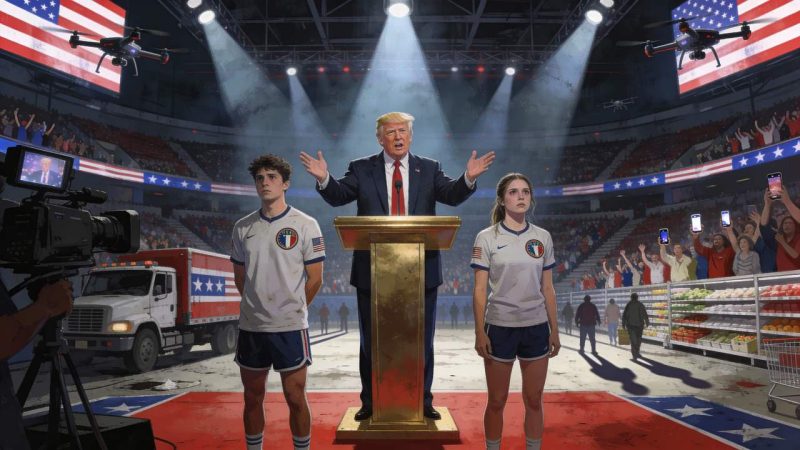
The timing could not have been more cinematically ironic. Trump rolled out this centerpiece of America’s 250th birthday bash while millions of Americans are watching their health insurance premiums skyrocket and grocery bills climb. Bread and circuses, indeed, and in case the metaphor wasn’t obvious enough, the fictional nation in The Hunger Games is literally called “Panem,” Latin for bread.
What The Patriot Games Actually Are
Trump announced the competition as part of “Freedom 250,” a new organization tasked with orchestrating the nation’s semiquincentennial celebrations in 2026. The Patriot Games will be a four-day athletic event in the fall, bringing together approximately 100 of the nation’s top high school athletes, one male and one female from each state and territory.
“In the fall, we will host the first ever Patriot Games, an unprecedented four-day athletic event featuring the greatest high school athletes, one young man and one young woman from each state and territory,” Trump declared in the announcement video.
The president made sure to include his signature culture war flourish: “But I promise there will be no men playing in women’s sports. You’re not going to see that.”
Details remain thin on what sports these high schoolers will actually compete in, which events they’ll participate in, and how “the greatest” athletes will be selected from each state. It’s all very preliminary, which makes the grandiose announcement feel more like brand marketing than event planning.
Democrats Were Ready With The Memes
California Governor Gavin Newsom, never one to let a good trolling opportunity pass, responded on X with the franchise’s signature phrase: “May the odds be ever in your favor.” His press office doubled down by posting images comparing Trump to President Coriolanus Snow, the authoritarian villain who presides over the fictional death matches.
Illinois Governor JB Pritzker went straight for the imagery, posting a still of President Snow raising a champagne glass, the kind of subtle political commentary that doesn’t require any words at all.
Representative Delia Ramirez of Illinois provided the most pointed critique: “A competition between teenagers created by authoritarians to distract the people from their brutality and corruption? What could possibly go wrong? If only there were a book that told us exactly what happens next.”
The Democratic Party’s official account shared a clip from the 2012 film with the opening decree from the fictional world: “And so it was decreed that, each year, the various districts of Panem would offer up, in tribute, one young man and woman to fight to the death in a pageant of honor, courage and sacrifice.”
Democratic commentator Brian Tyler Cohen summarized the mood: “We asked for affordable health care and Republicans are giving us the Hunger Games.”
The White House Fires Back
The administration wasn’t having it. The White House responded on X with characteristic combativeness: “Of course Democrats hate this, it doesn’t involve confused men stealing medals from women and calling it ‘equality.’ Celebrating elite young men and women who earn their recognition through hard work and talent is what real patriotism looks like.”
Supporters of the president also pushed back on the comparisons. Andrew Follett, a Club for Growth analyst, mocked the criticism: “Libs be like: ‘The Hunger Games is when kids are athletes!'”
Ryan Fournier, co-founder of Students for Trump, praised the initiative: “This is how you honor our country and American excellence.”
The Broader Freedom 250 Spectacle
The Patriot Games are just one piece of an elaborate calendar of events Trump has been planning since his campaign. Freedom 250 is led by Keith Krach, a former Under Secretary of State and tech entrepreneur, who called it “a celebration of America unlike anything we have ever done.”
The festivities kick off New Year’s Eve when the Washington Monument will be illuminated with “birthday lights” through January 5, 2026. A National Prayer Event on the Mall will “rededicate our country as One Nation Under God.” Memorial Day brings a “Spirit of America” parade.
Then things get really Trumpian. On June 14, Flag Day and Trump’s 80th birthday, the White House will host a UFC fight on the South Lawn. Dana White, the UFC CEO and staunch Trump ally, will put on the event featuring “the greatest champion fighters in the world, all fighting that same night.” It will be the first time the White House has ever hosted a sporting match.
From June 25 to July 10, the National Mall transforms into the “Great American State Fair” with pavilions from all 50 states. Independence Day promises “the largest fireworks display in the world” and another “Salute to America” celebration.
The Arc de Trump Looms
Meanwhile, Trump continues pushing his “triumphal arch” project, a structure he envisions near the entrance to Arlington National Cemetery, facing the Lincoln Memorial. At a Christmas reception last week, Trump revealed that Vince Haley, his former speechwriter and now director of the Domestic Policy Council, is in charge of the project.
“It will be like the one in Paris,” Trump said of his proposed arch. “But to be honest with you, it blows it away, blows it away in every way.”
The president described the arch as Haley’s “primary thing,” adding: “There is nothing that can compete with that.” This directive comes as Americans face rising costs from tariffs and health insurance premiums set to spike for millions, prompting critics to question whether a $250 million monument should be the Domestic Policy Council’s top priority.
Why The Hunger Games Comparison Sticks
Here’s the thing about the comparisons: they’re both completely apt and somewhat unfair at the same time. Nobody is going to die at the Patriot Games. These are athletic competitions, not gladiatorial combat. The structural similarity, one boy and one girl from each region competing in a nationally televised government spectacle, is where the comparison ends in terms of literal content.
But Suzanne Collins wrote The Hunger Games as a pointed critique of exactly this kind of political theater. In a 2010 interview marking the series’ tenth anniversary, Collins explained that the idea came from channel-surfing between reality television and footage of the Iraq War, the collision of entertainment spectacle with the human cost of political violence.
The Hunger Games wasn’t just about children fighting to the death. It was about a government using mass entertainment to distract citizens from their actual conditions, about forcing loyalty displays in the name of patriotism, about the Capitol’s gleaming spectacles while the districts starved.
When critics draw these parallels, they’re not saying Trump is going to make teenagers kill each other. They’re pointing to the symbolism of launching elaborate celebrations while healthcare costs surge, while deportations accelerate, while the administration simultaneously proposes cutting social programs. As one poster on X put it: “Healthcare costs are exploding for everyone. So Trump rolls out reality-TV ‘Patriot Games’ as a shiny distraction.”
The Pop Culture Problem
The Hunger Games comparison presents an interesting branding problem for the Trump administration. The franchise sold 100 million copies and grossed nearly $3 billion at the box office across four films. A fifth movie, Sunrise on the Reaping, arrives in 2026, the same year as the Patriot Games. Jennifer Lawrence and Josh Hutcherson are reportedly returning to their roles.
That’s a lot of cultural real estate devoted to a story whose explicit message is “authoritarian governments use spectacular entertainment to control populations.” Every time someone hears “Patriot Games” next year, a significant portion of the population will immediately think of Katniss Everdeen and totalitarian pageantry.
Whether that hurts the event’s appeal probably depends entirely on which America you live in. For Trump’s base, the comparison might feel like more evidence that liberals can’t appreciate anything patriotic without invoking dystopia. For critics, it’s a ready-made framework for understanding the event as distraction politics.
What Comes Next
The Patriot Games are scheduled for fall 2026. Between now and then, we’ll presumably learn which sports are involved, how athletes are selected, and what exactly happens during four days of competition. The Trump administration has made it clear this is part of a larger effort to put his stamp on America’s 250th birthday, from the arch in Arlington to the UFC fight on the White House lawn to the state fair taking over the National Mall.
Meanwhile, the Smithsonian Institution is under White House review, with demands that 250th anniversary content “renew national pride.” The Department of Agriculture has embraced the “Great American State Fair” initiative, which asks states to compete for Trump to choose the “most patriotic.”
It’s all very on-brand: competitive, spectacular, branded, and inescapably Trumpian. Whether you see that as a fitting celebration of American spirit or a troubling display of political theater probably says more about you than about the events themselves.
But maybe somebody in the White House communications shop should have Googled “one boy and one girl from each state” before the announcement went out. Some comparisons write themselves.