
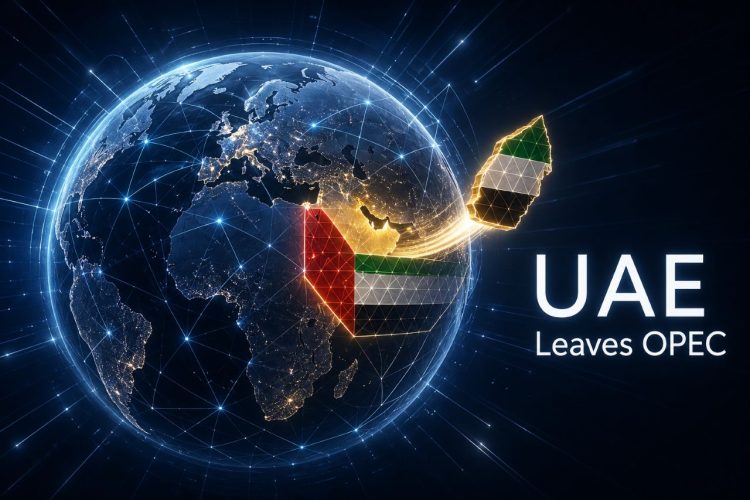
The United Arab Emirates just did something that no one in the global energy industry thought would happen in the middle of a war: it walked out of OPEC. After nearly 60 years as a member of the oil cartel, the UAE announced Monday that it will leave both OPEC and OPEC+ effective May 1, citing “national interests” that no longer align with the organization’s production caps. The timing could not be worse for the cartel, or more revealing about the fractures the Iran conflict has exposed in the architecture of global energy.
U.S. crude surpassed $100 per barrel for the first time since April 10 on the news. Citi analysts are projecting Brent could spike to $150 per barrel and average $130 through the third quarter. For American consumers already strained by two months of wartime energy disruption, the UAE’s exit is another accelerant on an already raging fire.
Why the UAE Left, and Why It Matters Now
The short answer is that the Strait of Hormuz is effectively closed, and the UAE decided there was no point staying in a cartel that cannot ship its own product. Iran shut down the strait again on April 18, choking off the primary export route for Gulf oil producers. The U.S. naval blockade of Iranian ports continues. And the peace talks that were supposed to resolve all of this have collapsed into a deadlock over Iran’s nuclear program and control of the waterway.
The longer answer is that the UAE has been chafing under OPEC’s production caps for years. Abu Dhabi invested billions expanding its production capacity, only to be told by Riyadh that it could not pump what it was capable of producing. Saudi Arabia, OPEC’s largest producer and its dominant political force, repeatedly blocked UAE requests to raise its production quota. The war gave the UAE the cover it needed to make the break it had been contemplating for at least three years.
The departure reduces OPEC’s share of global oil supply from roughly 30% to 26%. That is not a catastrophic drop on its own, but it represents something more significant than the numbers suggest: proof that the cartel’s ability to enforce discipline among its members is eroding at precisely the moment when coordinated production management matters most.
The Iran War Created the Conditions for This Rupture
Sixty days into the U.S.-Israeli military campaign against Iran, the conflict has reshaped every assumption about Middle Eastern energy politics. The Strait of Hormuz, through which roughly 20% of the world’s oil supply normally flows, has been closed, opened, and closed again as negotiations stumble. Iran offered to reopen the strait in exchange for the U.S. lifting its naval blockade, but Washington wants nuclear concessions bundled into any deal, and Tehran wants to defer nuclear talks to a later phase.
The result is paralysis. No oil is flowing through Hormuz. No peace deal is close. And the Gulf states that depend on that chokepoint for their economic survival are making increasingly desperate calculations about their own futures.
The UAE’s calculation is straightforward: if the strait is closed anyway, the cartel’s production caps are meaningless. And if the war ends and the strait reopens, the UAE wants to pump at full capacity without asking Saudi Arabia’s permission. Leaving OPEC now positions Abu Dhabi to capture market share once the crisis resolves, while also sending a political message to Riyadh that its dominance of Gulf energy policy is no longer guaranteed.
What This Means for Oil Prices and the American Consumer
The immediate impact on oil prices is upward. Markets had been pricing in the assumption that OPEC would eventually coordinate a production increase to offset the supply disruption caused by the war. The UAE’s departure makes that coordination harder and reduces the cartel’s ability to flood the market with supply when the strait reopens.
For American consumers, this translates to higher gasoline prices at a time when the economy is already absorbing the shock of the Iran conflict. The national average for a gallon of regular gas has been hovering near $4.50, up from $3.20 before the war started in early March. If Citi’s projections hold and Brent reaches $150, pump prices could push past $5.50 in many markets.
The ripple effects extend beyond the gas pump. Jet fuel prices are climbing, which means airfares will follow. Shipping costs are rising, which means consumer goods prices will increase. Fertilizer costs, heavily linked to energy prices, are spiking, which means food prices will go up. The U.N. Secretary-General has already warned of a global food emergency triggered by the conflict’s impact on fuel and fertilizer markets.
OPEC’s Existential Crisis
The UAE is not the first country to leave OPEC. Qatar departed in 2019, Ecuador left and rejoined and left again, and Indonesia has had an on-again, off-again relationship with the organization for decades. But the UAE is different. It is one of the largest producers in the Gulf, a founding member of the cartel, and a critical player in the Saudi-led coalition that has defined OPEC’s strategy for the past decade.
Its departure raises immediate questions about who might follow. Kuwait and Iraq have both expressed frustration with Saudi production dominance. Nigeria and Angola have chafed at quotas they view as unfairly restrictive. If the UAE’s exit is successful and Abu Dhabi gains market share as a result, other members will face intense pressure to follow the same path.
Saudi Arabia, for its part, faces a strategic nightmare. The Kingdom’s entire economic diversification plan, the $500 billion NEOM project and the broader Vision 2030 program, depends on oil revenues remaining high enough to fund the transition away from oil dependence. An OPEC that cannot enforce production discipline is an OPEC that cannot support prices, which is an existential threat to the Saudi model.
The Bigger Picture: Energy Security in a Wartime World
The UAE’s departure from OPEC is a symptom of a larger transformation in global energy politics that the Iran war has accelerated but did not create. The post-World War II energy order, in which the United States guaranteed freedom of navigation in the Persian Gulf in exchange for stable oil supplies from allied Gulf monarchies, is breaking down. The Gulf states are hedging their bets, diversifying their partnerships, and making decisions based on their own survival calculations rather than American strategic preferences.
For the United States, this means that the energy security framework it has relied on for half a century is less reliable than at any point since the 1973 oil embargo. The U.S. is a net energy exporter now, which provides some insulation, but oil is a globally priced commodity. When Brent spikes, American consumers feel it regardless of how much domestic production the U.S. has.
The war in Iran was supposed to be over quickly. Two months in, it has closed the world’s most important oil chokepoint, fractured the oil cartel that was supposed to manage supply disruptions, sent crude past $100, and created the conditions for a global food crisis. The UAE’s exit from OPEC is just the latest evidence that the consequences of this conflict are spiraling well beyond what anyone in Washington anticipated.