
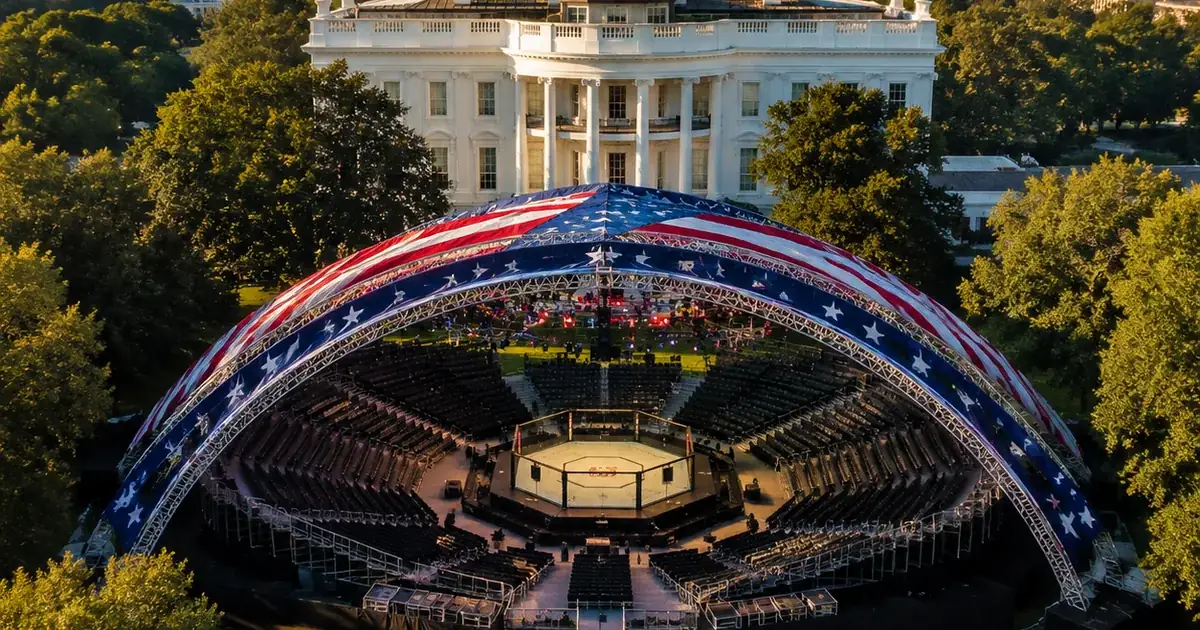
A federal lawsuit filed Saturday is trying to stop the UFC from staging a mixed martial arts event on the White House South Lawn on June 14, arguing that the planned “Freedom 250” fight card violates National Park Service regulations and amounts to a corrupt use of federal property for private commercial gain. The filing, the first known legal challenge to the event, lands less than a week before Trump’s 80th birthday celebration is set to go live on national television.
The Legal Arguments
The lawsuit was filed by the Public Integrity Project on behalf of two Virginia residents, a Vietnam War veteran and a retired government employee. PBS NewsHour reported Sunday that the complaint rests on three main claims: National Park Service regulations prohibit sporting events on federal parklands, Congress never consented to the construction of a towering arch structure overlooking the event space, and no environmental review was conducted before construction began.
The plaintiffs also argue the event financially benefits both President Trump and UFC President Dana White through promotional opportunities and stock holdings. That argument threads a needle the courts have largely avoided during this administration: whether a president’s personal financial interests can constitute corruption when the enrichment flows through a third party rather than directly into a government account.
The White House Response
The White House dismissed the lawsuit as “obstructionist, baseless, and dilatory,” insisting the UFC fight is “no different than the various other White House-hosted events on the South Lawn and properly permitted events on the Ellipse and National Mall throughout the year.”
That framing is doing a lot of heavy lifting. The South Lawn has hosted Easter egg rolls, state dinners, and Fourth of July celebrations. It has not, in living memory, hosted a pay-per-view combat sports event promoted by a private company whose president is a close political ally of the sitting president. The comparison to a state dinner is, to put it gently, a stretch.
Why This Fight Matters Beyond the Octagon
The UFC-White House arrangement is a case study in how the boundaries between entertainment, politics, and private commerce have dissolved in this era. ESPN reported Saturday that the event was organized to coincide with Trump’s birthday, and the spectacle is explicitly designed to appeal to the young male demographic that multiple polls show drifting away from the president.
That is not governance. That is campaign programming staged on public property with federal resources, wrapped in the language of patriotism. The “Freedom 250” branding is not subtle about what it is selling.
Dana White has been one of Trump’s most visible and consistent allies since 2016. Their relationship is transactional in both directions: Trump gets access to UFC’s audience, and White gets the kind of political proximity that money alone cannot buy. Hosting a fight at the White House is the logical endpoint of that arrangement, and the lawsuit is asking whether any legal guardrails still apply.
What Happens Next
The timeline is brutal for the plaintiffs. The event is six days away, construction is already underway, and the courts would need to issue an emergency injunction to stop it. Federal judges are generally reluctant to block events on the eve of their execution, particularly when the defendant is the executive branch.
Even if the lawsuit fails to halt the June 14 event, it could establish precedent about the limits of commercial activity on federal grounds. And it puts a legal marker on the record for future administrations considering similar arrangements.
For now, the arch is going up, the octagon is being assembled, and the White House is about to become the most expensive fight venue in history. Whether that is a celebration of freedom or a corruption of public space depends entirely on which side of the partisan divide you are standing on. The courts will get to weigh in. Whether they do so before the first bell rings is another question entirely.