
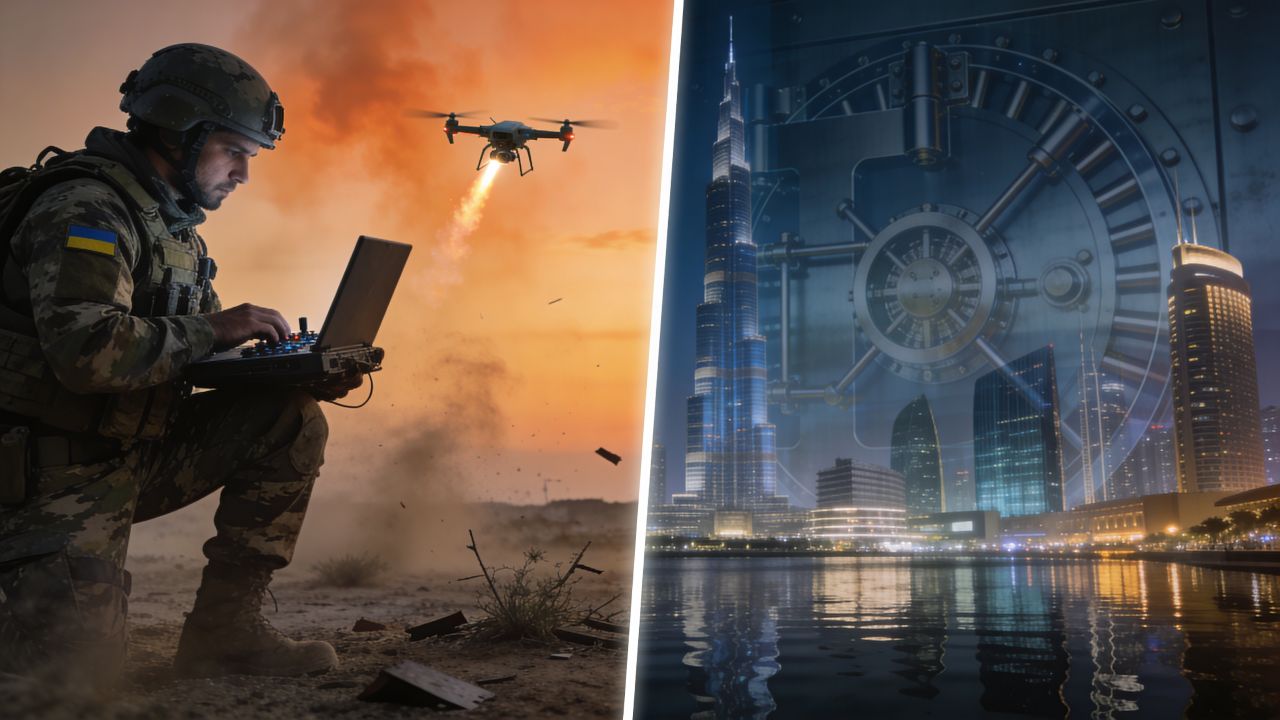
The war against Iran is now being fought on two fronts that have nothing to do with missile trajectories. Ukraine is deploying its hard-won expertise against the same Iranian drones that have ravaged its cities for four years.
And Dubai, long the quiet financial capital Tehran relied on to survive Western sanctions, is reportedly considering slamming the vault shut.
These two developments, breaking within hours of each other on Friday, represent a significant tightening of the strategic and economic noose around Iran, even as its missiles and drones continue to strike targets across the Gulf.
Ukraine Steps Into the Middle East Conflict
Ukrainian President Volodymyr Zelenskyy made it official this week: Ukraine is ready to send military specialists to the Middle East to help the United States and its Gulf partners counter Iranian drone attacks. The offer is not charity. It is the product of four brutal years on the receiving end of the same Shahed-136 drones now swarming U.S. military facilities in Bahrain, Kuwait, and beyond.
“Partners are reaching out to us,” Zelenskyy said Wednesday. “Our military possesses the necessary capabilities. Ukrainian experts will operate on site, and teams are already coordinating these efforts.”
The Pentagon has been paying attention. The commander of the U.S. military’s Joint Interagency Task Force 401, Brigadier General Matt Ross, confirmed this week that his counter-drone task force recently visited Kyiv specifically to study how Ukrainian forces have successfully defended against Shahed attacks. The visit concluded just before Zelenskyy went public with his offer.
“Nobody has more experience in this particular type of warfare and to counter these particular systems than Ukraine,” said Alex Plitsas, a senior fellow at the Atlantic Council and former chief of sensitive activities for the Office of the Deputy Assistant Secretary of Defense.
The $2,000 Drone Killer Rewriting Air Defense
What Ukraine has to offer is not theoretical. It is the distilled knowledge of fighting off more than 54,000 Shahed-type drones in 2025 alone, a volume of attack that forced Ukrainian engineers and soldiers to innovate under fire in ways no Western military has had to attempt.
The problem with the standard Western approach to drone defense is economic. A Shahed costs between $20,000 and $50,000 to produce. Shooting it down with a Patriot interceptor missile costs millions. That math does not work at scale, and Iran has tens of thousands of Shaheds in storage. Ukraine learned this lesson early and built a layered, cost-effective response.
The Ukrainian system combines radar and acoustic sensors feeding into a digital common operating picture, mobile fire teams mounted on pickup trucks with heavy machine guns, electronic warfare jamming, and, most critically, interceptor drones. These purpose-built drone killers, some produced for as little as $1,000 to $2,000, hunt and destroy Shaheds before they reach their targets. Ukraine has an excess production capacity of these systems right now.
Zelenskyy has signaled he would consider transferring interceptor drones to Gulf partners, but at a price: PAC-3 Patriot interceptor missiles. Ukraine’s own Patriot supplies are running low after four years of defending against Russian ballistic missiles, and the escalating Middle East war risks diverting more of those missiles away from Ukrainian skies.
President Trump, when asked by Reuters whether he would accept Ukrainian assistance in the region, gave a characteristically direct answer: yes. He said he would take help from any country.
A Geopolitical Calculus, Not Just Generosity
Zelenskyy has been clear-eyed about what Ukraine expects in return for its expertise. Assistance to Middle East partners, he said, will only proceed if it does not weaken Ukraine’s own defenses, and only if it creates leverage toward ending Russia’s war at home.
“We help to defend from war those who help us, Ukraine, bring a just end to the war,” Zelenskyy said.
The Ukrainian leader has also used this moment to make a case the West has been slow to hear: Russia and Iran are not separate problems. Iran supplied Russia with at least 57,000 Shahed drones for use against Ukrainian cities. Russia, in turn, has helped Iran develop its defense industry. The same weapon systems threatening U.S. forces in Kuwait are the same ones that killed Ukrainian civilians in Kharkiv and Zaporizhzhia. Zelenskyy wants that link to be part of any broader security conversation.
As a footnote to all of this, the planned new round of U.S.-brokered Russia-Ukraine peace talks has been postponed, with Zelenskyy citing the Middle East situation as the cause of the delay. Ukraine’s moment of leverage in one theater is temporarily freezing progress in another.
UAE May Cut Iran’s Financial Lifeline
On the economic front, the Wall Street Journal reported Friday that the United Arab Emirates is actively weighing whether to freeze billions of dollars in Iranian assets held within its banking system, a move that would represent a historic break from Dubai’s carefully cultivated posture of financial neutrality.
To understand why this matters, you have to understand what the UAE has been to Iran. Dubai is not just a city Iran has done business with. It is, by most analyst accounts, the most important financial gateway Iran has to the global economy. Shell companies registered in Dubai’s sprawling free zones have for years masked the origin of Iranian oil and commodities. Informal currency exchange houses have moved money across borders outside the reach of conventional banking oversight. U.S. Treasury data from 2024 suggests approximately $9 billion in transactions flowing through American banks appeared linked to covert Iranian economic activity, with 62 percent of those funds ultimately routed through UAE-based firms.
“The UAE’s move to restrict Iran’s financial activities is highly significant because the UAE is the most important gateway for Iran to engage with the global economy,” said Esfandyar Batmanghelidj, CEO of Iran-focused think tank Bourse and Bazaar.
What changed the calculation was not American pressure, though Washington has been pushing for years. What changed it was Iranian missiles and drones striking Dubai’s airport, the Burj Al Arab hotel area, and the Palm Jumeirah artificial island. When the bombs land in your backyard, the strategic neutrality calculus tends to shift.
What an Asset Freeze Would Target
According to the Journal’s reporting, Emirati authorities are considering a tiered set of measures. The first would target shell companies used by Iran to conduct trade and hide the origin of oil revenues. The second would crack down on local currency exchanges, the informal money transfer networks that sit at the center of Iran’s financial plumbing in the Gulf. Accounts linked to Iran’s Islamic Revolutionary Guard Corps have been identified as a priority target.
Emirati officials have privately warned Iranian counterparts that such action is under consideration. No final decision has been made, and the timing remains unclear. The UAE has also been careful to maintain its stated policy of avoiding direct military involvement in the conflict, reaffirming its commitment to what it calls “good neighborliness and de-escalation.”
But the financial warning alone carries weight. Iran’s economy was already under severe strain before the current conflict. Inflation, currency devaluation, and shortages had hollowed out domestic purchasing power. The military campaign has disrupted command structures and triggered an interim leadership council following the reported killing of Supreme Leader Ayatollah Ali Khamenei. Losing access to the UAE financial corridor, even partially, would compound those pressures significantly.
Analysts caution that any freeze will need to be selective. Hundreds of thousands of Iranian nationals live and work legally in the UAE. Blanket measures could disrupt legitimate commerce, remittances, and business relationships that have nothing to do with the IRGC or sanctions evasion. Getting the targeting right is not a simple task.
The Bigger Picture
Taken together, these two stories illustrate how rapidly the coalition of countries willing to take concrete action against Iran is expanding. A nation at war for its own survival is offering to export its hardest-won military knowledge. A city that built its reputation on being a safe harbor for capital from everywhere is debating whether to shut the door on one of its oldest clients.
Iran launched more than 1,000 drones and missiles at targets across the UAE and Gulf in the first week of the conflict following the U.S.-Israel Operation Epic Fury strikes on February 28. U.S. Central Command reports that Iranian ballistic missile attacks have since dropped by 90 percent as U.S. and Israeli operations have dismantled Iranian launch capabilities. But the Shahed drone threat remains very much active, and cheap enough to sustain for a long time.
Ukraine figured out how to beat that threat. The question now is whether the U.S. and its Gulf partners can absorb those lessons fast enough, and whether the UAE’s financial pivot comes in time to matter.
Both answers depend on decisions being made in the next few days. In a war moving this fast, that is not much runway.