
The Blockade Begins: How a Failed Peace Summit Escalated Into Economic Warfare
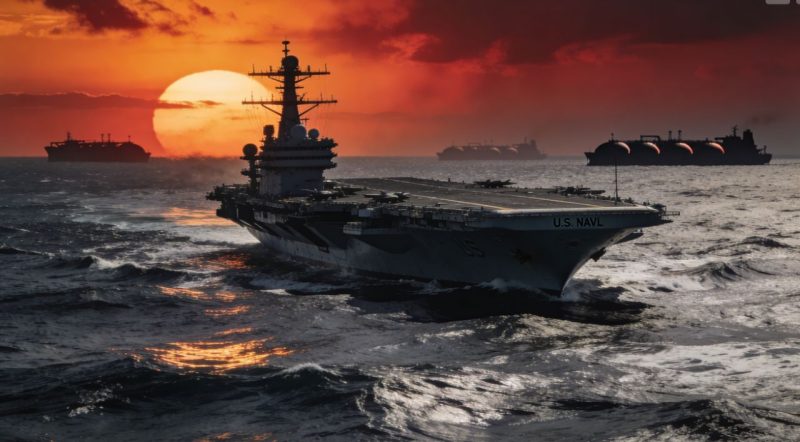
The United States Navy enforced a complete blockade of Iranian ports at 10 a.m. Eastern Time on Sunday, April 13, transforming what began as a regional confrontation six weeks ago into the kind of direct great-power confrontation that markets fear and democracies struggle to manage. Within hours, Brent crude oil surged past $102 per barrel, a visceral reminder that in the twenty-first century economy, military decisions made in the Persian Gulf instantly ripple through grocery stores in Stuttgart and heating bills in Stockholm.
This is not a metaphorical blockade. It is total. Every commercial vessel seeking to enter or leave Iranian territorial waters faces interdiction by the U.S. Fifth Fleet. The Strait of Hormuz, that narrow chokepoint through which roughly 20 percent of the world’s traded oil flows daily, now operates under conditions of military siege. And the decision to impose it came not after months of deliberation or congressional consultation, but after peace negotiations collapsed over a weekend in Islamabad.
When Diplomacy Moves at the Speed of Failure
Vice President JD Vance arrived in Pakistan on Friday with what aides described as a comprehensive framework for de-escalation. By Saturday evening, the talks had fractured. The specific stumbling blocks remain opaque, though sources close to the negotiations suggest the Iranian delegation demanded sanctions relief that the White House deemed politically impossible to deliver. Vance, accustomed to dealmaking in transactional politics, apparently discovered that territorial disputes and nuclear ambitions operate under different logic.
What matters now is not what went wrong in Islamabad but what comes next. The blockade announcement sent an unmistakable message: the United States has exhausted its patience for negotiation and is pivoting to coercion. This is how conflicts escalate. Not through miscalculation or accident, but through the deliberate choice to eliminate the off-ramp.
Oil Markets, Democracy, and the Burden of Unilateralism
Brent crude at $102 per barrel is already reshaping global politics in real time. Germany’s government, facing domestic pressure from both left and right over energy costs, announced 1.9 billion euros in fuel price relief measures. This is money that could have funded schools or infrastructure being redirected to subsidize the consequences of military escalation. It is a tax on democracy itself, paid by ordinary citizens in countries that were not part of the decision.
Herein lies the deeper problem with unilateral action in an interdependent global economy. When the United States imposes a blockade, it does not merely constrain Iran. It constrains Germany’s ability to fund social services. It raises transportation costs for every manufacturer dependent on Middle Eastern oil. It shrinks the available capital for climate transition investments. And it does all of this based on a decision made by one government, in consultation with some allies, but not subject to the democratic deliberation one might expect for actions this consequential.
Naval blockades worked in some contexts. They also failed spectacularly in others. They tend to harden rather than soften the resolve of those being blockaded, particularly when the blockading power is perceived as a foreign hegemon.
The Escalation Trap and Strategic Ambiguity
What concerns allied governments most is not the blockade itself but the absence of an obvious exit. A negotiated settlement requires at least some communication channel, some way for each side to signal when conditions have been met. The weekend’s collapse of talks suggests those channels have narrowed considerably. In their place, military escalation offers the illusion of control. It is visible, muscular, and unambiguous. It is also fragile.
Six weeks into this conflict, the question remains unanswered: what does victory look like? What set of Iranian concessions or behavioral changes would prompt the United States to lift the blockade? Without a public answer to that question, every decision by Iran to prepare for continued conflict, to stockpile supplies, to deepen relationships with allies like Russia and China, can be interpreted as intransigence rather than rational response to indefinite siege.
The institutional frameworks designed to prevent this kind of spiral are notably absent. The United Nations Security Council, where Russia maintains veto power, has been effectively sidelined. Multilateral diplomacy has given way to bilateral brinksmanship. The playbook for de-escalation in the era of great-power competition is being written in real time, and so far it reads like a tragedy rather than a diplomatic thriller.
What Global Markets Are Really Pricing
The energy market reaction is instructive because it reflects something economists call regime uncertainty. Traders are not simply calculating the probability that Iranian oil leaves the market. They are calculating the probability that this situation spirals further. Every military confrontation in the Persian Gulf carries the risk of accidental escalation: a miscommunication, a weapon fired in self-defense that is misinterpreted as an offensive act, a regional power deciding this is their moment to settle old scores.
The surge in oil prices reflects the rational fear that this blockade is not an end state but a waypoint toward something worse. It is the market pricing in the possibility that we are watching the opening moves of a much larger conflict.
The Democratic Deficit in Security Decisions
In the United States, Congress has not voted on this blockade. The House and Senate have not deliberated publicly about whether this course represents the best use of American military power and diplomatic capital. Major military escalations involving the potential disruption of global energy supplies now occur without the formal democratic input that the Constitution theoretically requires.
Progressive advocates for democratic accountability must wrestle with this reality. The rule of law and constitutional process matter enormously when things go wrong. Military actions taken without proper deliberation, without clear strategic objectives, without an exit strategy, without the American public having genuinely weighed the costs and benefits, are actions taken in a deficit of legitimacy. They are vulnerable to reversal, to public backlash, to the kind of institutional erosion that weakens democracies from within.
What Comes Next
The blockade is now in effect. Oil markets will adjust. European governments will scramble to manage energy costs. Iran will decide whether to challenge the blockade militarily, to accept it for now, or to escalate in other domains. The next seventy-two hours will matter considerably.
What should concern observers most is not the blockade itself but the institutional and diplomatic exhaustion that made it seem like the only option. A government with stronger alliances, clearer strategic communication, and a genuine commitment to negotiated settlements would have other tools. The fact that it chose this one suggests something about the limits of American patience, the weakness of diplomatic alternatives, and the gravitational pull of military solutions in a country accustomed to winning through force.
History will render judgment on whether April 13, 2026 was the moment when catastrophe became inevitable, or simply another escalatory step that diplomacy ultimately reversed. For now, we are living inside the possibility that it was the former.