
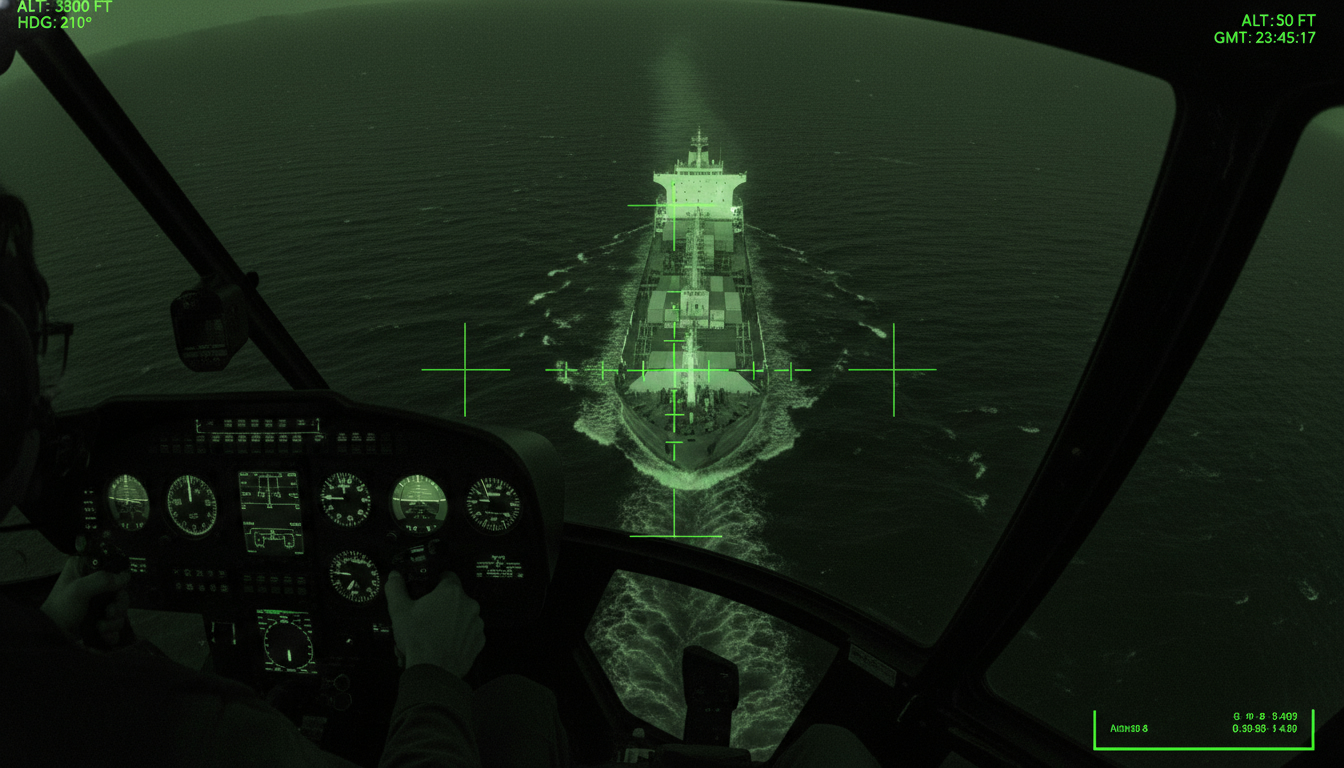
The Trump administration got the image it wanted this weekend. A guided missile destroyer, Marines rappelling from helicopters, and a disabled 900-foot Iranian cargo ship sitting dead in the water off the coast of Oman. What it also got, roughly 72 hours before its own two-week ceasefire with Iran is scheduled to expire, is a diplomatic crisis that looks engineered to fail.
On Sunday, the USS Spruance, a US Navy guided missile destroyer operating in the Gulf of Oman, fired on the Iranian-flagged vessel Touska after what US Central Command described as a six-hour standoff. The ship, nearly 900 feet long and bound for the Iranian port of Bandar Abbas from China, had refused repeated orders to stop. The Navy disabled its engine room. Marines boarded from helicopters launched off the USS Tripoli. And President Donald Trump announced the seizure himself, on Truth Social, with the tone of a man ordering highlights for the evening news.
“We have full custody of the ship, and are seeing what’s on board,” Trump posted.
What is on board, and what happens next, will define whether the Middle East spends the coming week inching toward a permanent peace or sliding back into open war.
What Happened In The Gulf Of Oman
The Touska is the first Iranian vessel seized by US forces since the American blockade of Iranian ports began on April 13. That blockade is itself a product of a ceasefire that has been fraying since the day it was signed. According to CENTCOM, the Spruance issued warnings for six hours before opening fire on the tanker’s engine room. Iran’s joint military command, responding early Monday, called the armed boarding “maritime highway robbery” and vowed retaliation, describing the operation as an act of piracy against a commercial ship traveling from China.
Naval analysts told CNN the Touska will likely be escorted to a regional port for inspection. If US authorities determine the ship was carrying sanctioned cargo or contraband, it could be forfeited to the US government as a “prize” under maritime law. In plain English, the vessel may never go home.
This was, notably, exactly the kind of escalation the administration quietly briefed reporters about last week. The Wall Street Journal reported days ago that the US military was preparing to board Iran-linked tankers in international waters. The Touska was not a surprise. It was a plan.
A Ceasefire That Was Always On Life Support
The two-week ceasefire between the United States and Iran, now in its final days, has been operating under conditions that made failure almost inevitable. Iran closed the Strait of Hormuz, through which roughly one-fifth of the world’s crude oil typically moves. The US responded by blockading Iranian ports. Each side accuses the other of violating the truce. Each side is, in a narrow legal sense, correct.
What sits underneath the naval theatrics is a war now in its eighth week. The US and Israel launched the campaign against Iran on February 28, ostensibly over Tehran’s nuclear program. According to figures reported by NPR and other outlets, at least 3,000 people have been killed in Iran, more than 2,290 in Lebanon, 23 in Israel, and over a dozen across Gulf Arab states. That is the backdrop for every word being exchanged between Washington and Tehran this week, and it is the reason so few people in the region believe either capital has the moral authority to claim the other violated the peace first.
Tehran Walks Away From The Table
Trump announced Sunday that US negotiators, led by Vice President JD Vance and including envoy Steve Witkoff and Jared Kushner, would arrive in Islamabad on Monday for a second round of peace talks. Within hours, Iranian state media reported that Tehran would not attend, citing “excessive demands” and the continued US blockade as evidence of bad faith.
Iran’s chief negotiator, parliament speaker Mohammed Bagher Qalibaf, struck a careful tone in public comments, saying there would be “no retreat in the field of diplomacy” while acknowledging a wide gap between the two sides. That gap is not subtle. It includes Iran’s enriched uranium stockpile, the future operational control of the Strait of Hormuz, and now the fate of the Touska itself.
Trump, meanwhile, did not soften his posture. He repeated a public threat to “knock out every single Power Plant, and every single Bridge, in Iran” if Tehran refused his terms. Iran has said that an American attack on its civilian infrastructure would prompt Iranian strikes on power stations and desalination plants across the Gulf Arab states, a warning that reaches deep into the economies of US allies and the oil customers keeping American refineries supplied.
The Economic Shockwave Nobody Voted For
The financial reaction was immediate. Brent crude rose roughly 5.5 percent to $95.33 a barrel on Monday, with US benchmark crude up 7 percent around $90. European equities opened in the red, with Germany’s DAX down 1 percent and France’s CAC off nearly a full point. S&P 500 futures slid 0.7 percent after the index closed at a record high on Friday.
American drivers are already paying for this. The national average for a gallon of gasoline hit $4.05 on Sunday. Energy Secretary Chris Wright told CNN that prices may not return below $3 a gallon until “next year.” That is the kind of admission an administration typically buries on a quiet Friday, not volunteers on a Sunday news cycle. The political logic is telling. The White House is preparing voters for pain.
For American consumers, for European industrial buyers, for Asian importers, and for the roughly 20,000 seafarers stranded on ships in the Gulf since February, the message is the same. The cost of this war is no longer abstract. It is the price at the pump, the power bill at the end of the month, and the container ship that never arrives at a port where somebody is waiting for it.
What Wednesday Looks Like
The ceasefire expires Wednesday. As of Monday morning, Iran has refused to attend talks. The US is holding a seized tanker and shows no sign of lifting its blockade. Trump is threatening to bomb Iranian infrastructure. Tehran is threatening to hit Gulf utilities. Nobody in the region seems confident that this ends quietly.
There is a version of this week in which back-channel diplomacy pulls both sides back from the edge, the Touska becomes a bargaining chip, and the ceasefire extends long enough to keep crude from pricing in a wider regional war. There is also a version in which Wednesday comes and goes, the war resumes openly, and a region that has already buried thousands buries thousands more.
The choice, for the moment, belongs to the two men who have benefited least from listening to anyone else: the president in Washington and the leadership in Tehran. Everyone else, from the shipping crews stranded in the Gulf to the drivers filling up in Ohio, is along for the ride.