
The world’s largest retailer just made a deal with one of the world’s most powerful AI companies, and the implications go far beyond “ask Gemini where to find paper towels.” Walmart announced Sunday that customers will soon be able to shop, build carts, and complete purchases entirely within Google’s AI assistant, never leaving the chatbot interface.
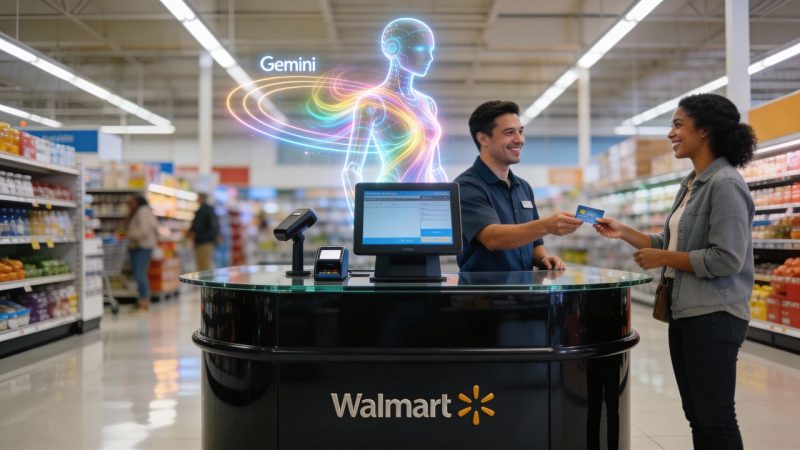
Incoming Walmart CEO John Furner and Google CEO Sundar Pichai announced the partnership from the stage at the National Retail Federation’s Big Show in New York City. The message was clear: the future of shopping might not involve visiting a store, downloading an app, or even opening a browser. It might just be a conversation.
How It Actually Works
When the integration goes live, asking Gemini about camping gear for spring won’t just get you advice. The AI will return actual products from Walmart’s inventory with prices and availability. If you decide to buy, the transaction happens right there in the chat, completed within Walmart’s checkout environment.
Customers who link their Walmart and Google accounts get personalization based on their purchase history. Want something that goes well with the tent you bought last summer? Gemini will know. The items get combined with whatever’s already in your Walmart or Sam’s Club online shopping cart, and all the benefits of Walmart+ and Sam’s Club memberships apply.
Walmart is one of the first major retailers to use Google’s new Universal Commerce Protocol, an open standard for what the industry is calling “agentic commerce.” The idea is that AI agents should be able to handle the entire shopping journey from discovery to decision to purchase, without humans needing to navigate multiple interfaces.
The AI Shopping Race Is On
This isn’t Walmart’s first foray into AI-powered shopping. The retailer announced a similar deal with OpenAI’s ChatGPT back in October, allowing shoppers to make purchases through an “Instant Checkout” feature. ChatGPT already has that feature live with Walmart and other retailers including Etsy, Skims, Vuori, and Spanx through Shopify merchants.
Google, OpenAI, and Amazon are all racing to create the platform where AI-powered shopping actually happens. The stakes are enormous. Whoever wins this race doesn’t just get transaction fees. They get to be the interface between consumers and commerce, the layer that sits between a person’s intent to buy and the actual purchase.
Google also announced it’s partnering with Shopify, Wayfair, and other major retailers on similar capabilities. The company is turning Gemini from just an assistant into a full-fledged merchant, capable of showing products, comparing options, and closing sales.
What This Means for Retail
“The transition from traditional web or app search to agent-led commerce represents the next great evolution in retail,” Furner said in a news release. “We aren’t just watching the shift, we are driving it.”
That’s not hyperbole. If shopping increasingly happens through AI conversations, the entire architecture of e-commerce changes. SEO matters less. Website design matters less. Product photography and detailed descriptions might matter more, since AI models need rich data to make good recommendations. The retail landscape continues to shift as companies adapt to changing market dynamics and technological disruption.
Walmart’s ecommerce chief David Guggina put it this way: “Agentic AI helps us meet customers earlier in their shopping journey and in more places. Over time, these agents will make it easier for customers to find what they need, want and love.”
The Delivery Play
The announcement came with another piece of news: Walmart is expanding its drone delivery partnership with Wing, an Alphabet subsidiary. The retailer will add 150 more stores to its drone delivery program, bringing the total to 270 locations by 2027, stretching from Los Angeles to Miami.
Connect the dots. You tell Gemini you need ingredients for dinner. The AI recommends a recipe, pulls products from Walmart’s local inventory, places the order, and a drone delivers it to your backyard within 30 minutes. That’s the vision, anyway. Whether it works at scale remains to be seen.
Walmart says it can already deliver hundreds of thousands of locally curated products in under three hours, with some items arriving in as fast as 30 minutes. Adding AI-powered discovery to the front end just shortens the time between “I want it” and “I have it,” as Furner put it.
The Workforce Question
Walmart is the largest private employer in the United States. When its leadership talks about AI transforming retail, people listen carefully for signals about jobs. CEO Doug McMillon, who is retiring with Furner taking over in February, has been blunt about the impact: “It’s very clear that AI is going to change literally every job.”
That’s not necessarily a prediction of mass layoffs. Walmart has invested heavily in training employees to work alongside AI tools. The company has its own customer-facing chatbot called Sparky, a yellow smiley-faced assistant on its app. For warehouse and logistics workers, AI optimization means different tasks, not necessarily fewer workers.
But the subtext is clear. If AI can handle discovery, recommendation, checkout, and delivery coordination, the humans in the system need to be doing things AI can’t do. What those things are, exactly, remains an open question.
Privacy and Data Considerations
Linking your Walmart and Google accounts to get personalized AI shopping recommendations means both companies have access to your purchase history, shopping habits, and preferences. For customers already using both services, that’s probably not a major new concern. But the integration does create a more complete picture of consumer behavior than either company had alone, according to Axios.
Google’s approach to advertising within Gemini is also evolving. The company says it goes beyond traditional search ads by using conversational context to determine when an offer is most relevant. Translation: the AI might recommend a product not because you searched for it, but because the conversation suggested you might want it.
The Bottom Line
Retail has been through this before. The shift from catalogs to department stores. From stores to malls. From malls to e-commerce. From websites to mobile apps. Each transition created winners and losers, and each seemed inevitable only in retrospect.
AI-powered shopping feels like the next transition. The question isn’t whether it will happen, but who will own the relationship with the customer. Google wants to be the conversational interface. Walmart wants to be the fulfillment engine. If they can make it work together, the future of shopping might look very different from browsing the aisles at your local Supercenter.
The experience launches first in the U.S., with international expansion to follow. Forty thousand retail executives at NRF this week are watching closely. So should everyone else.