
Jeff Bezos just answered the question of what a newspaper worth $261 billion to its owner is actually worth to him: not enough to keep it whole.
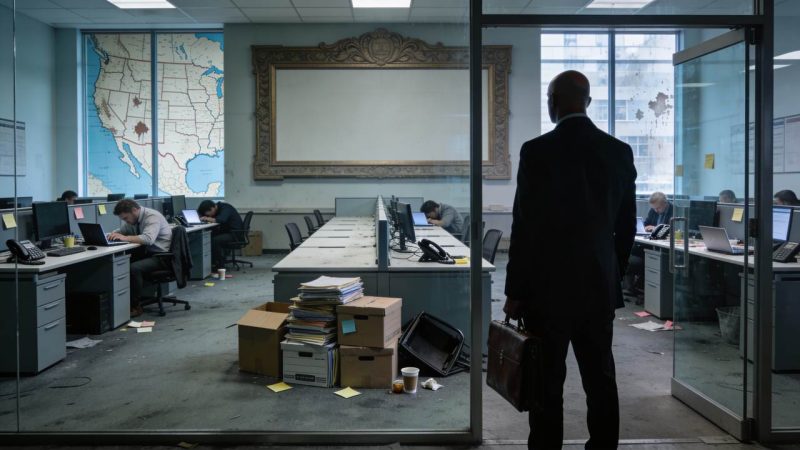
The Washington Post laid off one-third of its entire workforce Wednesday morning in a sweeping purge that eliminates the sports section entirely, shutters books coverage, guts the Metro desk, cancels the flagship “Post Reports” podcast, and dramatically reduces international bureaus. More than 300 journalists and staff received emails telling them their jobs no longer exist. The world’s richest man, who bought the paper for $250 million in 2013 promising to preserve its journalistic tradition, has instead presided over its systematic dismantling.
Bezos himself remained silent throughout the bloodletting. He did not address staff. He did not issue a statement. He simply let his executives do the dirty work while he continues courting the Trump administration. Just two days before the layoffs, Bezos was at his Blue Origin rocket facility in Cape Canaveral, giving Defense Secretary Pete Hegseth a guided tour and a thumbs-up for the cameras.
A “Strategic Reset” That Looks More Like Surrender
Executive Editor Matt Murray delivered the news in a companywide Zoom call, calling it “a strategic reset” necessary to compete in the era of artificial intelligence. Staffers were told to stay home and wait for one of two emails: one telling them they still had a job, another telling them they did not. “Today’s news is painful,” Murray wrote in an internal memo. “These are difficult actions.”
The scale of the cuts is staggering. The Metro desk, which once employed more than 40 journalists covering the Washington region that gives the paper its name, will be reduced to roughly a dozen. The entire Middle East bureau was eliminated, with correspondents announcing their terminations on social media. The paper’s New Delhi bureau chief learned via email that his role was gone. International coverage, once a hallmark that distinguished the Post from competitors, will be reduced to what Murray described as a “strategic overseas presence.”
Perhaps the most symbolically loaded casualty: Caroline O’Donovan, the reporter who covered Amazon. “Nearly every story I published at The Post included the disclaimer ‘Amazon founder Jeff Bezos owns The Washington Post,'” she wrote on X after learning she had been laid off. “That statement seems especially stark today.”
The Endorsement That Broke the Post
The layoffs represent the culmination of a crisis that began in late October 2024, when Bezos personally killed an editorial board endorsement of Vice President Kamala Harris less than two weeks before Election Day. The endorsement had already been drafted. Bezos overruled it.
The reaction was immediate and devastating. More than 250,000 subscribers canceled within days, representing roughly 10% of the paper’s paid readership. Columnists resigned. Editorial board members stepped down. Former executive editor Marty Baron, who had led the Post through its Trump-era renaissance, called the decision “cowardly.”
Bezos defended his choice in a rare op-ed, claiming presidential endorsements “do nothing to tip the scales of an election” and “create a perception of bias.” Few inside the paper bought the explanation. The timing, with Blue Origin executives meeting with Trump representatives the same day the endorsement was killed, suggested a different calculation entirely.
The subscriber exodus accelerated an already dire financial picture. The Post had lost $177 million over two years, according to figures CEO Will Lewis shared with staff in June 2024. Organic search traffic has fallen by nearly half in three years as Google increasingly serves AI-generated summaries instead of sending readers to news sites. Revenue from the journalism that remains still depends on copyrighted content that tech platforms use without adequate compensation.
Baron’s Blistering Indictment
Marty Baron, who steered the Post from 2012 to 2021 and oversaw its growth from roughly 600 journalists to more than 1,000, issued his harshest criticism yet of the man who once called him “brother.”
“This ranks among the darkest days in the history of one of the world’s greatest news organizations,” Baron wrote. “The Washington Post’s ambitions will be sharply diminished, its talented and brave staff will be further depleted, and the public will be denied the ground-level, fact-based reporting in our communities and around the world that is needed more than ever.”
Baron attributed the paper’s decline to “ill-conceived decisions” by Bezos, citing the endorsement fiasco as a self-inflicted wound that drove away “hundreds of thousands” of loyal subscribers. He recalled how Bezos once “spoke forcefully and eloquently of a free press and The Post’s mission, demonstrating his commitment in concrete terms. He often declared that The Post’s success would be among the proudest achievements of his life.”
“I wish I detected the same spirit today,” Baron added. “There is no sign of it.”
Becoming a Niche Publication
Murray’s memo outlined a refocused Post that will emphasize national politics, national security, business, health, and what he called “journalism that empowers people to take action, from advice to wellness.” The paper that once competed directly with The New York Times for global journalistic supremacy now appears to be positioning itself more like Politico or Punchbowl: a specialty publication for Washington insiders.
“We can’t be everything to everyone,” Murray told staff. Several former editors who spoke to NPR suggested the strategy reflects a diminished vision for an institution that once helped bring down a president.
The White House reporting team, recognizing what was coming, had written directly to Bezos in recent weeks. Bureau chief Matt Viser and seven other reporters warned that their most impactful coverage depends on collaboration with Metro, foreign correspondents, sports, and other desks now being gutted. “If other sections are diminished, we all are,” they wrote.
Their plea went unheeded.
The Billionaire’s Pivot
Bezos’s behavior toward the Post has shifted dramatically since Trump’s return to power. Last year, he overhauled the opinion section to promote “libertarian ideals, including free markets and personal liberties,” prompting opinion editor David Shipley to exit. Amazon, still Bezos’s primary source of wealth, spent more than $70 million to acquire and market a documentary about Melania Trump, far exceeding typical industry spending and drawing accusations that Bezos was attempting to curry favor with the White House.
The contrast with his first-term posture is stark. When Trump repeatedly attacked the “Amazon Washington Post” during his initial presidency, Bezos pushed back. He spoke about the importance of a free press. He invested heavily, expanding the newsroom by roughly 85% at its peak.
Now, Trump praises Bezos. “He’s doing a real job” at the Post, the president said last March. The paper that once operated under the banner “Democracy Dies in Darkness” appears to be dimming its own lights.
The Industry’s Darkest Day
National Press Club president Mark Schoeff Jr. called the layoffs “a devastating setback for the scores of individual journalists affected and for the journalism profession.”
“When newsrooms shrink, accountability shrinks with them,” Schoeff said, “and the public is left with fewer facts and fewer answers.”
The Washington Post Guild, which represents newsroom staff, is planning a rally for Thursday outside the paper’s headquarters. In a statement, the union said the quiet part out loud: “If Jeff Bezos is no longer willing to invest in the mission that has defined this paper for generations and serve the millions who depend on Post journalism, then The Post deserves a steward that will.”
Bezos has a personal fortune estimated at $261 billion. The Post’s annual losses represent less than 0.1% of that wealth. The question the layoffs answer isn’t whether Bezos can afford to sustain the paper. It’s whether he wants to.
On Wednesday, we got our answer.
Sally Quinn, the longtime contributor and widow of legendary Post editor Ben Bradlee, captured the sentiment on CNN. “It just seems heartbreaking that he doesn’t feel the paper is important enough to bankroll,” she said. The paper her late husband helped build into a national institution, the paper that exposed Watergate, the paper that once stood as proof that serious journalism could survive and thrive, is being hollowed out by a man who could fund it indefinitely without noticing the expense.
Democracy isn’t dying in darkness. It’s being switched off in broad daylight, one layoff notice at a time.