
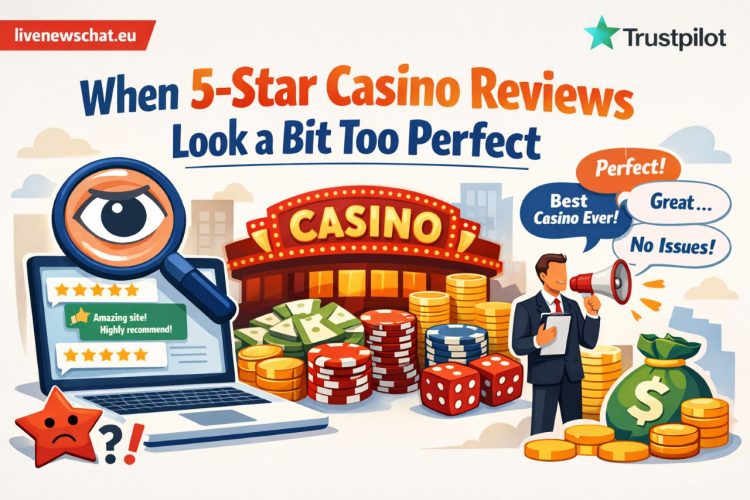
A wall of glowing five-star reviews should make you more confident about an online casino. Often, it does the opposite. Experienced players have learned that a perfectly polished Trustpilot profile, scores of enthusiastic reviews, zero complaints, and responses that sound like a PR agency drafted them are themselves warning signs. Real businesses accumulate real friction. The absence of it is suspicious.
Trustpilot’s review system allows anyone to submit a review organically, but companies can also send invitation-based review requests to customers after a transaction. This distinction matters enormously. A casino that actively solicits reviews immediately after a successful deposit will naturally harvest positive feedback — players who just topped up their account and haven’t yet tried to withdraw are at their most positive point. The reviews are technically genuine but structurally biased toward a moment in the customer journey that tells you almost nothing about how disputes are handled or how long withdrawals actually take.
Understanding this dynamic changes how you read any casino’s Trustpilot profile.
Why “Perfect” Trustpilot Review Profiles Can Be Misleading
One pattern worth paying attention to is when a casino accumulates dozens of reviews in a short window and every single one scores five stars — this is worth interrogating. The speed on its own can sometimes raise questions, but what those reviews contain is even more telling.
When they repeat the same phrases, like “great experience,” “fast deposits,” “highly recommend,” without any specific context, the profile becomes less informative than it appears. Real users typically reference concrete details: a particular pokie they played, how long a withdrawal took, whether ID verification was requested, and how smoothly it went. A review that contains no specific detail, such as no game mentioned, no withdrawal described, no friction of any kind, could have been written by someone who signed up, clicked around for five minutes, and left. That tells you nothing about what the experience actually looks like once real money is involved.
Rating distribution is the other thing to look at. On Trustpilot, a TrustScore is calculated as a weighted average of all reviews, but the spread matters as much as the final number. A profile sitting at 94% five-star reviews, with almost nothing below four, doesn’t reflect the depth of experience — it reflects a narrow slice of the customer journey, usually the part before anything went wrong.
One more thing worth checking is whether the accounts leaving reviews have any history beyond that single post. Trustpilot’s systems can flag patterns linked to manipulation, but not always quickly enough to stop those reviews from shaping a site’s visible score.
How to Read the Review Content, Not Just the Score
The text itself often tells you more than the star rating. Use this checklist when working through a casino’s Trustpilot profile:
- Do reviews mention specific details? Real players who’ve successfully withdrawn money tend to name the method used, how long it took, and whether verification was required. Generic praise about bonuses, with no mention of friction, reads like marketing copy.
- Do positive reviews describe the full customer journey? A review written right after a deposit tells you nothing about withdrawal. Look for accounts that cover both sides of the transaction.
- How does the casino respond to one-star reviews? Defensive boilerplate, blame shifted to payment processors without resolution steps, or a generic “please contact support” reply without acknowledging the specific complaint — these are operational red flags, not just tone problems.
- Are negative reviews acknowledged or buried? The willingness to engage honestly with criticism is harder to fake than a flood of enthusiasm. A business that only responds to positive reviews is telling you something.
- Does the response match the complaint? A personalised reply that addresses what the player actually described suggests a real support process exists. A copy-pasted response that could apply to any complaint suggests it probably doesn’t.
Sites like livenewschat.eu, which cover consumer trust and digital platforms across industries, have noted that the gap between a brand’s public image and its private customer experience shows up most clearly in how complaints are handled, not in how five-star moments are celebrated.
What a More Realistic Trustpilot Profile Actually Looks Like
A casino profile worth trusting rarely looks spotless. What you actually want to see is a mix of positive reviews from players who had a good run, alongside a handful of more critical ones flagging slower withdrawals, verification requests that caught them off guard, or a support exchange that needed a second attempt. A smaller but present tail of one- and two-star complaints confirms that real people with real issues actually used the service.
This becomes especially clear with casinos that draw players who care about transaction speed. Take PayID Pokies — a profile covering Australian casinos that support PayID, a bank-linked payment method known for fast deposits. Players who use these casinos come in with a clear expectation: money in quickly, money out the same way. When that holds up, they say so. When it doesn’t, they say that too. Either way, you end up with feedback that covers the full experience rather than just the early stage of signing up and making a first deposit.
Reading Trustpilot the Way Experienced Players Do
A Trustpilot score somewhere between 3.8 and 4.6 is often more credible than a 4.9. It means enough players went through the full cycle of deposit, play, withdraw, and occasionally ran into a problem, to produce something that reflects actual experience. Detailed reviews, a visible spread of ratings, and complaints that got a real response are often signs that the profile reflects real user experience rather than being tightly curated to appear flawless.
Invitation-based reviews are not inherently dishonest. Casinos may ask satisfied players to leave feedback, and plenty do. The problem is when that’s the only feedback that ever shows up, and nothing about the deeper experience makes it through.
So, before you hand over your details and make your first deposit, spend a few minutes reading the one- and two-star reviews. Not to talk yourself out of signing up, but to see how the casino behaved when a player had a bad experience. Did they respond to the actual complaint, or did they paste a generic reply? Did they offer a path to resolution, or just say “contact support”? That tells you something concrete about what you’re dealing with. A casino that handles problems honestly in public is a reasonable bet to handle yours the same way.