
On January 2, Trump posted that if Iran “shoots and violently kills peaceful protesters,” the United States would “come to their rescue” and is “locked and loaded and ready to go.” That is a public pledge to consider force against Iran’s government if it massacres its own citizens.
Is this just bluster? Probably, but it’s careless and another clown move by the Orange Man.
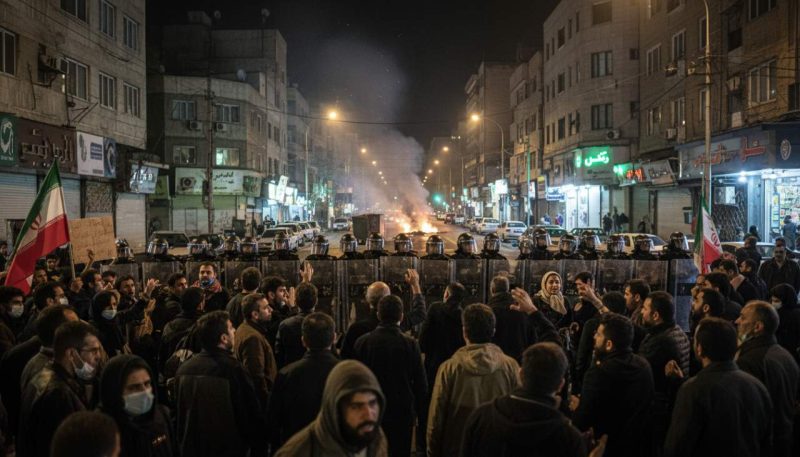
Inside Iran, protests over economic collapse and political repression have spread across major cities. At least several people have been killed. The images are familiar: burning cars, clouds of tear gas, young Iranians sprinting down avenues that have seen wave after wave of unrest since 2009.
Trump’s statement dropped into that crisis like a match into an oil slick. Tehran’s response made clear that its leaders read it as a military threat, and they answered with military threats of their own.
Iran Puts US Bases “On The Table”
Iranian officials did not bother with coded language. They went straight to talking about targets.
Ali Larijani, secretary of the Supreme National Security Council, warned that any American intervention in what he called a “domestic matter” would bring “destabilisation of the whole region and the destruction of American interests.” He told Americans to think about “their own soldiers,” a sentence that only makes sense if you are hinting at missiles aimed at US bases.
Ali Shamkhani, a senior adviser to Supreme Leader Ayatollah Ali Khamenei, said that Iran’s national security is a “red line” and that any hand of intervention “will be cut off before it can act.” In the region’s political dialect, that phrase is not about diplomacy. It is a promise of preemptive force.
Parliament speaker Mohammad Bagher Qalibaf went even further. He said Trump’s threat made every American base and every US force across the region a “legitimate target” in the event of what he called American “adventurism.” This is not about tariffs. It is about the legal and political groundwork to fire on US soldiers if Trump’s words ever turn into orders.
Iran’s foreign ministry and defense establishment then echoed the same line. Officials boasted that the armed forces are on standby and “know exactly where to aim” if Iran’s sovereignty is violated. The message is simple. If the United States hits Iran, Iran will hit Americans wherever it can reach them.
Protesters Caught Between Regime Guns And Great Power Threats
The people who have the least power in this drama are the ones who started it: ordinary Iranians furious about inflation, corruption, and the sheer exhaustion of life under a security state.
They are the ones facing live ammunition and mass arrests. They are the ones who will suffer if Tehran uses Trump’s rhetoric as proof that every protester is part of an American plot. That is exactly how the regime has framed past uprisings.
Trump’s “locked and loaded” language hands Iran’s rulers a propaganda gift. They can claim the unrest is not about bread prices or forced veiling but about Washington trying to stage a “color revolution.” That gives cover for a harder and bloodier crackdown.
There is another risk. If Trump or any future US administration felt pressured to make good on a promise to “come to their rescue,” it would be doing it in some of the most crowded cities in the Middle East, against a state with ballistic missiles, drones, and proxies across the region. Civilians would be in the blast radius of every decision.
The Authoritarian Echo Chamber
Look closely and you can see how Trump and Iran’s hard‑liners use each other.
Trump gets to posture as the singular strongman willing to threaten force in defense of “freedom loving protesters,” even as he undermines democratic norms back home and treats Congress as an afterthought when talking about war.
Iran’s leadership gets to point to Trump’s statement and say to its own people, “See, this is not about your wages or your rights. This is a foreign plot.” That justifies more surveillance, more arrests, more bullets.
Both sides talk about red lines and toughness. Neither has to talk seriously about what actual people in the streets are asking for.
What A Pro‑Democracy Response Would Look Like
A response rooted in democratic values and the rule of law would sound very different from “locked and loaded.” It would start from three basic principles.
First, center Iranian agency. The core question should be what protesters themselves are demanding, not what makes an American politician look toughest on television. That means listening to activists who are asking for internet access, targeted sanctions on human rights abusers, and safe asylum options. It does not mean threatening to bomb Tehran in their name.
Second, reduce the regime’s capacity for repression without strangling civilians. That means precise sanctions on security officials, judges, and units involved in shootings and torture. It also means avoiding broad measures that deepen poverty and give the regime another excuse to blame “economic war” for its own failures.
Third, restrain presidential power over war. Congress should make it unmistakable that no president, present or past, can launch strikes on Iran without debate and authorization. If the country is going to slide toward another Middle East war, it should not happen because of a single social media post.
None of this is as dramatic as promising to be “ready to go.” It is also far less likely to get US soldiers killed or Iranian neighborhoods turned into battlefields.
A Test For Democracies Everywhere
Iran’s leadership has made clear that if Washington crosses its declared lines, it is prepared to treat US forces “across the region” as open targets. Trump has signaled that he is willing to talk about intervening militarily over human rights abuses. Those are stark, military positions, not symbolic jabs.
The question now is not whether this is a trade spat. It is whether democratic systems in the United States and Europe can prevent a spiral in which one man’s impulse and one regime’s paranoia turn a domestic uprising into a regional war.
The people on Iran’s streets are asking for something basic and radical. They want a government that cannot beat and shoot them without consequence. The least the outside world can do is avoid turning their demand for dignity into the spark for the next conflict.