
The most powerful drug lord still walking free in Mexico is dead. And the country is paying for it in real time. Mexican military forces killed Nemesio Rubén Oseguera Cervantes, the notorious cartel boss known as “El Mencho,” during a fierce operation in the western state of Jalisco on Sunday.
The 59-year-old leader of the Jalisco New Generation Cartel, or CJNG, was wounded during a raid in the town of Tapalpa and died while being airlifted to Mexico City. It was the biggest blow to organized crime in Mexico in over a decade, and the immediate aftermath proved exactly why these operations terrify everyone involved.
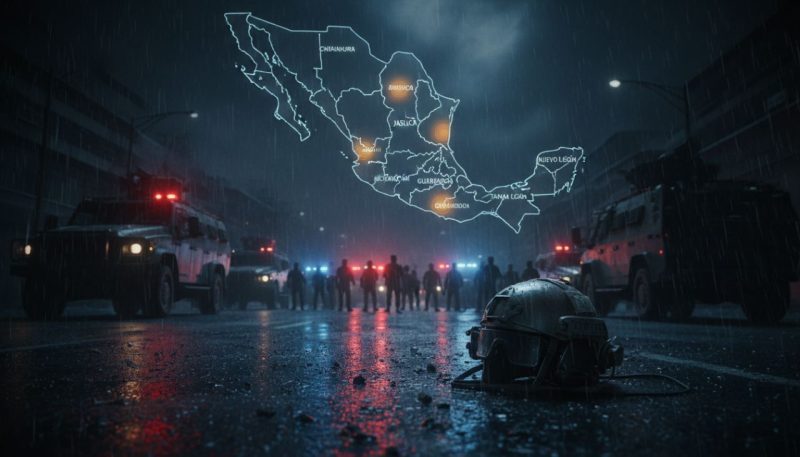
Within hours, suspected cartel gunmen torched buses, blocked highways with burning vehicles, and unleashed a coordinated wave of chaos across at least eight Mexican states: Jalisco, Guanajuato, Nayarit, Michoacán, Colima, Guerrero, Tamaulipas, and Zacatecas. Smoke billowed over the tourist resort of Puerto Vallarta. Panicked travelers sprinted through the Guadalajara airport. Jalisco’s governor activated a “code red” emergency protocol and told everyone to stay home.
Who Was El Mencho?
Born into poverty in Michoacán, Oseguera grew avocados, dropped out of elementary school, and emigrated illegally to the United States in the 1980s. After multiple arrests and a deportation in the early 1990s, he reinvented himself as a Jalisco state police officer before crossing over into organized crime. He worked his way up through the now-defunct Milenio Cartel before co-founding the CJNG around 2009.
What followed was one of the most ruthless ascents in cartel history. Under El Mencho’s leadership, the CJNG grew from a regional splinter group into what the FBI considered Mexico’s most powerful trafficking organization, responsible for shipping massive quantities of cocaine, methamphetamine, heroin, and fentanyl into the United States. Their estimated assets topped $20 billion.
El Mencho wasn’t just a drug trafficker. He built a paramilitary machine. The CJNG pioneered the use of explosive-laden drones, deployed rocket-propelled grenades against rivals and the military, and in 2020 orchestrated a brazen assassination attempt on Mexico City’s police chief using grenades and high-powered rifles in broad daylight. The U.S. had a $15 million bounty on his head, making him one of the most wanted fugitives on the planet.
How The Operation Went Down
Mexico’s Defense Ministry said special forces from the army and national guard launched the operation in Tapalpa, a town roughly 130 kilometers southwest of Guadalajara, with support from the air force and military intelligence. The troops came under attack during the raid. Four cartel members were killed at the scene. Three more, including El Mencho, died during the airlift to Mexico City. Two suspects were arrested, and authorities seized armored vehicles, rocket launchers, and an arsenal of weapons. Three soldiers were wounded.
Critically, the Defense Ministry confirmed that U.S. authorities provided “complementary information” that supported the operation. A U.S. defense official told multiple outlets that a new Joint Interagency Task Force focused on counter-cartel operations, which was quietly launched late last year, played a direct role. The task force operates through U.S. Northern Command and involves multiple American government agencies working alongside Mexican military forces.
Chaos Erupts Immediately
The cartel’s response was swift and predictable, because this is exactly what happens every time a kingpin goes down in Mexico. Burning vehicle roadblocks, a signature CJNG intimidation tactic, appeared across highways in at least eight states within hours. In Guadalajara, gunfire erupted and armed men reportedly set a gas station ablaze. Videos showed thick columns of smoke rising over Puerto Vallarta’s beachfront skyline.
Airlines moved fast. Delta, American Airlines, Alaska Airlines, Southwest, and Air Canada all suspended or canceled flights to Puerto Vallarta and Guadalajara. The U.S. Embassy issued shelter-in-place advisories for Americans in Jalisco, Tamaulipas, Michoacán, Guerrero, and Nuevo León. Public transportation across the entire state of Jalisco was suspended.
Mexican President Claudia Sheinbaum urged calm, noting that activities were proceeding normally in most of the country. But the optics were devastating: a nation that is supposed to host the FIFA World Cup in just four months looked like a war zone in its western corridor.
The World Cup Problem
The timing could not be worse. Guadalajara is one of the host cities for the 2026 FIFA World Cup, with matches scheduled to begin in June. The images of panicked civilians, burning vehicles, and military operations in the city’s metropolitan area will raise serious questions about Mexico’s readiness to safely host hundreds of thousands of international visitors.
Jalisco’s governor has been working to project an image of stability ahead of the tournament. Sunday shattered that narrative in spectacular fashion, even if the government manages to restore order quickly.
U.S.-Mexico Relations And The Trump Factor
El Mencho’s killing arrives against a backdrop of intense pressure from the Trump administration, which has threatened direct military strikes against Mexican cartels if the country doesn’t step up enforcement. Last February, Trump signed an executive order designating CJNG and seven other cartels as foreign terrorist organizations. The designation opened the door for more aggressive U.S. involvement, and the intelligence-sharing that helped enable Sunday’s raid is a direct product of that framework.
U.S. Deputy Secretary of State Christopher Landau wasted no time celebrating, calling El Mencho “one of the bloodiest and most ruthless drug kingpins” and declaring the operation a “great development for Mexico, the US, Latin America, and the world.”
But the celebration may be premature. This is exactly the pattern that security experts have warned about for years.
What Happens Next Could Be Far Worse
Here’s the uncomfortable truth about “kingpin strategy” that neither government wants to talk about right now: decapitating a cartel doesn’t end the cartel. It fractures it. And fracturing is often far bloodier than the original organization.
El Mencho’s family has been systematically dismantled. His brother Antonio “El Tony Montana” Oseguera was extradited to the U.S. in February 2025. His son, known as “El Menchito,” is in prison. His daughter is in custody. His son-in-law was arrested in California after faking his own death. There is no obvious successor waiting in the wings.
That means regional CJNG bosses across Mexico will almost certainly begin fighting each other for control, exactly as happened when El Chapo was captured and the Sinaloa Cartel eventually splintered into a civil war between rival factions. Vanda Felbab-Brown, an expert on international organized crime, was blunt in her assessment: “A tremendous amount of violence is going to happen.”
President Sheinbaum, ironically, has been a vocal critic of this exact approach. She has publicly questioned the “kingpin strategy” of previous administrations, arguing that taking out cartel leaders creates power vacuums that trigger explosions of violence. And yet, under immense pressure from Washington, her government just delivered precisely the kind of high-profile takedown that follows that playbook.
For Mexico, the next weeks and months will reveal whether El Mencho’s death brings any lasting reduction in drug trafficking, or whether it simply reshuffles the violence into something even more chaotic and unpredictable. History, unfortunately, suggests the latter.
The Bottom Line
El Mencho’s death is unquestionably a significant moment. The man who carried a $15 million U.S. bounty, who eluded capture for over a decade while building one of the most violent criminal empires in the Western Hemisphere, is gone. The joint U.S.-Mexico operation that brought him down represents a level of bilateral cooperation that would have been difficult to imagine even a year ago.
But the fires burning across eight Mexican states tonight are a reminder that in Mexico’s drug war, killing the king doesn’t end the game. It just starts a new, bloodier round. With the World Cup looming, a fractured cartel splintering, and an American president itching for more aggressive action, Mexico is entering one of the most dangerous chapters in its long and costly fight against organized crime.