
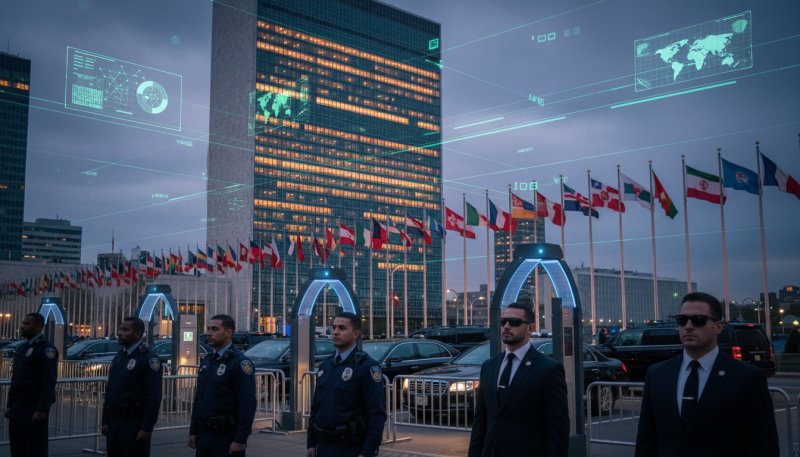
First Lady Melania Trump made history on Monday by becoming the first spouse of a world leader to preside over the United Nations Security Council. She did so while her husband’s military was actively
bombing Iran, while the administration’s explanation for why this war started was crumbling in real time, and while the charred remains of an Iranian girls’ school were being pulled from rubble in Minab.
The optics were, to put it gently, surreal. The meeting’s topic? “Children, Technology, and Education in Conflict.” The backdrop? An expanding war that has already killed six American service members, an estimated 800 Iranians according to the Iranian Red Crescent Society, and 165 schoolgirls at an elementary school that was struck on the very first day of the bombing campaign.
A First Lady With the Gavel, a War Without a Story
The United States holds the rotating Security Council presidency for March 2026, and the White House chose to hand the gavel to Melania Trump rather than the U.S. Ambassador or a senior official. It was, the White House said, an opportunity to spotlight education’s role in “advancing tolerance and world peace.”
In her remarks, the First Lady offered condolences to the families of fallen service members, said “the U.S. stands with all of the children throughout the world,” and urged Council members to “pledge to safeguard learning.” She championed AI as a tool for democratizing knowledge and connecting children to other cultures. She did not mention Iran by name. She did not mention the school in Minab.
UN Under-Secretary-General Rosemary DiCarlo was less circumspect. She acknowledged the reality the meeting was trying to paper over: schools across Israel, the UAE, Qatar, Bahrain, and Oman had closed and shifted to remote learning because of the ongoing military operations. She also referenced the reports from Minab, noting that U.S. authorities had said they were “looking into” them.
The Security Council’s previous session, held just two days earlier, had been a contentious emergency meeting where Secretary-General Antonio Guterres condemned the U.S. and Israeli strikes as violations of international law.
The Minab School Strike: 165 Dead, No One Claims Responsibility
Hanging over Monday’s proceedings was the strike on the Shajareh Tayyebeh girls’ elementary school in Minab, a city in Iran’s Hormozgan province near the strategically critical Strait of Hormuz. The attack took place on Saturday, February 28, just hours after the joint U.S.-Israeli bombing campaign began. Iranian authorities put the final death toll at 165 people, most of them girls between seven and 12 years old, with at least 95 wounded.
The school sits near an Islamic Revolutionary Guard Corps base that was also targeted that day. Both the U.S. and Israel have distanced themselves from responsibility. The Israeli military said it was not aware of strikes in that area. Secretary of State Marco Rubio told reporters that U.S. forces “would not deliberately target a school.” Defense Secretary Pete Hegseth said the military was “investigating.”
Iran held a mass funeral on Tuesday, with thousands filling a public square in Minab. Coffins draped with Iranian flags were carried on trucks. A woman who identified herself as the mother of a student named Atena held up photographs from the school and called them “a document of American crimes.” UNESCO condemned the strike as a grave violation of humanitarian law. Nobel laureate Malala Yousafzai and UN Secretary-General Guterres both issued condemnations.
So while Melania Trump sat in the president’s chair at the world’s most powerful security body, speaking about safeguarding children’s access to education, the world was watching footage of small coffins.
The Administration Cannot Get Its Story Straight
If the Security Council scene was surreal, the administration’s messaging on why this war is happening at all has been something closer to incoherent. In the span of roughly 72 hours, the justification for Operation Epic Fury shifted so many times that even Trump’s own allies could not keep up.
Here is the timeline of excuses, as best anyone can reconstruct it.
Before the strikes, Trump’s special envoy Steve Witkoff said Iran was enriching uranium at dangerously high levels. Rubio later contradicted that, saying Iran was “not enriching right now” but was pursuing its nuclear program through other means. U.S. intelligence, in the form of an unclassified Defense Intelligence Agency assessment, reportedly concluded that Iran striking the U.S. homeland with an ICBM was still a decade away.
Then came Trump himself, who told ABC News about the killing of Supreme Leader Ayatollah Ali Khamenei: “I got him before he got me. I got him first.” But Republican Rep. Mike Turner said he had spoken with Rubio, who told him the U.S. “did not target Khamenei, and we were not targeting the leadership in Iran.”
On Monday, Rubio offered what may have been the most politically damaging version of the rationale yet. He told reporters that the U.S. knew Israel was planning to strike Iran, that this would prompt Tehran to retaliate against American forces in the region, and that the U.S. therefore launched preemptive strikes to avoid higher casualties. In other words: Israel was going to act, and the U.S. tagged along.
By Tuesday, Rubio was in full cleanup mode, insisting his words had been taken out of context and declaring “this had to happen anyway.” Trump offered yet another version: “They were getting ready to attack Israel. They were gonna attack others.”
Hegseth’s Pentagon Performance
Defense Secretary Pete Hegseth, who had been largely absent from public view for months, surfaced Monday for a Pentagon briefing that managed to create more confusion than it resolved. He declared the operation had “clear, devastating, decisive” objectives, then proceeded to deliver remarks that were anything but clear.
“This is not Iraq. This is not endless,” Hegseth said. He insisted the mission was to destroy Iran’s missile capabilities, destroy its navy, and prevent nuclear weapons. “No stupid rules of engagement, no nation building quagmire, no democracy building exercise, no politically correct wars,” he said.
Then came the line that alarmed diplomats, Muslim advocacy groups, and a good portion of the internet: Hegseth referred to Iran as a “crazy regime, hell-bent on prophetic Islamic delusions.” The Council on American-Islamic Relations called the remark an apparent reference to Shia eschatological beliefs and said every American should be “deeply disturbed by the holy war rhetoric.” Reports subsequently emerged from the Military Religious Freedom Foundation that some U.S. commanders had been telling troops the war was intended to “induce the biblical end of times.”
On regime change, Hegseth attempted a rhetorical trick that satisfied no one: “This is not a so-called regime change war,” he said. “But the regime sure did change. And the world is better off for it today.” It was the kind of statement that sounds like a talking point written by someone who thinks contradictions are clever rather than damning.
The MAGA Coalition Is Cracking
Perhaps the most consequential fallout from the messaging disaster is the visible fracture within Trump’s own political base. This is not coming from the usual Democratic critics. It is coming from inside the house.
Tucker Carlson, who reportedly tried to talk Trump out of attacking Iran, told ABC News the decision was “absolutely disgusting and evil.” On his podcast, he said bluntly that this is “Israel’s war” and is “not being waged on behalf of American national security objectives.”
Former Rep. Marjorie Taylor Greene, who broke with Trump over the Epstein files earlier this year, was incendiary. She called the administration “a bunch of sick f—ing liars” and declared that “‘Make America Great Again’ was supposed to be America first, not Israel first.” On Megyn Kelly’s show, Greene raised questions about who is actually making these decisions and said her generation “has been let down, abused, and used by our government.”
Daily Wire host Matt Walsh summed up the confusion with precision: “So far we’ve heard that although we killed the whole Iranian regime, this was not a regime change war. And although we obliterated their nuclear program, we had to do this because of their nuclear program. And although Iran was not planning any attacks on the U.S., they also might have been, depending on who you ask.” The critique stung enough that White House press secretary Karoline Leavitt issued a direct public rebuttal.
Rep. Thomas Massie connected Rubio’s admission to the “America First” promise: “The administration admits [Israel] dragged us into the [Iran] war that’s already cost too many American lives and billions of dollars. Before it’s over, the price of gas, groceries, and virtually everything else is going to go up. The only winners in [the U.S.] are defense company shareholders.”
Trump’s response? “I think that MAGA is Trump. MAGA’s not the other two,” he told journalist Rachael Bade, referring to Carlson and Kelly.
Congress Demands Answers, Fears Escalation
Bipartisan war powers resolutions are expected to reach the floor this week, though they face steep odds given Republican majorities in both chambers. The classified briefings Rubio and Hegseth delivered to Congress on Tuesday did not calm nerves.
Sen. Angus King of Maine said he was “disturbed” by Rubio’s earlier comments. “The implication is that we’re delegating the decision of whether this country goes to war to another country,” he said. Sen. Richard Blumenthal of Connecticut emerged from the briefing even more alarmed, saying he was “more fearful than ever” that the U.S. may soon put ground troops in Iran. Even Sen. Josh Hawley, a Republican, noted that sending troops would require congressional authorization and hinted that support may not be automatic.
Rubio, for his part, projected confidence about what lies ahead: “You’re gonna really begin to perceive a change in the scope and in the intensity of these attacks as frankly, the two most powerful air forces in the world take apart this terroristic regime.”
The Contradictions Keep Piling Up
What makes this moment so dangerous is not just the war itself, but the speed at which the administration’s own narrative is collapsing. The George W. Bush administration’s “weapons of mass destruction” claims took years to fully unravel. The Trump administration’s justifications for attacking Iran are falling apart in hours.
There is no coherent answer to the most basic question in any war: why are we fighting? Is it about nuclear weapons? Iran wasn’t enriching. Is it about ICBMs? Intelligence says that threat is a decade away. Is it about preempting an attack on U.S. forces? The administration acknowledged in private briefings that no such attack was imminent. Is it about Israel? Rubio essentially said yes before spending the next 24 hours saying he didn’t.
And through it all, a First Lady sat at the United Nations talking about children and peace while her husband’s military was dropping bombs on a country where, just days earlier, 165 schoolgirls were buried alive in their classroom.
The administration wants the world to see strength and clarity. What the world is actually seeing is chaos, contradiction, and a growing stack of coffins that nobody wants to claim.