
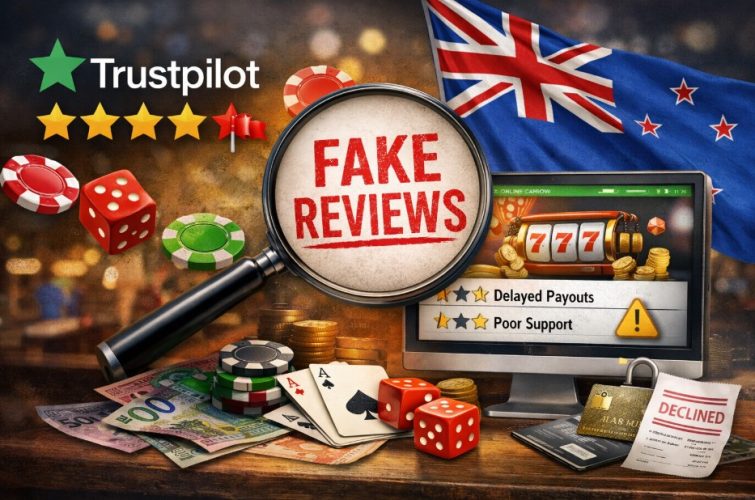
Trustpilot can be useful, but for New Zealand players, it should be treated as a starting point, not a verdict. That matters because the local legal context is unusually messy: the Department of Internal Affairs recognises that Kiwis can access offshore gambling websites, even though those operators are not licensed or regulated in New Zealand and do not provide the same consumer protections. For LiveNewsChat readers, that means a review page is only valuable if it helps separate actual player experience from review-page marketing.
That caution is not paranoia. Trustpilot’s own 2025 Trust Report says it removed 4.5 million fake reviews in 2024, representing 7.4% of all reviews posted that year, and that 90% of detected fake reviews were removed automatically. It also says the vast majority of fake reviews taken down were positive, which is exactly why players should be suspicious of profiles that look spotless at first glance. A wall of praise is not proof of safety; sometimes it is the first thing that deserves scrutiny.
When a Five-Star Page Tells You Almost Nothing
A New Zealand player is rarely judging a locally licensed product with clearly familiar protections. They are usually reading reviews about offshore operators in a market where advertising those offshore gambling services is prohibited under section 16 of the Gambling Act 2003, even while people in New Zealand can still access such websites. That gap between availability and regulatory protection makes review quality far more important. The real question is not just, “Is this rated highly?” but “What are reviewers actually describing — and what are they leaving out?”
The Reviews That Look Reassuring First — and Fall Apart on Closer Reading
The problem with weak review pages is not always that they look suspicious. Quite often, they look polished, upbeat, and even convincing at first glance. That is exactly why NZ players need clearer warning signs: the most misleading pages are often the ones that appear most reassuring until you read them properly.
- Generic praise with no operational detail. If dozens of reviews say a site is “great” or “fast” but say nothing about verification, payout timing, payment methods, limits, or dispute handling, the page is not giving you information you can actually use to judge a site by. Trustpilot’s own rules say reviews should be based on genuine experiences and not be incentivised, while fake reviews are prohibited and removed.
- A high score is treated as the whole story. Trustpilot explains that its TrustScore is not a simple average; it weighs recency, frequency, and a Bayesian model. In practice, that means players should read the review mix and timeline, not just the number beside the stars.
- No evidence that complaints are being addressed. A credible profile does not need to look perfect, but it should show that negative feedback is visible and answered. Silence around complaints is often more revealing than the complaints themselves. Trustpilot also highlights that reviews can be flagged and checked regardless of whether a business uses paid services.
- Reviews that feel detached from NZ payment reality. Kiwi players often care about practical issues such as bank transfer friction, local deposit methods, cash-out timing, and verification delays. If a review page barely mentions those themes, it may be optimised for promotion rather than usefulness. In a market where the DIA still describes online casino gambling as unregulated, detail matters more than hype.
- A profile that gives no route for verification. At Trustpilot, reviewers may be asked to verify by uploading certain documents if their reviews are flagged. That is a reminder for readers too: the most valuable reviews are the ones that sound like they came from a real transaction or customer journey, not from templated marketing language.
Taken together, these signals show whether a review profile is genuinely helping players assess risk or merely making that risk look softer than it is. For NZ readers, that matters especially in an offshore market where access is easy, but meaningful recourse is far less certain.
What a More Credible Review Profile Actually Looks Like
That is the standard any payment-specific review profile should be judged against — including Surfpokies. It’s not framed as a vague “top sites” page, but as a narrow service proposition around POLi payments for Kiwi users. Surfpokies’ profile at Trustpilot offers a regularly updated list of operators accepting real-money POLi deposits, with testing focused on deposit speed, minimum and maximum limits, overall reliability, and how smoothly the system works for New Zealand users. That is the kind of scope definition serious readers should look for, because it tells you what the profile is actually trying to evaluate.
That same principle applies to any payment-focused review page. A useful poli pay casino guide should help readers answer practical questions: which sites still support the method, how deposits work in practice, what limits apply, and whether the convenience on the deposit side holds up once withdrawals are involved. If it cannot do that, the payment angle is not adding much real value.
Surfpokies’ current Trustpilot profile also offers a more grounded signal because it does not look artificially clean. Trustpilot shows the profile as claimed, with 24 reviews, a 4.2 score, and a record of replying to 50% of negative reviews, typically within a week. More importantly, the review feed includes criticism — including a January 2026 complaint from a user who said some of the listed sites no longer offered POLi after sign-up. The company replied publicly and acknowledged that POLi availability had become limited at some operators. That kind of visible correction is more persuasive than polished praise, because it shows the review page is encountering the same market drift players encounter.
Trustpilot Helps Most When It Makes You More Sceptical
The smartest NZ readers do not use Trustpilot to feel reassured. They use it to pressure-test claims. On a platform where millions of fake reviews are still being removed each year, the right question is never whether a page has stars. It is whether the reviews reveal enough about money movement, verification, support behaviour, and changing payment availability to make those stars meaningful. That is the standard LiveNewsChat should apply to every review-led gambling article: less polish, more proof.