
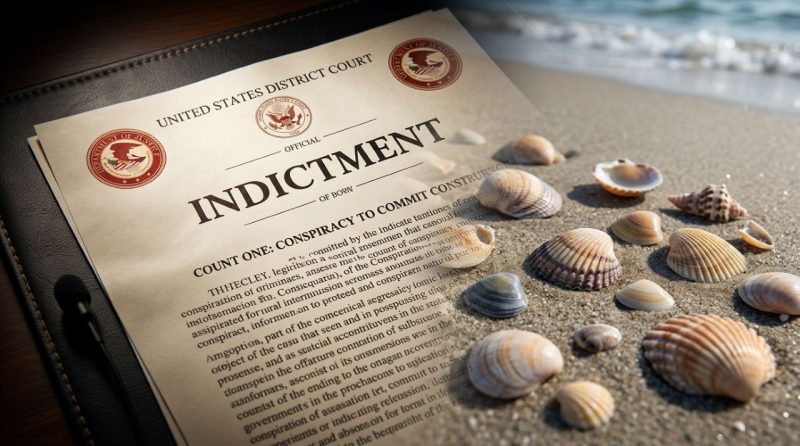
The Department of Justice has now indicted a former FBI director twice for posting a picture of seashells on Instagram. That sentence should sound absurd, because it is.
But absurdity, it turns out, is no barrier to federal prosecution in 2026, and the second indictment of James Comey tells you everything you need to know about how the Justice Department is being wielded as a political instrument under this administration.
A federal grand jury returned a two-count indictment on Tuesday charging Comey with making and transmitting threats against the President of the United States. The alleged threat: a photo Comey posted on Instagram in 2025 showing seashells arranged on a beach to spell “86 47.” The DOJ argues that “a reasonable person would interpret the image as a serious expression of an intent to do harm to the President of the United States.”
In the lexicon of American slang, “86” means to get rid of, to discard, to throw out. “47” refers to Donald Trump as the 47th president. Comey captioned the photo “Cool shell formation on my beach walk.” He later deleted it, writing “I didn’t realize some folks associate those numbers with violence. I oppose violence of any kind.”
The DOJ’s Second Swing at the Same Target
This is not the first time the Justice Department has tried to make this case. The initial indictment, brought approximately seven months ago, was thrown out. The DOJ went back to a grand jury, secured new charges, and is trying again. The persistence is notable. Federal prosecutors do not typically re-indict on the same facts unless they believe they have a significantly stronger case, or unless they are operating under pressure from above to deliver a particular outcome.
The legal standard for a threat prosecution under 18 U.S.C. 871 requires that the communication constitute a “true threat,” meaning it must be made with the intent to threaten, and a reasonable person would understand it as a genuine expression of intent to harm the president. Courts have traditionally drawn a bright line between political speech, even heated or provocative political speech, and actionable threats. Hyperbole, satire, and symbolic expression are protected under the First Amendment.
Comey’s attorney, Patrick Fitzgerald, the former U.S. Attorney who prosecuted the Scooter Libby case, called the charges vindictive and stated that his client “vigorously denies the charges contained in the Indictment.” Fitzgerald said he looks forward to “vindicating Mr. Comey and the First Amendment” in court.
The Reasonable Person Test and the Problem of Context
The government’s case hinges on the “reasonable person” standard, and this is where the prosecution’s argument becomes almost comically strained. A reasonable person looking at a photo of seashells on a beach would need to first identify that the shells form numbers, then know that “86” is slang for discarding something, then connect “47” to Trump’s presidential number, then conclude that the combined meaning constitutes a credible threat of physical harm to the president.
That is a lot of interpretive work for a reasonable person to do while looking at seashells. The phrase “86 47” was widely used during the 2024 campaign as shorthand for voting Trump out of office, not as a call to violence. Political merchandise, bumper stickers, and social media posts bearing the phrase were ubiquitous. If every person who used those numbers is now subject to federal prosecution, the DOJ has just created a class of political prisoners numbering in the tens of thousands.
The more honest reading of the indictment is that the DOJ is not prosecuting a threat. It is prosecuting a man who investigated the president and who the president has publicly despised for nearly a decade. The seashells are a pretext. The prosecution is the point.
Comey’s History With Trump and the DOJ
James Comey has been in Donald Trump’s crosshairs since before the first inauguration. As FBI director, Comey oversaw the investigation into Russian interference in the 2016 election. Trump fired him in May 2017, an act that triggered the appointment of Special Counsel Robert Mueller. Comey subsequently testified before Congress, wrote a bestselling memoir critical of Trump, and became one of the most prominent public critics of Trump’s approach to law enforcement and democratic norms.
Trump has never hidden his contempt for Comey. He has called him a “leaker,” a “liar,” and worse. The desire to see Comey prosecuted is not a matter of inference. It is a matter of public record, expressed repeatedly on social media and in public statements.
Against that backdrop, the DOJ’s decision to bring a second indictment over the same Instagram post looks less like a sober exercise of prosecutorial discretion and more like a campaign of legal harassment against a political enemy. The first indictment failed. A second indictment, based on the same facts, suggests that the instruction from above is not “evaluate the evidence and act accordingly” but “keep trying until something sticks.”
The Broader Pattern of Weaponized Prosecution
The Comey indictment does not exist in isolation. It is part of a pattern that has become impossible to ignore. In the same week, the FCC ordered early broadcast license renewals for ABC’s stations in retaliation for a Jimmy Kimmel joke about Melania Trump. The administration has used ICE and CBP in ways that have drawn bipartisan criticism. Federal agencies are being deployed not to enforce the law neutrally but to reward allies and punish critics.
The erosion of prosecutorial independence at the Department of Justice is particularly alarming because of the institution’s unique role in American democracy. The DOJ is supposed to be the one federal agency that operates without regard to political considerations. Its independence is not a courtesy extended by the president. It is a structural necessity for the rule of law. When the attorney general’s office becomes an instrument of political retaliation, the entire legal system loses credibility.
Acting Attorney General Todd Blanche, who has overseen both the Comey prosecution and the recent marijuana rescheduling, has shown little appetite for institutional independence. His tenure has been characterized by a willingness to use the department’s power in ways that align with the president’s publicly stated preferences, whether that means going after political enemies or delivering policy wins that play well with the base.
What the First Amendment Actually Protects
The First Amendment does not protect all speech. True threats, incitement to imminent lawless action, and certain categories of obscenity fall outside its protections. But the Supreme Court has consistently held that political speech, including speech that is provocative, offensive, or critical of government officials, receives the highest level of constitutional protection.
A photo of seashells on a beach, whatever numbers they may form, is a long way from a true threat. It is a long way from incitement. It is a long way from any recognized exception to First Amendment protection. If this prosecution succeeds, the precedent it sets will make it possible to prosecute virtually any political expression as a threat, so long as a creative prosecutor can construct a chain of inferences connecting the expression to a government official.
Patrick Fitzgerald is right to frame this case as being about the First Amendment. Whatever one thinks of James Comey, his politics, his decisions as FBI director, or his post-government public persona, the question of whether the federal government can prosecute a citizen for posting a photo of seashells on social media goes to the heart of what political expression means in a democracy. If the answer is yes, then the only speech that is truly safe is silence.