
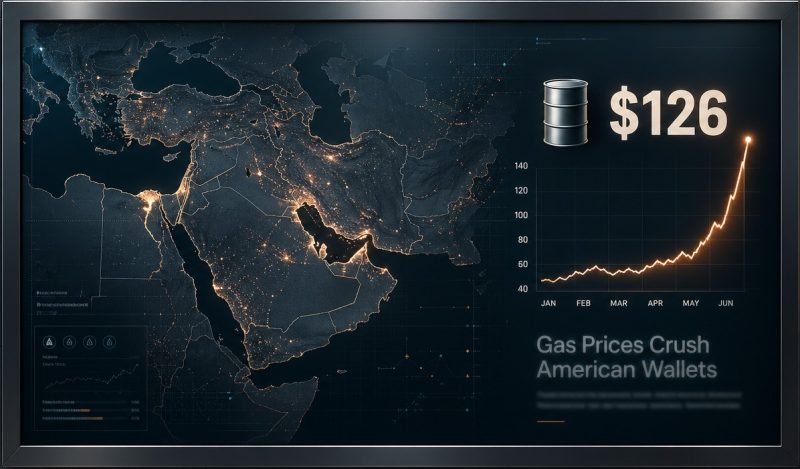
The Iran war is now squeezing the country from both ends: a $28 billion military tab that keeps climbing, and $4.30 gas that’s draining household budgets faster than any tax hike ever could.
The math on America’s Iran war got a lot uglier on Thursday.
On one side of Washington, Defense Secretary Pete Hegseth sat before the Senate Armed Services Committee defending a $1.5 trillion Pentagon budget and a war that has already cost $28 billion. On the other side, President Trump received a classified briefing from CENTCOM Commander Adm. Brad Cooper on a new menu of military options that could push that number dramatically higher. And at gas stations across the country, Americans watched the price of a gallon tick past $4.30, the highest it has been since Russia’s invasion of Ukraine in 2022.
This is the convergence point the administration has been racing toward since Operation Epic Fury launched in late February. The ceasefire is holding in name only. Negotiations have stalled. And the Strait of Hormuz, the narrow waterway through which roughly a fifth of the world’s oil and natural gas normally flows, remains effectively shut. Eight straight days of rising crude prices culminated Thursday morning when Brent briefly touched $126.41 a barrel, a four-year high, before pulling back to around $115.
The question facing Trump is no longer whether the current approach is working. It is whether to double down.
The Options On The Table
According to Axios, which broke the story of Thursday’s CENTCOM briefing, the military has prepared what officials describe as a “short and powerful” wave of strikes targeting Iranian infrastructure. But that’s only one course of action. A second plan involves seizing part of the Strait of Hormuz itself, an operation that could require ground forces. A third, even more provocative option: a special forces mission to secure Iran’s stockpile of highly enriched uranium.
Each option represents a significant escalation from the current posture of naval blockade and economic strangulation. Each carries risks that extend well beyond the battlefield.
Trump, for his part, has told advisers he views the blockade as “somewhat more effective than the bombing,” according to two sources familiar with his thinking. He rejected Iran’s latest negotiating offer earlier this week, insisting the blockade remains in place until Tehran completely abandons its nuclear program. That is not a position Iran’s supreme leader has shown any willingness to accept.
Joint Chiefs Chairman Gen. Dan Caine is expected to attend the briefing alongside Cooper. What they present will shape the trajectory of a conflict that most Americans experience not through casualty reports, but through the price displayed on the pump outside their local gas station.
The Price Americans Are Actually Paying
Goldman Sachs estimates that exports through the Strait of Hormuz have fallen to just 4% of normal levels. That single statistic, compounded by the UAE’s historic exit from OPEC this week, explains nearly everything about what is happening to energy markets.
Gas prices have surged more than 30% since the war began. The national average crossed $4.30 on Thursday, according to AAA, and analysts see no near-term catalyst for relief. If anything, the trajectory is pointed higher. Oil briefly topped $126, and Goldman’s models suggest prices could climb further if the Hormuz disruption drags into the summer driving season.
The economic ripple effects extend far beyond the gas pump. Diesel prices are climbing, which means everything that moves by truck costs more. Airlines are adjusting fuel surcharges. Manufacturing inputs are getting more expensive. The Federal Reserve, already navigating a tricky inflation landscape, now faces the prospect of energy-driven price spikes that monetary policy is essentially powerless to address.
Economists at several major banks have begun saying out loud what markets have been pricing in quietly: if the Strait of Hormuz remains closed through the second half of the year, a global recession becomes a realistic scenario. Not a tail risk. A baseline case.
Trump met with oil and gas executives earlier this week, a signal that the administration understands the political vulnerability. Gas prices are the most visible, most frequently encountered economic indicator in American life. Every voter sees them, every day, on their commute. No amount of messaging about national security resolve can outrun $5 gas heading into a midterm election year.
The War Powers Clock Nobody Can Agree On
Layered on top of the military and economic pressures is a constitutional question that got sharper during Hegseth’s testimony Thursday.
The War Powers Act of 1973 gives the president 60 days to conduct military operations without congressional authorization. That clock has been a source of friction between the administration and Democrats in Congress for weeks. Hegseth offered a novel legal theory from the witness chair: the ceasefire, he argued, means the 60-day clock “pauses or stops.”
That interpretation has no obvious precedent and drew immediate pushback. If a ceasefire pauses the clock, any president could theoretically wage open-ended war with periodic ceasefires resetting the timeline indefinitely. It is the kind of legal argument that sounds reasonable in a hearing room and collapses under five minutes of scrutiny.
Sen. Elizabeth Warren pressed Hegseth on whether he had invested in any defense manufacturers ahead of the war. He denied it. She did not appear convinced.
The broader point is this: Operation Epic Fury is now operating in a legal gray zone where the administration claims constitutional authority that a significant number of lawmakers dispute, while simultaneously asking those same lawmakers to approve a $1.5 trillion defense budget to fund it.
What Happens Next
The honest answer is that nobody outside a very small circle knows what Trump will decide after Thursday’s briefing. The options range from maintaining the status quo, which is itself an escalation through economic attrition, to military operations that would represent the most significant American ground commitment in the Middle East since Iraq.
What is clear is that the two tracks of this crisis are converging. The military options and the economic pain are no longer parallel storylines. Every day the Hormuz blockade continues, the domestic political cost rises alongside the barrel price. Every military escalation risks a response from Tehran that could push oil toward $150 or beyond, a level that energy analysts at Gulf News have flagged as plausible within weeks.
Trump has spent his career trusting his leverage instincts. The blockade is leverage. The CENTCOM strike plans are leverage. But leverage only works if the other side eventually folds. Iran’s leadership has shown no sign of folding. And the Americans paying $4.30 a gallon did not sign up to be the collateral in a game of chicken over enriched uranium.
The war’s price tag is $28 billion and counting. The price at the pump is $4.30 and climbing. Somewhere between those two numbers is the political math that will determine what happens next.