
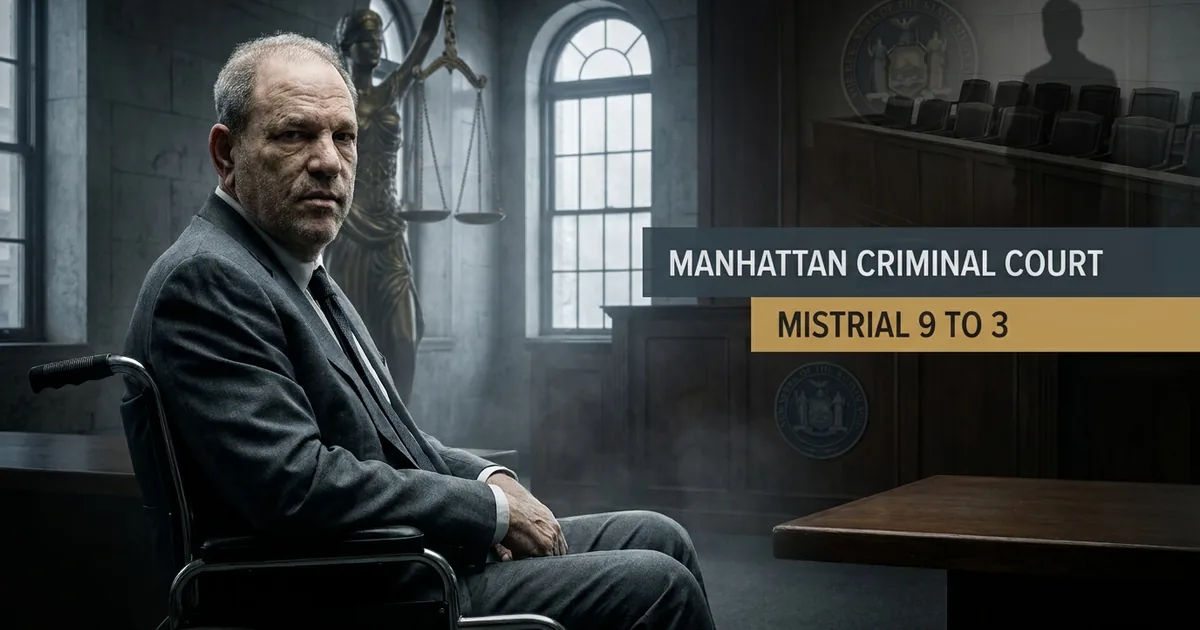
Harvey Weinstein’s third New York rape trial collapsed into a mistrial on Friday after a Manhattan jury split 9-3 in favor of acquittal on the third-degree rape of Jessica Mann, leaving Manhattan District Attorney Alvin Bragg 30 days to decide whether to put the case in front of a fourth jury.
That is a verdict in everything but name, and the people inside the courtroom know it.
Three Trials, One Charge, No Conviction
The Mann count is the same single charge that has now been put to twelve jurors three separate times since 2020 and has produced one conviction, one appellate reversal, and one hung jury. As CNN reported on May 15, Judge Curtis Farber declared the mistrial after the panel deliberated for roughly nine hours across three days, with foreperson notes describing the deadlock as immovable. Jurors interviewed in the courthouse hallway said the holdouts pointed to gaps in Mann’s testimony surfaced during cross-examination, particularly around dates and the on-again, off-again relationship she maintained with Weinstein in the years after the 2013 Manhattan hotel encounter at the center of the charge.
A 9-3 split is the kind of number a DA’s office reads twice. It is not a near miss. It is a jury most of whose members were prepared to walk Weinstein on this count, and it lands in the public record after the 2020 conviction on the same allegation was overturned by the New York Court of Appeals last year on the grounds that the original trial judge had improperly allowed testimony from women whose accusations were not part of the indictment. Strip out the prior-bad-acts witnesses and what remains is exactly what jurors saw this time: Mann, the documentary record of her communications with Weinstein, and a defense team built around the inconsistencies that record produces. Three trials in, the prosecution has not solved that problem.
Why the DA Probably Tries Again Anyway
Bragg’s office told reporters Friday it would “review next steps,” code that buys the time the calendar already provides. A hearing on June 24 will set the decision deadline, and the political incentives all point the same direction.
A fourth trial is expensive, exposes the office to the same risk it just absorbed, and runs into a witness who has now testified three times with three opportunities for the defense to map her exact recall. The case against pulling the plug is real. But Bragg cannot easily be the prosecutor who walked away from a Weinstein charge after losing it, particularly while the Hollywood Reporter and every other entertainment outlet covering the courthouse frames the mistrial as the symbolic loss it functionally is. Conventional Manhattan-DA political math says he tries it a fourth time, optimizes around Mann’s testimony, and accepts whatever outcome the jury delivers.
The bigger question is what the case looks like by then. Mann’s willingness to take the stand a fourth time is not guaranteed; complainants in long-running prosecutions burn out, and the legal community has watched the cost compound on her in real time. Without Mann, there is no count. With Mann, the DA gets a witness who has now told the same story enough times that any single deviation gives the defense a thread to pull.
What This Does to the #MeToo Legal Reckoning
The Weinstein file is the spine of every legal story written about #MeToo since 2017, and the spine is now load-bearing. He is still incarcerated; the Los Angeles conviction and 16-year sentence on separate sexual assault charges are intact, and he is not going home from this. But “still in prison on other charges” is not the same as a system that consistently delivers verdicts on the specific allegations brought against him in New York. Three trials, one conviction since vacated, one hung jury, and no current standing conviction on the Mann count is a record that a future defendant’s lawyer reads as a template.
The structural problem the Weinstein trials keep exposing is the gap between what a complainant remembers, what contemporaneous documentation shows, and how a cross-examiner uses the second to attack the first. The 2020 prosecution tried to patch that gap with testimony from uncharged accusers and got reversed. The 2026 retrial tried to litigate the count straight, on Mann’s testimony alone, and got a 9-3 hung jury. The lesson sitting between those two results is uncomfortable: when the legal standard is unanimous proof beyond a reasonable doubt, decade-old sexual assault allegations involving a complainant who maintained contact with the accused are very difficult cases to win.
That is not a verdict on Mann’s credibility. It is a verdict on the criminal evidentiary standard as applied to this category of case. The civil track, with its preponderance standard and broader admissibility rules, is where most successful #MeToo accountability now lives, and the Weinstein outcomes are the reason.
The Next 30 Days
Three things to watch between now and the June 24 hearing.
One, whether Bragg’s office signals a charging tweak that would let it argue a different version of the same conduct in a fourth trial. Two, whether Mann publicly confirms she would testify again; her statement, when it comes, is the lever that decides the case. Three, whether the defense team moves to seal portions of the courtroom record from this trial, which would be the early signal that they expect a retrial and want to limit the cross-examination footprint they have just generated.
Weinstein himself, his lawyers told reporters Friday, intends to appeal his Los Angeles conviction as well, on procedural grounds his team has telegraphed since 2023. None of that is in motion this month. What is in motion is a Manhattan prosecutor’s office deciding whether one more trial is worth the political cost of losing it again. The 30-day clock starts now.