
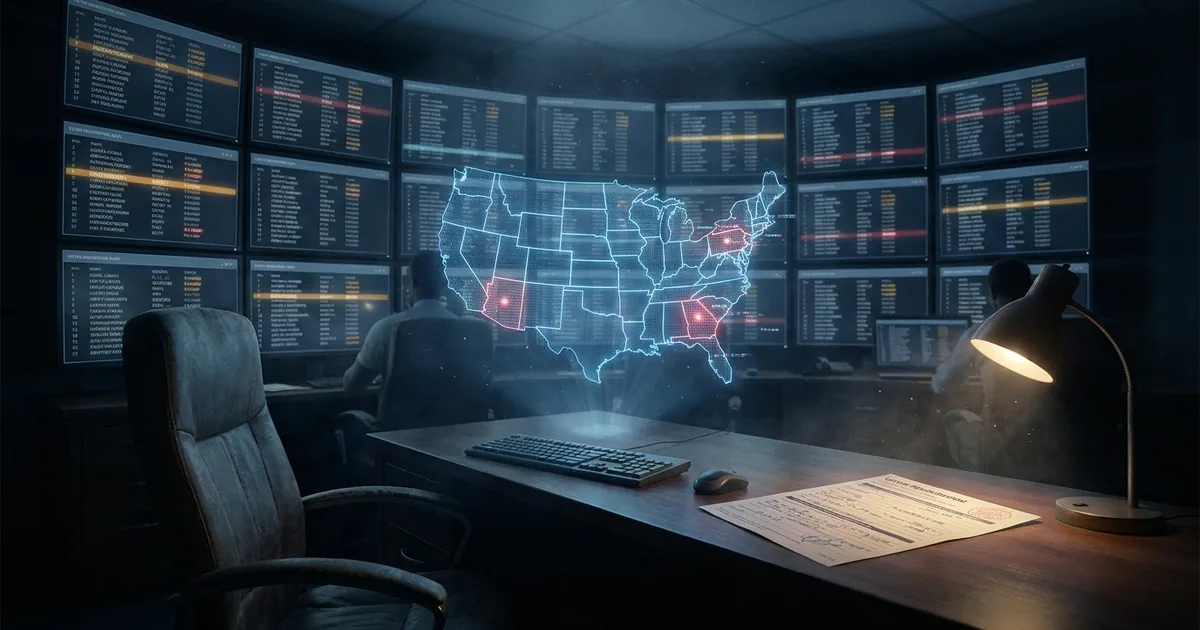
The Trump administration has quietly run the names of at least 67 million registered voters through federal databases in what officials call a routine verification program and critics call the largest voter purge operation in American history.
The effort, revealed in detail Saturday by the Washington Post, uses an expanded version of the SAVE (Systematic Alien Verification of Entitlements) system, originally designed to check immigration status for benefit applications, now repurposed to flag voter registrations for potential removal before the 2026 midterms.
The numbers are staggering in scale and modest in yield. Of the 67 million registrations checked, primarily from Republican-controlled states that voluntarily submitted their rolls, roughly 24,000 were flagged as potential noncitizens and approximately 350,000 as people who appear to have died. That means the program’s hit rate for the noncitizen problem it was designed to solve is 0.036 percent. Voting rights advocates have filed at least six federal lawsuits arguing the program will do far more damage to legitimate voters than it will to fraudulent ones.
How the SAVE System Was Weaponized
SAVE has existed for decades as a Department of Homeland Security tool. Its original purpose was narrow: when someone applied for government benefits, agencies could check their immigration status against DHS records. The system was never designed for mass voter verification, and until this administration, nobody tried to use it that way.
Under the current program, state election officials submit their voter rolls to DHS, which cross-references them against immigration databases and Social Security Administration death records. The process sounds straightforward. In practice, it is riddled with the kind of data-matching problems that have plagued every large-scale government database project in modern history: name variations, outdated records, naturalized citizens who appear in immigration databases because they were once noncitizens, and clerical errors that can turn a legitimate voter into a flagged record.
The Washington Post investigation documented cases where naturalized citizens were flagged because their immigration records had not been updated to reflect their current status. In a system processing tens of millions of records, even a small error rate translates into thousands of legitimate voters receiving notices that their registration is under review, or worse, being removed from the rolls without notification.
The Timing Is Not a Coincidence
The midterm elections are in November. Voter registration deadlines in many states fall in September and October. The window for a wrongly flagged voter to discover the problem, navigate a bureaucratic appeals process, and get their registration restored before Election Day is narrow, and in some states, essentially nonexistent.
This is the mechanism that concerns voting rights lawyers more than any individual case of wrongful removal. The ACLU’s Freda Levenson put it directly: if a voter is wrongly removed, by the time they learn about it and attempt to correct it, they may have already missed their opportunity to vote. The burden falls on the individual voter to prove they belong on the rolls, not on the government to prove they do not.
That burden falls disproportionately on communities that are already underrepresented in the electorate. Naturalized citizens, voters in communities with high mobility rates, and people with common names that generate false matches are statistically more likely to be flagged. The overlap between those populations and Democratic-leaning demographic groups is not lost on anyone paying attention.
The Legal Battlefield
Six federal lawsuits and counting. The legal challenges attack the program from multiple angles: some argue that SAVE was never authorized for voter verification purposes, others challenge the adequacy of the notice and appeals process, and several cite the National Voter Registration Act’s prohibition on systematic purges within 90 days of a federal election.
The administration’s defense, articulated by Assistant Attorney General Harmeet Dhillon during a Fox News appearance, is that the program is simply verifying what should already be true: that everyone on the voter rolls is eligible to vote. Dhillon pointed to the 350,000 deceased voters identified as evidence the rolls need cleaning. What she did not address is whether the SAVE system is an appropriate tool for that cleaning, or whether the error rate for living, eligible voters is acceptable collateral damage.
The Campaign Legal Center has documented the history of voter purge programs and their consistent pattern: they are launched with promises of precision, they generate alarming-sounding numbers about ineligible registrations, and they ultimately remove far more eligible voters than ineligible ones. The pattern is not new. What is new is the scale and the federal infrastructure backing it.
What This Means for the Midterms
The 2026 midterms are shaping up to be the most consequential in a generation. The House majority is razor-thin. The Senate map favors neither party decisively. Control of governorships and state legislatures will determine redistricting and election administration for the next decade. In that environment, even small shifts in voter access can change outcomes.
The SAVE program is not the only front in the battle over voter access. The Supreme Court’s recent Alabama redistricting decision, which cleared the way for eliminating a majority-Black congressional district before the midterms, and the broader erosion of Voting Rights Act protections create a cumulative effect. Each individual action can be defended on narrow technical grounds. Taken together, they form a pattern that voting rights advocates say amounts to systematic disenfranchisement.
The administration rejects that characterization. Officials maintain they are simply ensuring election integrity, a phrase that has become the most contested two words in American politics. The question the courts will ultimately have to answer is whether election integrity includes the integrity of the process for removing voters from the rolls, or only the integrity of who remains on them.
The Stakes Beyond November
Win or lose in the courts, the SAVE voter verification program establishes a precedent. If it survives legal challenge, the infrastructure for mass voter roll checks against federal databases will exist permanently, available to any future administration for any purpose it can justify. The data pipeline between DHS, SSA, and state election offices, once built, does not get dismantled when the political winds shift.
That is the concern that extends beyond partisan politics. The right to vote is the foundation of democratic legitimacy. A system that can remove voters from the rolls at scale, based on database matches with known error rates, operating on a timeline that makes correction practically impossible before an election, is a system that concentrates enormous power in the hands of whoever controls the databases. Today, that is the Trump administration. Tomorrow, it could be anyone.
Sixty-seven million records checked. Twenty-four thousand flagged. Six lawsuits filed. And an election in less than six months that will determine whether this program is remembered as a legitimate modernization effort or the most sophisticated voter suppression operation in American history. The courts will decide. But the voters who get caught in the machinery may not get a say.