
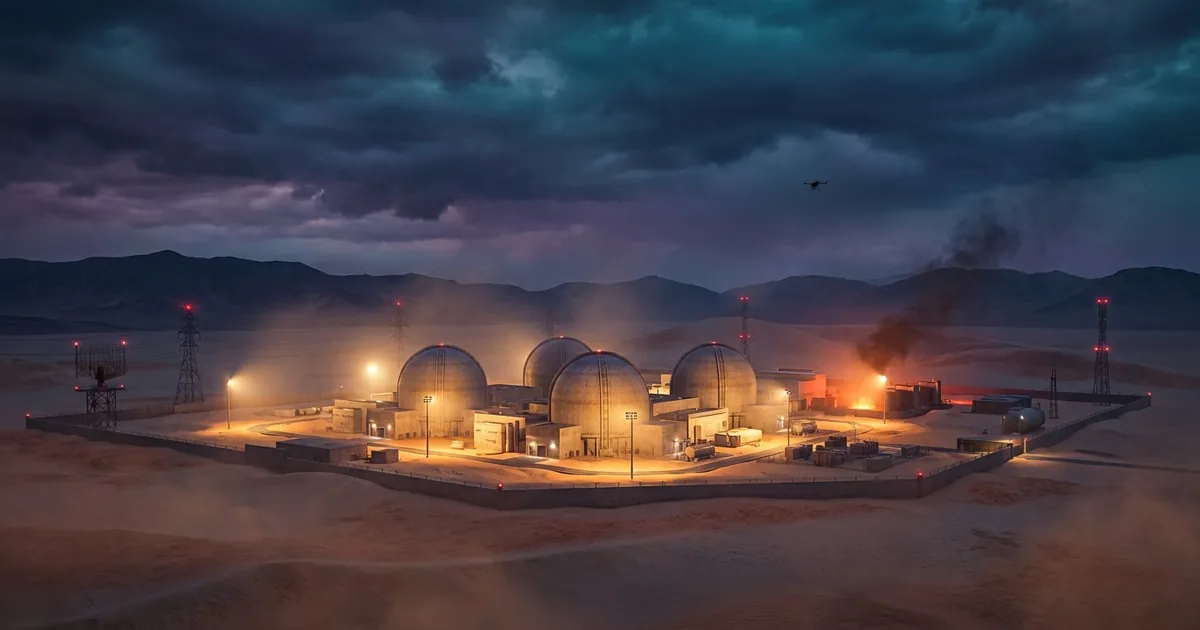
A drone struck an electrical generator outside the perimeter of the Barakah Nuclear Power Plant in Abu Dhabi on Saturday, sparking a fire and triggering what may be the most dangerous escalation of the Iran war to date.
Three drones entered UAE airspace from the western border. Air defenses intercepted two. The third got through. No injuries were reported, no radiation was released, and the International Atomic Energy Agency confirmed that plant operations continued normally. But the fact that a projectile landed anywhere near a functioning nuclear facility in the middle of an active regional conflict changes the risk calculus for everyone involved.
Yemen’s Iran-backed Houthi rebels claimed responsibility for the attack. The UAE government condemned it as a “treacherous terrorist attack” but notably did not name Iran directly, a diplomatic omission that speaks volumes about Abu Dhabi’s desire to avoid being drawn deeper into a war it did not start and cannot control.
What Happened at Barakah
The Barakah Nuclear Power Plant, located in Abu Dhabi’s remote Al Dhafra region near the Saudi border, is the Arab world’s first operational nuclear energy facility. It has four reactors and represents the UAE’s most significant infrastructure investment in energy diversification, a project worth more than $20 billion that took over a decade to build.
According to the UAE’s Federal Authority for Nuclear Regulation, the drone struck an electrical generator outside the plant’s inner perimeter. The fire was contained quickly. All essential safety systems continued to operate, and radiological monitoring showed no impact on safety levels. IAEA Director General Rafael Grossi issued a statement calling military activity that threatens nuclear safety “unacceptable” and urging all parties to exercise restraint.
The technical reality is that the plant was never in serious danger. Nuclear facilities are designed with multiple layers of containment, and a single drone hitting a peripheral generator is not the same as a direct strike on a reactor building. But the technical reality is almost beside the point. The symbolic and strategic implications of targeting a nuclear power plant, even its outer perimeter, represent a threshold crossing that international nuclear safety experts have warned could set a dangerous precedent.
The Houthi Escalation Strategy
The Houthis have been the wild card in the Iran war from the beginning. Operating as Iran’s most capable proxy force in the region, they have launched drone and missile attacks against Saudi and Emirati targets for years. But the Barakah strike represents something new: the deliberate targeting of nuclear infrastructure, a move designed to generate maximum fear with minimum actual destruction.
This is asymmetric warfare at its most effective. The Houthis do not need to breach a reactor containment vessel to achieve their strategic objective. They just need to demonstrate that they can reach it. The message to the UAE, to Saudi Arabia, and to every Gulf state with critical infrastructure is unmistakable: nowhere is safe, and the Iran war’s consequences will not stay contained within Iranian borders.
The timing is not accidental. The attack came as the ceasefire between the United States and Iran was expiring with no deal in sight. The Houthis, who are not party to the ceasefire agreement, have consistently acted as spoilers, launching provocations designed to complicate diplomatic efforts and widen the conflict beyond the Strait of Hormuz chokepoint that has dominated headlines. Barakah represents a geographic and strategic expansion of their target set.
The UAE’s Impossible Position
The United Arab Emirates has spent the past several months trying to thread an impossible needle: maintaining its security partnership with the United States while avoiding direct confrontation with Iran, its neighbor across the Persian Gulf. Abu Dhabi’s decision to leave OPEC in May was partly driven by the need for greater flexibility in oil production decisions during the war, but it also signaled a broader desire for strategic independence.
The Barakah attack complicates that calculation enormously. A direct strike on the country’s most important energy infrastructure, by forces aligned with Iran, creates political pressure to respond. Sheikh Abdullah bin Zayed, the Deputy Prime Minister and Foreign Minister, called the attack a “treacherous terrorist act” and promised accountability. But accountability against the Houthis means military action in Yemen, which means deeper entanglement in a regional conflict the UAE has been trying to exit.
The diplomatic language is revealing. By condemning the attack without naming Iran, Abu Dhabi is leaving itself room to pursue back-channel diplomacy with Tehran while publicly responding to the Houthi threat. It is a distinction that may not survive another successful strike on Emirati soil.
The Nuclear Safety Precedent
The international response focused almost entirely on the nuclear dimension, and for good reason. There is no established framework for how the world responds when a non-state actor targets a nuclear power plant during a regional conflict. The IAEA’s mandate covers nuclear safety and nonproliferation, but it has limited authority to enforce security around civilian nuclear facilities in wartime conditions.
The precedent this sets extends far beyond the Gulf. There are more than 400 operational nuclear reactors worldwide, many in regions where military conflict is either ongoing or plausible. If drone strikes on nuclear plant perimeters become an accepted tactic of asymmetric warfare, the security calculus for every country operating nuclear energy infrastructure changes overnight. The cost of defending these facilities increases. The insurance and investment landscape shifts. And the political case for building new nuclear capacity, which had been gaining momentum as a climate solution, weakens.
What This Means for the Wider War
The Barakah attack is the latest in a series of escalations that have pushed the Iran war beyond its original geographic and strategic boundaries. What began as a targeted U.S. military operation against Iranian nuclear and military facilities has metastasized into a regional crisis involving naval blockades, proxy attacks, oil price shocks, and now the targeting of civilian nuclear infrastructure.
Each escalation creates new constituencies for continued conflict. The UAE now has a domestic political incentive to respond. Saudi Arabia, which has its own vulnerabilities to Houthi attack, faces pressure to strengthen its defenses rather than pursue diplomacy. And the United States, which is already stretched between the Strait of Hormuz escort operations and the broader military campaign, now has another ally asking for protection and another front to monitor.
The ceasefire expired Sunday with no replacement. The diplomatic channels that might have produced one are clogged with recriminations and competing demands. And a drone just hit a nuclear power plant. The Iran war is not winding down. It is spreading. The question is no longer whether it can be contained, but how far it goes before someone finds a way to stop it.