
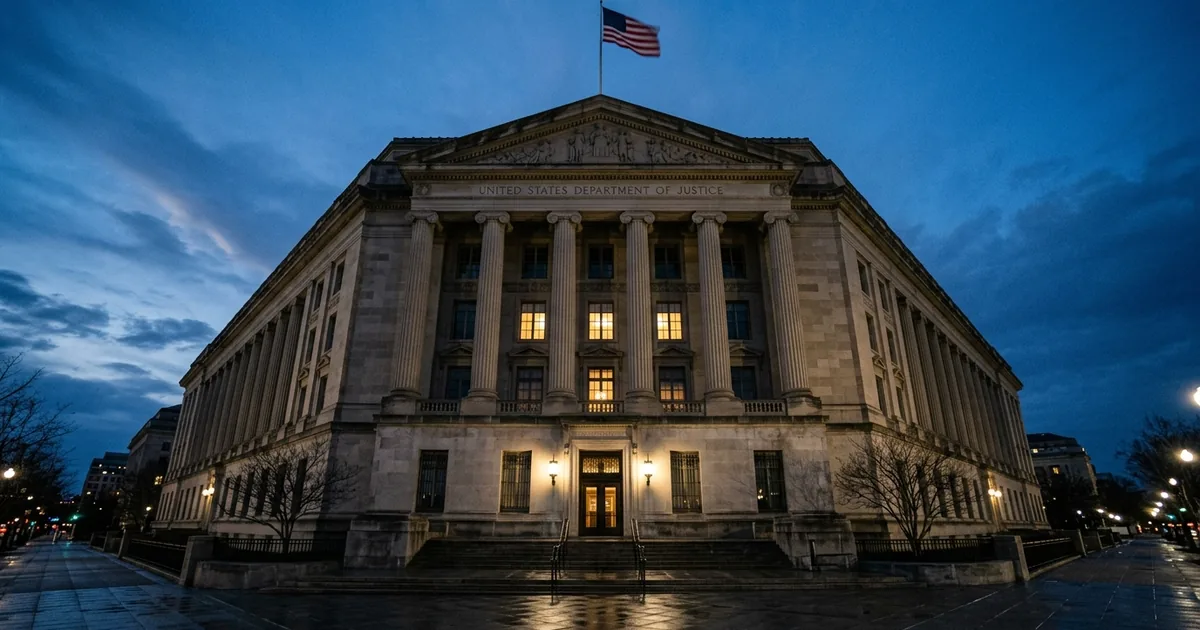
The Justice Department announced on Monday that it had created a $1.776 billion fund to compensate “victims of lawfare,” the same day President Donald Trump quietly dismissed his $10 billion lawsuit against the Internal Revenue Service over his leaked tax returns.
The two events were not a coincidence. They were the settlement.
How the Trade Worked
Acting Attorney General Todd Blanche framed the fund in a Monday statement as “a lawful process for victims of lawfare and weaponization to be heard and seek redress.” NBC News reported that the fund’s creation was the direct counterparty to Trump dropping his suit, a sequence the DOJ’s own statement and the filings make plain. Trump sued the IRS in his personal capacity. The IRS, an agency Trump now runs, did not contest the suit so much as resolve it by transferring $1.776 billion of taxpayer money into a discretionary account managed by Trump’s own Justice Department.
The mechanics matter because they are the story. A sitting president sued an executive agency he controls, and his administration’s response was to settle for nearly two billion dollars. There is no congressional appropriation behind the fund. There is no statute creating it. The DOJ stood it up on its own authority and has said claims will be processed through December 15, 2028, a runway that lines up neatly with the back half of Trump’s current term.
Who Gets Paid
Pressed at a House budget hearing on Tuesday over who is eligible, Blanche refused to rule out payments to people convicted of violence on January 6, 2021. PBS News reported that Blanche told lawmakers any applicant who “believe[s] they were a victim of weaponization” can file. By his own description that includes defendants who assaulted Capitol Police officers.
A coalition of 93 House Democrats filed an amicus brief seeking to block the fund, calling it a “$1.7 billion slush fund” that Trump could use to “reward allies, including the nearly 1,600 defendants convicted or charged in connection with the January 6th attack on the Capitol.” That framing is sharp but it is not editorializing. It is a description of the fund’s published eligibility criteria.
The pattern is not new. Earlier this year the DOJ paid $1.25 million each to Michael Flynn and Carter Page to resolve their “weaponization” claims. Trump himself is separately demanding $230 million from the same DOJ for what he calls the wrongful Mar-a-Lago search and the original Russia investigation. The $1.776 billion fund is what these one-off settlements look like once they get industrialized.
The Constitutional Question
Article I gives Congress the power of the purse. The Anti-Weaponization Fund, as constructed, is an end-run around that power. Blanche told the House panel that the fund operates from existing DOJ accounts, but the legal authority to compensate “victims of lawfare” without an appropriation or a statutory cause of action is, in plain terms, asserted rather than granted. The Department claimed the authority. The Department now controls the payouts. The Department reports to the president, who is also the primary beneficiary of the original $10 billion claim that triggered the fund.
Bondi’s combative Senate testimony last month previewed exactly this dynamic, with the former attorney general defending earlier individual settlements as “case-by-case” judgments and refusing to commit to congressional oversight of the pattern. She was fired in April over a separate fight about the Epstein files. Blanche, her acting replacement, is now defending what looks like the institutionalization of the same approach.
The pattern Democrats are flagging is straightforward. Settlements that flow from the Justice Department to the president’s political allies are, structurally, payments from one branch to itself. They do not become routine because the DOJ wrote a memo calling them lawful. The check on this kind of self-dealing is supposed to be Congress, and the design of the fund, particularly its 2028 sunset, suggests the administration knows that.
The Pattern Underneath the Headline
The actual story is not the dollar amount. It is the mechanism. A president can now sue an agency he runs for a number large enough to be alarming, drop the suit when the agency creates a fund for his allies, and refer questions about eligibility to an acting attorney general who will not rule anyone out. The fund does not need to pay $1.776 billion to do its work. It needs to exist. The credible threat of payouts is itself the prize, because it deters future career prosecutors from opening investigations that might one day be reclassified as “weaponization.”
Federal employees pay attention to incentive structures. The signal sent by a $1.8 billion compensation pool, sitting on the DOJ’s books, payable to people the administration believes were targeted, is that prosecuting an ally of the sitting president is now a career risk with a price tag attached. That is the institutional cost. It is harder to see than a wire transfer to a January 6 defendant, but it is the part of this story that will outlast the litigation.
What Happens Next
The amicus brief from the 93 House Democrats has not been ruled on. A handful of constitutional scholars are likely to challenge the fund’s authority directly in court, though standing is going to be the immediate obstacle, as it usually is when the harm is institutional rather than personal. The first claim payouts have not yet been disclosed. Blanche’s December 2028 deadline gives the fund a runway of roughly two and a half years to do whatever it is going to do.
The question worth watching is not whether the fund pays out a violent January 6 rioter. The acting attorney general has already declined to rule that out, and the question itself is now part of the public record. The question is whether Congress, when it returns from recess, is willing to assert its appropriations power against an administration that has decided the answer is no.