
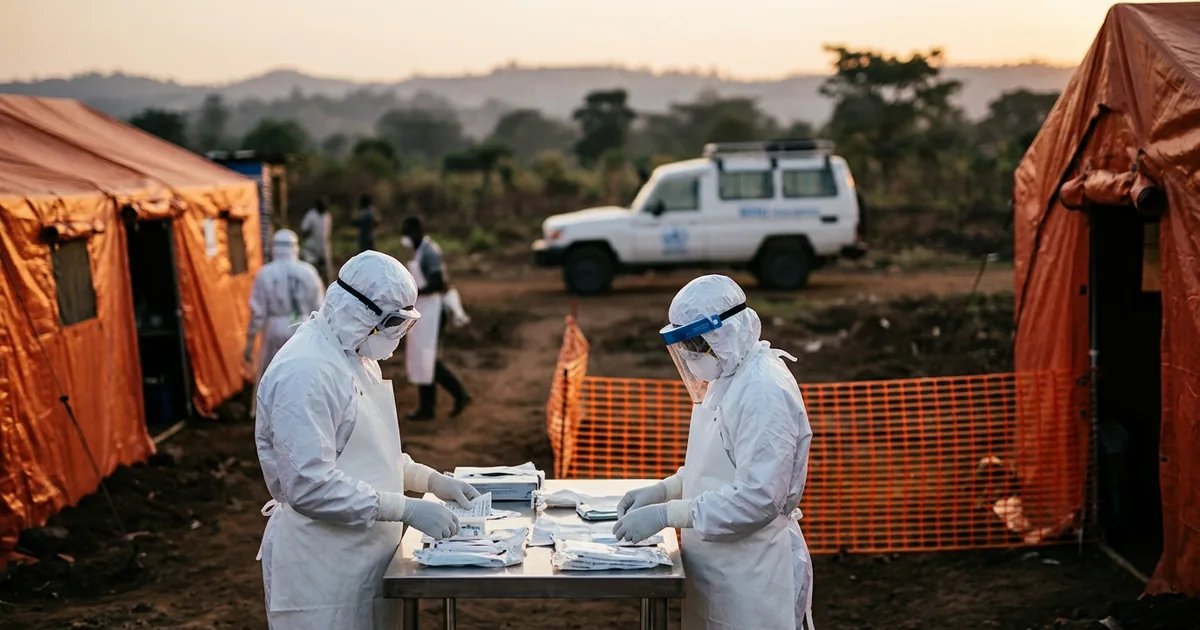
The World Health Organization declared the Ebola outbreak tearing through eastern Congo a global health emergency on May 17, and within hours the headline most Americans saw was the one about an American testing positive.
That framing is technically accurate and almost entirely misleading, because the infected American is a health worker who contracted the virus while treating patients in the Democratic Republic of Congo, not a case that walked off a plane in Atlanta.
The distinction matters, and not only for accuracy. How this story gets told over the next two weeks will shape whether the United States responds with the calm machinery of public health or the political theater of a border panic. The early signs point in both directions at once.
What the WHO Actually Declared
The World Health Organization’s determination that the outbreak constitutes a public health emergency of international concern is the agency’s highest level of alarm, the same designation it used for COVID-19 and the 2014 West Africa Ebola crisis. The Director-General invoked it under Article 12 of the International Health Regulations, the legal trigger that obligates member states to coordinate a response rather than improvise one.
The numbers underneath the declaration are moving fast. As of May 16, the WHO counted eight confirmed cases, 246 suspected cases, and 80 suspected deaths concentrated in Congo’s Ituri Province, across the health zones of Bunia, Rwampara, and Mongbwalu. By May 19, the U.S. Centers for Disease Control and Prevention was citing a far larger tally: 536 suspected cases, 105 probable cases, 34 confirmed cases, and 134 deaths. Two confirmed cases, including one death, had also surfaced in Kampala, Uganda, a capital of more than 1.6 million people. An outbreak that reaches a dense city is a different animal than one contained to rural health zones, which is precisely why the WHO moved when it did.
The American Case, in Context
Here is what actually happened to the American. On May 17, according to the CDC’s situation summary, a U.S. citizen who was exposed while caring for patients in the DRC tested positive for Bundibugyo virus disease and was transferred to Germany for treatment. There is no American patient in an American hospital. The CDC states plainly that no Ebola cases have been confirmed in the United States as a result of this outbreak, and that the overall risk to the American public and travelers remains low.
That is not the story built for cable news, where “first American tests positive” is engineered to imply something it does not say. The reality is quieter and, frankly, more honorable: an American clinician was doing frontline work in one of the hardest places on earth to do it, and got infected for the trouble. The people most exposed to this virus are the doctors and nurses treating it, which is exactly how the 2014 outbreak tore through West African health systems long before it reached anyone in the West.
A Strain with No Vaccine
The genuinely worrying part of this outbreak is not the American case. It is the virus itself. This outbreak is driven by Bundibugyo virus, a less common species of Ebola, and per the WHO there are currently no approved Bundibugyo-specific therapeutics or vaccines. The Ervebo vaccine that helped contain recent Zaire-strain outbreaks does not map onto this one.
Take the vaccine off the table and containment falls back on unglamorous fundamentals: case identification, contact tracing, isolation, safe burials, and the early supportive care the WHO notes is itself lifesaving. None of that is high technology. All of it is labor, logistics, and institutional trust, the parts of public health that are easiest to cut in a budget cycle and hardest to rebuild in an emergency.
The Real Test Is Bureaucratic
Within a day of the declaration, the CDC moved to stand up the standard playbook. It began enhanced screening and monitoring for travelers arriving from the DRC, Uganda, and South Sudan, placed entry restrictions on non-U.S. passport holders who had been in those countries in the previous 21 days, and issued a Level 3 travel notice for Congo urging Americans to reconsider nonessential travel. On paper, this is the system working as designed.
The open question is whether the system can still execute. This is the same federal public-health apparatus that spent the spring answering to Congress over measles outbreaks and vaccine policy, now led by a Health and Human Services secretary who built a career questioning the very tools an outbreak response depends on. Airport screening and traveler monitoring are only as good as the staffing, the data systems, and the institutional credibility behind them. An administration that has spent two years treating public-health expertise as an adversary does not get to summon that expertise back at full strength the moment it becomes politically useful.
There is also a hard truth about money. The American clinician now in a German isolation ward is a product of exactly the kind of overseas health investment that budget hawks in Washington routinely flag as waste. Outbreaks do not respect that accounting. A virus contained in Bunia is a virus that never reaches Brussels or Newark, and the cheapest place to stop Ebola is always the place where it starts.
What to Watch
The next signal worth watching is not whether a case appears in the United States, which remains unlikely, but whether Kampala sees sustained transmission and whether the WHO’s member states actually fund the response they just declared an emergency. As CNN noted in its explainer on the outbreak, the urban spread and cross-border movement are what separate a contained flare-up from a regional crisis.
Emergency declarations are the easy part. The follow-through, the money, the personnel, the unglamorous competence, is where these things are won or lost. For now the honest American summary is this: the risk here is low, the panic is optional, and the real exposure is not at the border. It is in whether the country still trusts the institutions built to handle exactly this.