
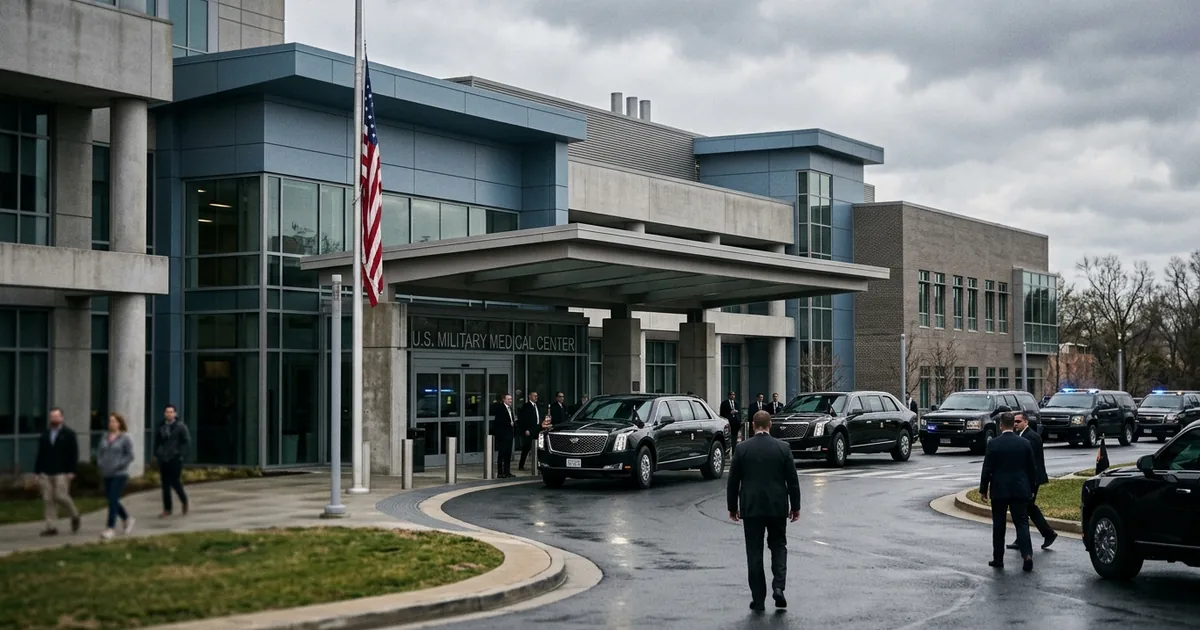
President Donald Trump arrives at Walter Reed National Military Medical Center on Tuesday for what the White House is calling a routine annual physical, his third visit to the facility in 13 months and the third of a second term that is barely a year old.
In a White House that controls every syllable of what gets released about the president’s body, three trips to a military hospital in just over a year is itself the disclosure.
Three Visits, Thirteen Months, One Word: Routine
The administration’s framing is deliberately unremarkable. The White House announced two weeks ago that the appointment would cover “routine annual dental and medical assessments as part of his regular preventive healthcare,” a phrase engineered to make a pattern sound like a calendar reminder. The pattern is real regardless. Trump visited Walter Reed twice in 2025, in April and again in October, and Tuesday’s exam comes just seven months after the last one, as NPR noted in its preview of the visit.
Annual physicals are, by definition, annual. Three in 13 months is not an annual cadence, and calling it one is a small tell. It does not prove anything is wrong. It does suggest that someone in the president’s medical orbit wants eyes on something often enough that the public deserves a straight account of what.
What We Actually Know
Strip away the messaging and a real medical picture emerges from the past year. Last summer, the White House disclosed that Trump had been diagnosed with chronic venous insufficiency, a condition in which the leg veins struggle to return blood to the heart, which fits the swollen ankles visible in recent photographs. In December, the administration acknowledged that a Walter Reed visit had included a CT scan to assess his cardiovascular and abdominal health, the kind of imaging you do not typically order for a man in uncomplicated condition.
Then there are the hands. The persistent bruising on the back of Trump’s hands, which he covers with a layer of makeup, was attributed by the White House to a combination of frequent handshaking and a daily aspirin dose higher than his own doctors recommend. Each of these has an innocent explanation on its own. Together they are why outside physicians keep asking questions that the official statements keep answering with adjectives.
“Excellent Overall Health,” and Other Things We Take on Faith
The president’s physician, Navy Captain Sean Barbabella, has said Trump “remains in excellent overall health.” That may be entirely true. The problem is that no one outside the White House medical unit can test the claim, because in the American system the president decides what the public learns about his own fitness, and Trump has guarded that information more tightly than most of his predecessors.
This is where the story stops being about one man’s veins and starts being about institutional accountability. Voters elected a commander-in-chief, not a medical record, but the two are not as separable as the White House would like. A president exercising live war powers, ordering strikes on Iran in the middle of fragile negotiations, is making split-second judgment calls that depend on cognitive sharpness the public is simply asked to assume. Transparency about presidential health is not gossip. It is one of the few mechanisms a democracy has to confirm that the person holding the most consequential job on earth is up to it.
A 79-Year-Old President Running Several Crises at Once
Context matters, and the context is age. Trump turns 80 in June, which already makes him the oldest person ever to take the presidential oath and the second-oldest to occupy the office, behind only the predecessor whose age he spent a campaign attacking. He is doing the job during a shooting war with Iran, an escalating trade conflict, and a domestic agenda he is pushing at full speed. This is the same president whose handling of the Iran war has drawn pointed questions about strategy and stamina, and a third hospital visit in just over a year does not quiet those questions. It sharpens them.
None of this requires pretending to diagnose the man from a distance, which would be its own kind of dishonesty. The fair standard is the one we would apply to any 79-year-old in a high-stress job with a documented vascular condition: more information, not less. The White House has the opposite instinct, releasing the minimum and labeling it excellent.
So the real test of Tuesday is not whether Trump walks out of Walter Reed and pronounces himself the healthiest president in history, which he will. It is whether the public gets to see the actual results, in detail, from a doctor willing to take questions. If the answer is a one-paragraph statement with another adjective in it, that is its own kind of diagnosis, just not of the patient.