
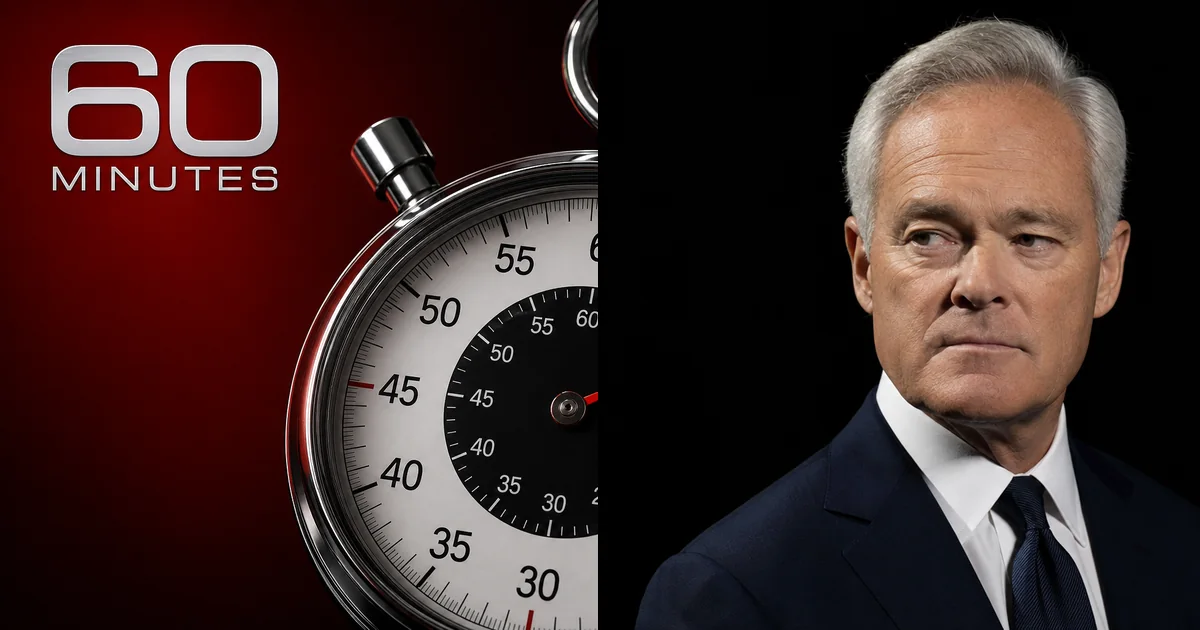
Scott Pelley says CBS News editor-in-chief Bari Weiss asked 60 Minutes to recut a report on two people killed during a federal immigration crackdown in Minneapolis, and every change she wanted pushed the story toward the version of events the Trump administration has been selling.
In his first interview since CBS fired him last week, Pelley told The New York Times the notes amounted to a level of political pressure he had not seen in nearly four decades at the network, and he refused to make the edits.
The dispute is not about a comma or a chyron. It is about whether the most storied newsmagazine in American television would describe a dead woman and a dead nurse the way the footage shows them, or the way the people who killed them would prefer.
What Pelley Says Was in the Email
The segment ran in February and covered the January killings of Renee Good and Alex Pretti during the immigration surge in Minneapolis. Pelley says the piece went through the normal screenings and rewrites and was approved to air. Then, roughly four hours after a noon deadline, his team got a note from Weiss requesting changes.
Two of those requests stopped him cold. One asked the team to make the protesters look more violent. The other asked that Good be described as driving toward the officer who shot her. Pelley was careful to say he was paraphrasing rather than quoting, but the thrust was unmistakable, because “driving toward the officer” is the exact framing the Trump administration has used to justify the shooting. The footage says otherwise. Multiple video analyses from different angles found that Good was turning her vehicle away when the agent opened fire through her windshield.
Pelley did not make the changes, and no one called to insist. “It occurred to me that maybe Bari Weiss didn’t see the broadcast and didn’t realize that those changes hadn’t been made,” he told the Times. He described the episode to NBC News as part of a pattern of pressure that, in his telling, pushed CBS coverage toward a friendlier read of the administration.
The Facts the Video Already Settled
This is where the request collapses under its own weight. Renee Good was 37, a mother of three, shot on January 7 by an ICE agent who fired three rounds into her SUV. The “driving toward the officer” framing is not a contested interpretation that an editor can reasonably nudge. It is a claim the video evidence from the Minneapolis shooting directly contradicts.
Alex Pretti makes the asymmetry starker. He was a 37-year-old intensive care nurse for the Department of Veterans Affairs, an Army veteran with a Minnesota permit to carry and no criminal record. He was filming agents and directing traffic on January 24 when he stepped between an officer and a woman who had been shoved to the ground. Officers pepper-sprayed him, wrestled him down, and as roughly six agents surrounded him, one shouted that he had a gun. Two Customs and Border Protection agents then shot him in the back while he lay on the pavement holding his phone. Both were placed on leave. LNC has tracked from the start how ICE’s killings of American citizens in Minneapolis hardened into a constitutional crisis, and these two deaths sit at the center of it.
An editor asking a reporter to make “the protesters look more violent” against that record is not asking for balance. It is asking the broadcast to describe something the cameras did not record.
The Crackdown the Segment Was About
To understand why the edits matter, you have to understand the scale of what 60 Minutes was covering. Operation Metro Surge began on December 4, 2025, and expanded on January 6 into what the Department of Homeland Security itself called the largest immigration enforcement operation ever carried out. More than 3,000 ICE and Border Patrol officers flooded the Twin Cities and the rest of Minnesota. Gregory Bovino, the Border Patrol commander running it, described the approach as a “turn and burn” strategy. Roughly 3,000 people were arrested, with the administration leaning hard on Somali and Southeast Asian refugee communities.
The response was the kind of civic mobilization the country rarely sees. Labor unions, faith leaders, and local officials called a statewide day of action, and hundreds of businesses closed in a general strike to protest the surge and the killings. Minneapolis later estimated the operation cost the city more than $203 million in economic impact in a single month, according to NPR’s reporting on the surge. Two of the people federal agents killed during it, Good and Pretti, were US citizens. That is the story Weiss’s note proposed to reframe.
Why the Note Came From the Top
The reason this lands harder than a routine editing fight is who sent it. Weiss founded The Free Press and built a brand as a contrarian opinion writer. She had never run a newsroom before Paramount Skydance acquired her outlet for roughly $150 million and named her CBS News editor-in-chief in October 2025, a role created for her, reporting directly to Skydance chief executive David Ellison. So the note did not come from a beat editor weighing sourcing. It came from the top of the masthead, after deadline, on a story about federal agents killing civilians.
That arrival followed a year of pressure on CBS that started at the corporate level. Paramount settled a lawsuit Donald Trump brought over a 60 Minutes interview with Kamala Harris for $16 million, a payment many in the newsroom read as a capitulation, as NPR documented when Weiss took over. Longtime 60 Minutes executive producer Bill Owens resigned, saying he could no longer make independent decisions about what was right for the broadcast. CBS News chief Wendy McMahon left soon after. The note about Renee Good did not appear in a vacuum. It appeared in a building that had already learned what management wanted.
CBS pushed back on Pelley’s account. A spokesperson said Weiss “made four points in the course of editorial back-and-forth,” that “they had no political motivation and were proposed solely to make the piece as strong, fair, and accurate as possible,” and that not everything she raised survived into the final cut. The trouble with the “fair and accurate” defense is that accuracy, in this case, was already on tape. When the verified record shows a car turning away, “fair” does not mean splitting the difference with the shooter’s version.
A Pattern, Not a Single Email
The Good segment is not the first 60 Minutes story to run into the new leadership. Correspondent Sharyn Alfonsi clashed with Weiss last year over a piece on the administration’s deportation of Venezuelan men to a prison in El Salvador, which Alfonsi has said was pulled for political reasons. On May 28, CBS removed Alfonsi, fellow correspondent Cecilia Vega, executive producer Tanya Simon, and executive editor Draggan Mihailovich in a single stroke. Pelley pressed the program’s new executive producer, technology journalist Nick Bilton, about those firings at the staff meeting that preceded his own.
Read together, the El Salvador story, the Good note, and the May purge describe a standing expectation rather than a one-off disagreement. One email gets refused and forgotten. A pattern of segments softened, delayed, or staffed out reshapes what reporters bother to pitch in the first place. That is how a newsroom bends without anyone announcing a new policy.
What the Firing Signals
Pelley did not go quietly. CBS fired him on June 2, a day after a staff meeting where he questioned Bilton’s qualifications and accused leadership of “murdering” the show. He told interviewers that “CBS News is on fire.” His termination came in a short meeting with CBS News president Tom Cibrowski. Weiss defended the decision in the days that followed, telling staff that trust and mutual respect had been broken and that her team had tried to reconcile with him. Pelley flatly disputed that account.
Set this against the past year and the throughline is hard to miss: the $16 million settlement, the Owens and McMahon exits, the El Salvador segment, the May firings, and now the departure of the correspondent most associated with the program’s spine. Each event was explained on its own terms. Stacked together, they describe a news division learning where the new lines are, and the broader collapse rippling through American news institutions gives it grim company.
The test was never whether one Minneapolis segment aired intact. It did. The test is whether the next reporter handed a note that asks the footage to lie will do what Pelley did, and whether there will be anyone left in the building with the standing to back them up.