
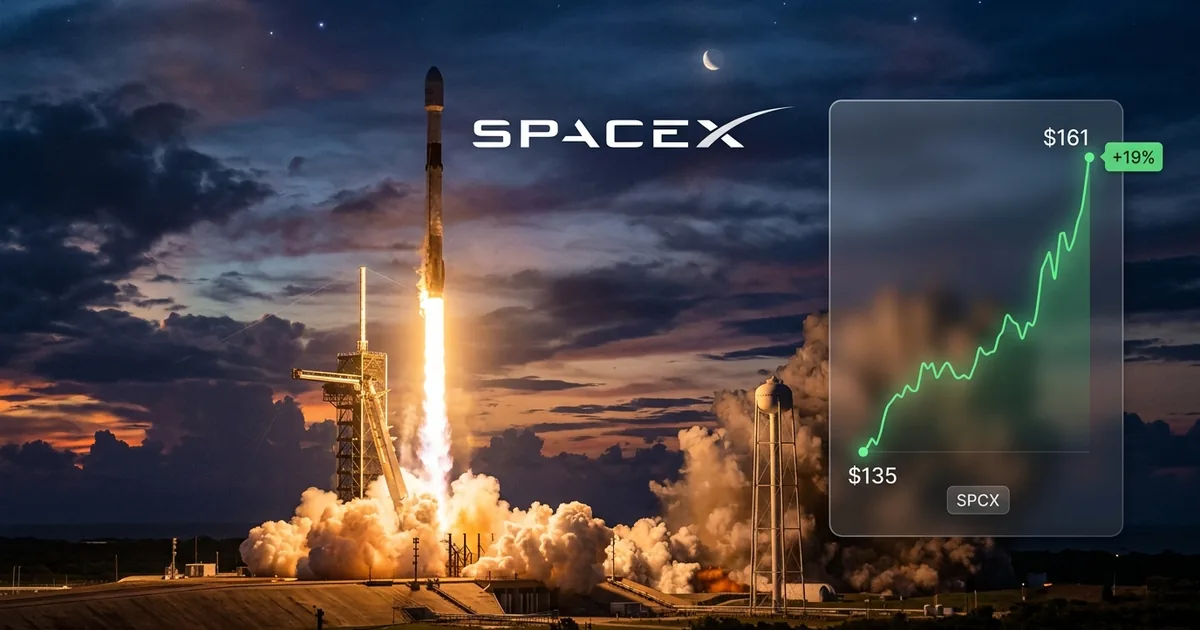
For the first time, anyone with a brokerage app and a few hundred dollars can buy a sliver of SpaceX.
The rocket company went public on Nasdaq under the ticker SPCX on Friday, priced at $135 a share, and promptly shot up 19 percent to close at $160.95. It is the biggest stock-market debut in history, and for a few wild minutes at midday the company was worth more than $2.25 trillion. The question worth sitting with is not how high the stock went. It is what, exactly, the public just bought a piece of.
By Dana Reyes, LiveNewsChat senior technology writer. A decade covering Silicon Valley, space, and the politics of big tech.
Because this is not only a rocket company anymore. When you buy SPCX today, you are buying Falcon 9 launches, the Starlink satellite-internet network beaming down from low orbit, and Elon Musk’s artificial-intelligence lab, xAI, which SpaceX absorbed earlier this year in an all-stock deal that valued the combined business at $1.25 trillion. Three of the most consequential technologies of the decade, bundled into one ticker, sold to the public on the same Friday.
The Most Democratic IPO Ever, on Paper
There is a genuinely populist story here, and it deserves to be told straight. SpaceX set aside roughly 30 percent of its shares for everyday retail investors, about three times what a company this size normally hands to the general public. The usual playbook reserves the best allocation for hedge funds and the well-connected, and ordinary buyers get the scraps after the pop. This time the company deliberately opened the door wider, and millions of people who have watched Falcon 9 boosters land themselves back on the pad got to own a piece of that.
That is a real thing, and the excitement is earned. Watching a rocket land upright never stops being astonishing, and there is something democratic about letting the people who cheered those landings share in the upside. The trouble is what the fine print says about how much of a say that ownership actually comes with.
You Bought the Stock. Musk Kept the Steering Wheel.
Here is the catch that the launch footage tends to drown out. SpaceX went public with a dual-class share structure, the same arrangement that lets founders sell the economics of a company while keeping the control. Public shareholders get exposure to the profits. Musk keeps the votes. After Friday he controls roughly 85 percent of the voting power while owning something closer to 42 percent of the actual equity, a gap engineered on purpose so that no outside investor, no matter how large, can tell him what to do.
So you can own SpaceX without owning any influence over it. Your shares rise and fall with a company run by a man who is simultaneously steering a car company, a social network, a brain-implant startup, and now a frontier AI lab, and who answers to no shareholder vote that matters. This is the same dynamic we wrote about when Musk’s trillion-dollar Tesla pay package became real, and the IPO pushes it further. The public gets to fund the ambition. Musk keeps the wheel.
When One Man Owns the Sky
Step back from the ticker and the bigger picture comes into focus. Starlink is becoming critical infrastructure, the connective tissue for everything from rural broadband to battlefield communications. The launch business is effectively a monopoly on cheap access to orbit. xAI is a serious contender in the race against OpenAI, Google, and Anthropic to build the most powerful AI systems on earth. Now all three sit inside a single publicly traded company whose strategy is set by one person.
That should give even the most enthusiastic buyer pause. We have watched private power concentrate before, but rarely this much, this fast, across launch capability, global internet, and artificial intelligence at once. The IPO does not change who is in charge. It just hands the public a financial stake in an empire it cannot govern, and it does so at a valuation that assumes everything keeps going right.
What to Watch Now
The honeymoon numbers are dazzling, and the skeptics have not gone anywhere. The real test arrives later, when the lockup period ends and early employees and insiders are free to sell, when xAI’s enormous cash burn starts showing up on quarterly statements the public can finally read, and when the first piece of bad news forces the market to decide what this thing is actually worth without the launch-day adrenaline.
For now, a lot of regular people own a small piece of the future Musk is building. Whether that turns out to be a smart bet or an expensive lesson, they will be along for the ride either way, cheering the next landing from the outside of a company they technically, partly, own.