
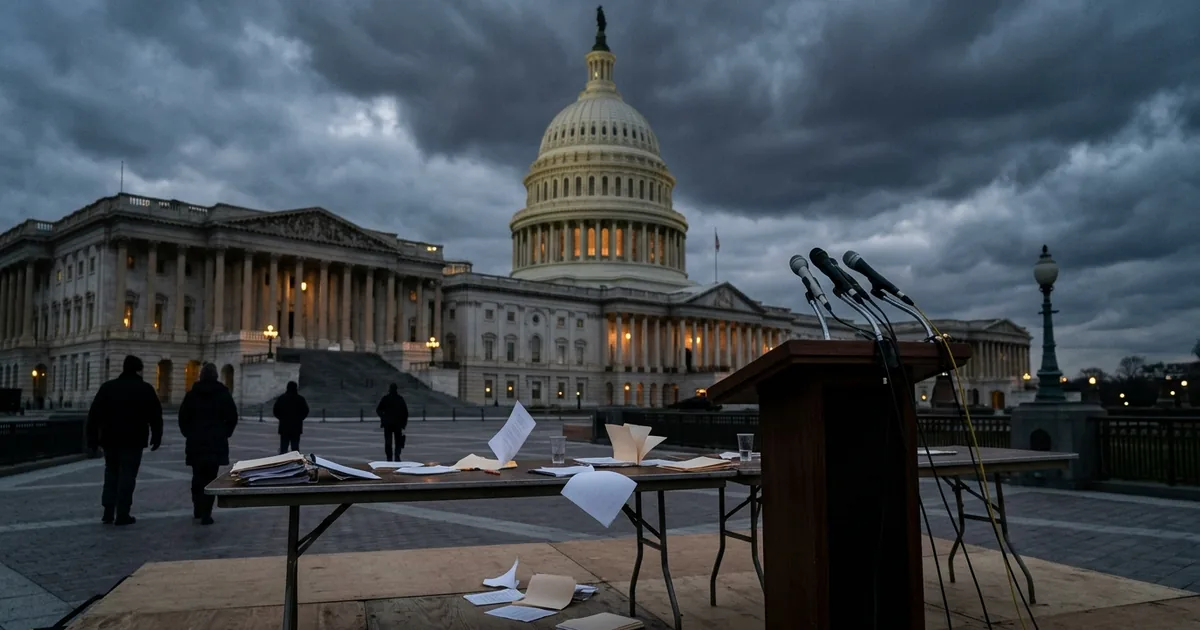
President Trump blew up the confirmation hearing for his own intelligence director pick on Tuesday, directing Jay Clayton not to appear before the Senate Intelligence Committee in an early-morning social media post that blindsided Republican leaders and further entangled a critical national security tool in unrelated legislative demands.
It was a masterclass in self-inflicted political chaos, even by this administration’s standards.
What Actually Happened
The sequence of events would be difficult to believe if it were not documented in real time. The Senate Intelligence Committee had scheduled Jay Clayton, the former SEC chairman and current U.S. Attorney for the Southern District of New York, for a confirmation hearing on Tuesday to become the permanent Director of National Intelligence. Republican leadership had the votes lined up. The hearing was ready to go.
Then, just hours before Clayton was set to testify, Trump posted on Truth Social that he was “cancelling” the hearing. His stated reason: frustration that Congress had not passed his SAVE America Act, a voter ID and election overhaul bill, and that the Senate was moving “too fast” on a confirmation he himself had initiated. He threatened to refuse to sign any bill reviving the expired FISA Section 702 surveillance authority unless it was bundled with the election legislation.
NBC News reported that the post caught GOP senators off guard, leaving Senate leadership scrambling to figure out whether the hearing was actually cancelled or whether this was another Truth Social negotiating tactic. Clayton did not appear.
The FISA Section 702 Wreckage
The collateral damage here extends well beyond one nomination hearing. FISA Section 702 is the legal authority that allows U.S. intelligence agencies to collect communications of foreign targets located outside the country without individual warrants. It is, by most accounts from intelligence professionals across the political spectrum, one of the most important surveillance tools in the national security arsenal.
That authority expired last week after Congress failed to reauthorize it, partly because of disputes over privacy protections and partly because the political environment has made any FISA vote radioactive for members on both flanks. Trump’s decision to use the reauthorization as a bargaining chip for an unrelated voting bill makes revival significantly harder, not easier.
The practical consequence is that intelligence agencies are now operating without a legal tool they have used extensively since its creation after 9/11. Career intelligence officials have warned that gaps in collection capability create blind spots that adversaries can exploit, and those warnings are not theoretical. The same FISA 702 authority was instrumental in identifying the kind of threat networks that, just this week, the FBI disrupted in the alleged plot targeting the White House UFC event.
The Pattern of Self-Sabotage
What makes this episode particularly striking is that Trump nominated Clayton himself barely a week ago. This was not a hostile hearing for an adversary’s pick. It was a confirmation for the president’s own chosen official, one who had bipartisan goodwill from his SEC tenure and was widely expected to sail through. Torpedoing your own nominee’s hearing to force concessions on an unrelated bill is the kind of move that burns political capital with exactly the allies you need to get anything done in the Senate.
Republican senators, several of whom had spent days preparing for the hearing and lining up supportive votes, were left publicly defending a process that the president himself had just undermined. Senate leadership had to determine in real time whether to proceed without the nominee, postpone, or treat the Truth Social post as something less than an official directive. They chose to postpone.
What Happens to Intelligence Leadership
The immediate problem is that the Director of National Intelligence position remains unfilled by a Senate-confirmed official. Bill Pulte, the federal housing official Trump installed as acting DNI after the previous director’s departure, has faced questions about his qualifications for a role that oversees 18 intelligence agencies. House Democrats have challenged whether Pulte’s appointment even complies with the Federal Vacancies Reform Act.
The longer-term problem is that the intelligence community is operating in a leadership vacuum during a period of elevated global threats. Russia, China, Iran, and an expanding portfolio of non-state actors are not waiting for Washington to sort out its internal dysfunction. Every week without confirmed leadership at the top of the intelligence apparatus is a week where coordination, prioritization, and strategic direction suffer.
Clayton remains the nominee. The hearing will presumably be rescheduled once Trump decides he has wrung enough political value from the standoff, or once the pressure from intelligence professionals becomes too loud to ignore. But the damage to the confirmation process, to the FISA reauthorization timeline, and to the credibility of the intelligence community’s independence has already been done.