
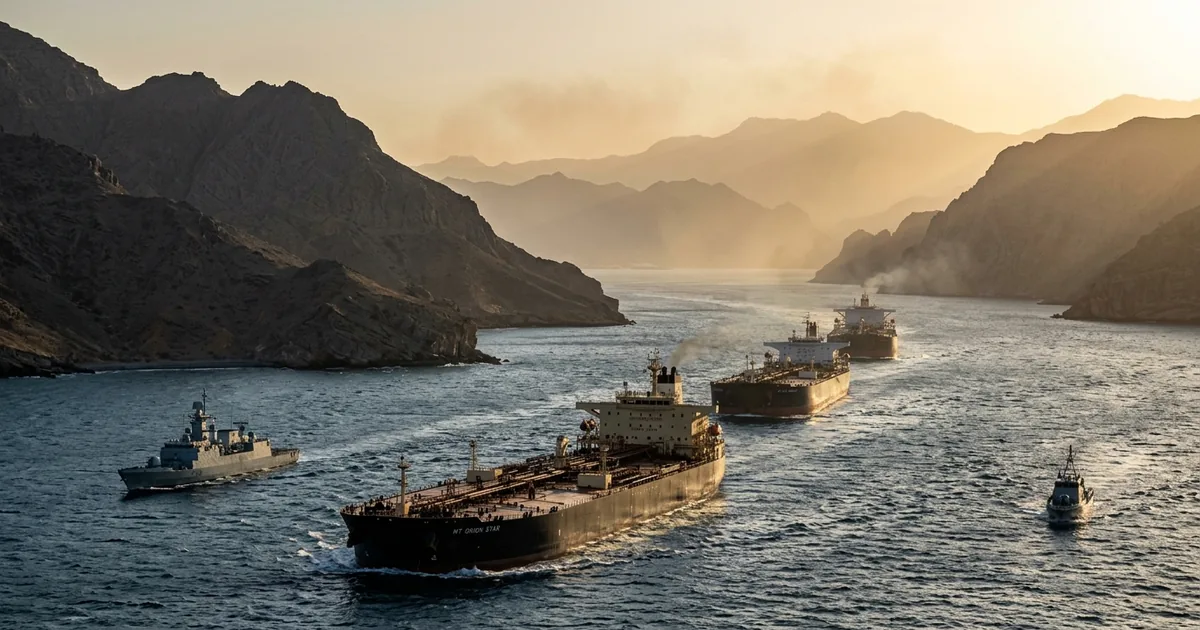
Three Saudi oil tankers switched their tracking signals back on in the Gulf of Oman on Thursday, the first Saudi-owned crude to clear the Strait of Hormuz since Iran shut the waterway in March.
The cargo, about six million barrels, matters less than the message: the most dangerous chokepoint on earth is open again, and it stayed closed for as long as one government decided it should.
That is the uncomfortable truth underneath the relief rally. A strait that carries a fifth of the world’s seaborne oil reopened not because international law compelled it, but because a deal signed over dinner at a French palace made it briefly worth Tehran’s while.
A Crossing That Is Mostly Symbol
The Saudi ships had been trapped inside the Persian Gulf since the conflict began, unable to run the gauntlet of a strait Iran declared closed in early March. Their reappearance on Thursday is a confidence signal more than a supply event. Six million barrels is a rounding error against the roughly 20 million barrels a day Hormuz moved before the war. The point is that a Saudi owner was willing to send hulls and crews through at all, which is its own kind of vote on whether the ceasefire will hold long enough to matter.
It will take far longer to clear the backlog than to send the first ships. Even with a deal in hand, oil could take weeks or months to fully flow, as insurers reprice risk, crews rejoin idled vessels, and naval escorts sort out who guarantees what. The water is open. Trust in the water is not.
The Deal That Reopened the Strait
The reopening traces to a memorandum of understanding that President Trump and Iranian President Masoud Pezeshkian signed on June 17, which Trump put his name to during a dinner with French President Emmanuel Macron at the Palace of Versailles after the G7 summit. A day later Pakistan, the conflict’s primary mediator, announced that the agreement obliges Tehran to promptly reopen Hormuz and that the American naval blockade of Iranian ports would cease immediately. The terms call for full reopening without tolls for at least 60 days.
To understand how high the stakes climbed, rewind to how the strait closed. On February 28, the United States and Israel launched coordinated airstrikes on Iran under Operation Epic Fury, hitting military and nuclear sites and killing Supreme Leader Ali Khamenei. Iran answered with missile barrages and, on March 4, declared the Strait of Hormuz closed and threatened to fire on any ship that tried to pass. We covered the diplomacy as the Trump-Iran framework took shape with Tehran still obstructing on Hormuz. Thursday’s tankers are the first physical proof that the framework reached the water.
Who Actually Controls the Water
Read the fine print and the upper hand stays exactly where it has been. The “without tolls for at least 60 days” language is not a guarantee of permanent freedom of navigation. It is a 60-day lease. Iran has conceded passage for a defined window while keeping the underlying capability, and the willingness, to choke the strait again if the broader settlement frays. That is not peace. It is a pause with an expiration date written into it.
The safe-passage question is doing a lot of unglamorous work here. As Al Jazeera laid out in its explainer on how safe passage for ships will actually be ensured, reopening a strait on paper does not clear the mines, restore the insurance market, or rebuild the confidence that lets a tanker captain commit to a transit. Until those pieces are in place, every crossing is a calculated bet that this particular week, Tehran has more to gain from open water than from closed.
The Institutions Left Holding the Risk
This is where the deal’s design should worry anyone who prefers durable rules to personal rapport. A waterway that underpins the global economy was reopened by a leader-to-leader memorandum, signed at a banquet, riding on the relationship between two presidents and the goodwill of a mediator in Islamabad. There is no treaty, no ratified framework, no multilateral guarantor standing behind the 60-day window. When the mechanism is a handshake, the cliff is built in.
The people who absorb that fragility are not the principals who signed it. They are the Gulf shippers and crews who run the strait, the insurers who underwrite them, and households worldwide who already paid for the closure in higher prices. The damage is concrete: ADNOC’s chief executive put fuel costs up 30 percent, fertilizer up 50 percent, and airfares up roughly 25 percent since the war began. Reopening the strait starts to unwind that bill, slowly. A second closure would reinstate it overnight.
The Test Is Keeping It Open
Sending three tankers through a calm strait is the easy part. The hard part is everything the memorandum left unresolved: what happens on day 61, who enforces safe passage when there is no enforcer, and whether a deal this personal can survive the first time either government has a reason to walk. The Saudi ships crossing Hormuz on Thursday answered one question. The far larger one, whether this opening lasts, is still sitting out there in the water.