
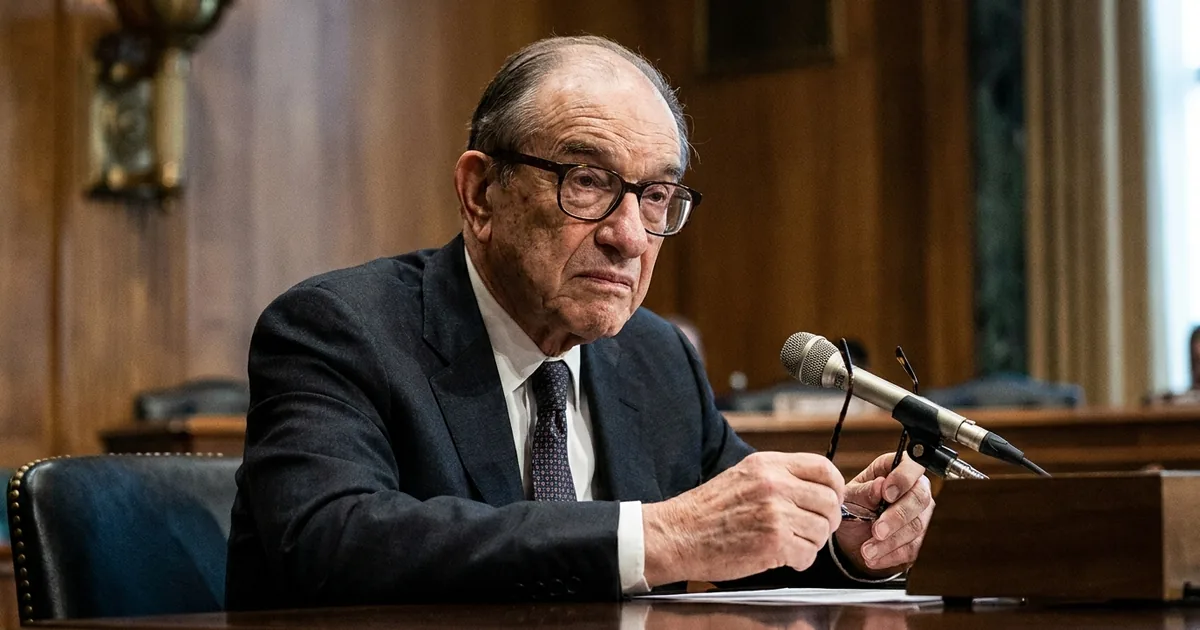
Alan Greenspan, the Federal Reserve chairman whose every murmur could move markets and whose 18-year run turned an obscure central-banking post into the most powerful unelected job in Washington, died Monday at his home in the capital at 100.
His wife, NBC News correspondent Andrea Mitchell, said the cause was complications from Parkinson’s disease, closing the book on a man Americans were trained to treat as an oracle and lived to watch get the biggest call of his career catastrophically wrong.
For almost two decades, Greenspan was the closest thing the United States had to an economic high priest. Presidents of both parties reappointed him. Senators quoted him. Cable networks built a cottage industry around guessing his next move. Then the system he spent a career insisting could regulate itself nearly collapsed, and the legend went down with it.
From Jazz Bands to the Ayn Rand Circle
Greenspan was born in New York City in 1926 and started his adult life not in economics but in music. He studied clarinet and saxophone at the Juilliard School and toured for a stretch with a professional swing band before deciding numbers suited him better than scales.
In the 1950s he fell in with the novelist Ayn Rand and became a fixture in her inner circle, the self-styled “Collective” that gathered around her gospel of unfettered markets and rational self-interest. That faith never really left him. Decades later, as the most powerful financial regulator on earth, Greenspan still carried the conviction that markets, left mostly alone, would discipline themselves. It made him, for a long time, the perfect chairman for an era that wanted to believe the same thing.
Ronald Reagan put him atop the Fed in 1987. He stayed until 2006, serving under George H. W. Bush, Bill Clinton, and George W. Bush, the second-longest tenure in the central bank’s history.
The Cult of the Maestro
The nickname was not subtle. Bob Woodward titled his 2000 biography “Maestro,” and the label stuck because it captured how Washington actually treated him. Greenspan was not a politician, yet he held more durable power than most of the politicians around him. He never ran for anything, and that was precisely the point. His authority came from the belief that he sat above the partisan fray, reading the economy’s vital signs with a precision no elected official could match.
The reverence got strange. Television crews used to film the thickness of his briefcase as he arrived for policy meetings, treating a fat folder as a clue to whether interest rates were about to move. NPR, in its obituary, described a man whose pronouncements were parsed like scripture. He spoke in a deliberately foggy dialect that came to be known as “Fedspeak,” and he was candid about why. “If I have made myself clear,” he once said, “then you have misunderstood me.”
That opacity was a tool. As CNN noted in tracing his career, Greenspan grasped that a central banker’s words could move trillions, so he used vagueness to keep his options open. It also did something less flattering. It trained a country to outsource its economic judgment to one man and to assume he always knew best.
The 2008 Reckoning
He did not. The same hands-off philosophy that made Greenspan a hero in the boom years helped set up the bust that defined the decade after he left.
Through the 2000s he held interest rates low, championed the deregulation of complex financial instruments, and brushed aside warnings that the housing market was inflating into a bubble. He argued that banks, acting in their own interest, would never take risks big enough to destroy themselves. The 2008 financial crisis proved otherwise. The bipartisan Financial Crisis Inquiry Commission later concluded that the meltdown was triggered in part by his failure to rein in subprime lending and his push for deregulation.
The most human moment of his career came in the wreckage. Hauled before a House committee in October 2008, Greenspan admitted he had “found a flaw” in his model of how the world worked, and conceded he had been wrong to assume banks could police themselves. The oracle had misread the biggest signal of his life, and he said so out loud.
The Question His Career Leaves Behind
Greenspan’s death lands at a moment when the Fed matters more, not less. The central bank that Kevin Warsh now leads holds even more sway over jobs, rents, and retirement accounts than the one Greenspan inherited, and Americans are once again being asked to trust that the people inside the building know what they are doing.
That is the real inheritance. Greenspan proved how much power a society will hand to an unelected expert when it wants to believe someone has the controls, and he proved how dangerous that bargain becomes when the expert turns out to be human. The Maestro is gone. The faith he built, and the bill it can leave behind, is still very much in play.