
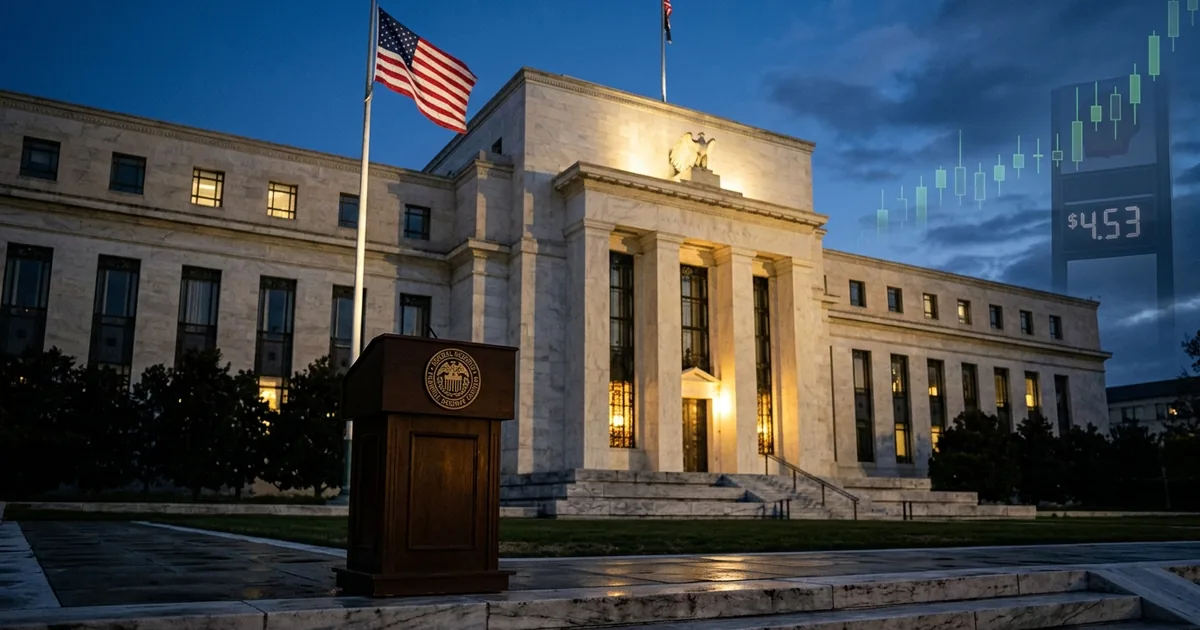
Kevin Warsh walks into the Eccles Building on Thursday as Federal Reserve chair, sworn in after a 54-45 confirmation vote that NPR called the closest in the modern era.
He inherits an economy where AAA’s national gas average just hit $4.53 a gallon, the Iran conflict is still feeding energy-price volatility, and a president who picked him is loudly demanding rate cuts before the first meeting he chairs.
That meeting is already on the calendar. The Federal Open Market Committee gathers June 16 and 17, with Warsh at the head of the table and Jerome Powell, the chair he replaces, expected to remain in the room as a Fed governor through 2028. The optics are awkward. The math is harder.
A Confirmation Vote That Tells You What’s Coming
The vote count is its own story. Only one Democrat, Senator John Fetterman of Pennsylvania, crossed the aisle to back Warsh, per CNN’s confirmation coverage. The rest of the caucus voted no, including senators who had once treated Fed independence as a bipartisan reflex. Republicans split too, with Senator Thom Tillis stalling the nomination for weeks over the Justice Department’s probe of Powell, a probe DOJ eventually dropped. The path cleared once that investigation died, a sequence LNC covered when Powell’s last FOMC meeting and the Warsh path opened up.
The thinness of the margin matters because monetary policy works on credibility. The chair speaks, markets price the next move, and the institution’s reputation does the heavy lifting between meetings. When the confirmation vote is 54-45 instead of the 80-vote majorities that confirmed Powell to his second term in 2022, the institution starts every press conference a step behind.
The Inflation Problem He Cannot Talk His Way Out Of
The April CPI print came in at 3.8 percent year over year, up from 3.3 percent in March. That is not the trajectory of an economy that needs lower rates. Gas at $4.53 a gallon, according to AAA’s national average released this week, reflects what an open shooting war in the Strait of Hormuz does to crude. The Fed cannot drill wells or end the Iran conflict. It can decide whether to make borrowing cheaper while inflation expectations are climbing, and that is the decision in front of Warsh on June 17.
Polymarket has the implied probability of no change at the June meeting north of 97 percent. CME’s FedWatch is in the same place. The market is telling Warsh what every Fed economist already knows: cutting into a 3.8 percent CPI print with oil at $100 a barrel is the kind of move that breaks an inflation-fighting reputation for a decade.
This Is Warsh’s Second Stint, Which Is the Whole Point
Warsh first joined the Board of Governors in 2006 at age 35, the youngest governor in Fed history, and served through the 2008 financial crisis before stepping down in 2011. He spent the intervening years at the Hoover Institution and on corporate boards, building a public posture that is hawkish on inflation, skeptical of asset-purchase programs, and openly comfortable with rate paths the Yellen and Powell Feds avoided.
That résumé is the asset the White House bought when it nominated him. It is also the asset the White House is asking him to spend. Trump has said publicly that the Fed should cut “immediately” and called Powell variations on every name short of disloyal for refusing to do it. Warsh’s pitch in his Senate hearings was that he would use his own judgment, per NPR’s confirmation coverage. The first chance he gets to demonstrate that judgment is six weeks away.
Powell Stays in the Building
The unusual wrinkle of this transition is that Powell is not leaving. He told reporters at his final press conference as chair that he intends to serve out his term as a Fed governor, which runs into 2028. Powell framed it as protecting the institution from political pressure. The Washington Post reported this week that Trump allies are already warning rate cuts may have to wait, an admission that even the chair the White House handpicked cannot wave away a 3.8 percent inflation print.
Two chairs, one room. The FOMC will function the way the FOMC always functions, by a vote of the regional bank presidents and the governors. But Powell sitting two seats down at every meeting is a check on how far Warsh can move without losing the room. That is the design feature, not the bug.
What to Watch Between Now and June 17
Three things will tell you where this is heading. First, the speech Warsh gives in the next ten days. Every new chair plants a flag. Listen for whether he frames the Iran-driven energy shock as “transitory,” the word that nearly ended Powell’s first term, or as “passed through into core inflation,” which would signal the cut Trump wants is further off than the White House is saying.
Second, the dot plot the FOMC publishes after the June meeting. Median projections for the federal funds rate at year-end 2026 will reveal whether the committee is in any position to move at all, or whether the data has frozen Warsh into the same hold pattern that made Powell a Trump target.
Third, what happens at the gas pump. If the national average crosses $5 before the Fourth of July, the political pressure on Warsh becomes the political pressure on every Fed governor, and the institutional case for holding the line gets harder to make in public. The country is about to learn whether a Fed chair the president handpicked is in fact the Fed chair the president can control.