
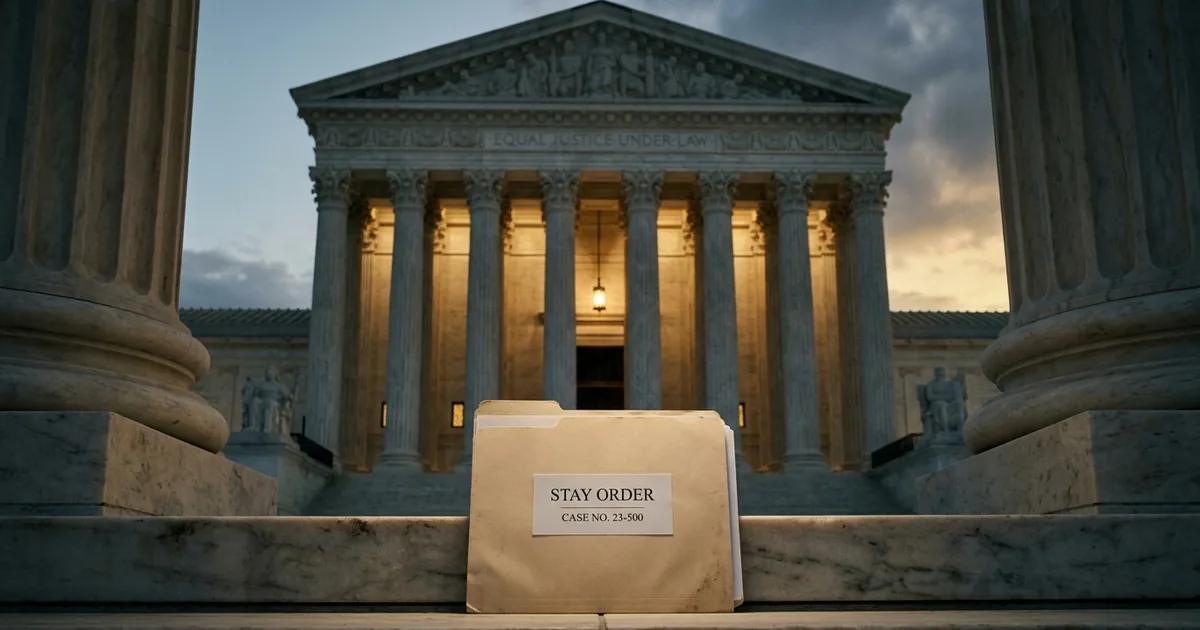
The Supreme Court on Thursday blocked a 5th Circuit ruling that would have forced women back into in-person doctor visits to obtain mifepristone, preserving the telehealth and mail-order pathways that handle most of the country’s medication abortions. The order was unsigned, the vote count undisclosed, and only Justices Clarence Thomas and Samuel Alito noted dissents, a lineup that tells you more about where this is heading than the one-line stay tells you about where it stands.
The stay arrived less than two weeks after the 5th Circuit’s panel suspended the FDA’s 2023 REMS for mifepristone, and three days after the same Court extended its own deliberation deadline by 72 hours. The timing matters. So does what just happened across town at the FDA.
What the Court Actually Did, and What It Did Not Do
The Court did not rule on whether telehealth dispensing of mifepristone is lawful. It did not rule on Louisiana’s underlying claim that the FDA’s 2023 expansion of the REMS exceeds the agency’s authority. It froze the 5th Circuit’s May 1 order while the case proceeds, which is the procedurally narrow move that preserves the status quo and forces the merits fight to play out on a slower calendar. As CNN reported in its breakdown of the ruling, the Court “imposed a pause on a May 1 decision from the 5th US Circuit Court of Appeals that abruptly required women to obtain the drug through in-person visits.”
That is what a stay does. The status quo, in this case, is the regime that has governed mifepristone since 2023: telehealth visits permitted, mail dispensing allowed, in-person requirements lifted. Roughly two-thirds of U.S. abortions now involve mifepristone, and the share of those handled via telehealth has climbed steadily. The Court declined to disrupt that.
Alito and Thomas Wrote the Roadmap
The dissents are the document. Alito’s opinion calls the majority’s unreasoned order “remarkable” and argues, per NPR’s coverage of the dissents, that the plaintiff drugmakers Danco and GenBioPro failed to demonstrate the irreparable injury the Court’s own precedent requires. He frames the underlying push for telehealth access as a “scheme to undermine our decision in Dobbs,” a reference to the 2022 opinion he authored that overturned Roe.
Thomas’s separate dissent picked up Louisiana’s argument that mail-order dispensing of mifepristone violates the Comstock Act, the 1873 federal law that prohibits mailing “obscene” materials. The Comstock theory has been a long-running project of the anti-abortion legal community, and it has been waiting for a vehicle. Thomas just gave it the most prominent endorsement a sitting justice can give a dormant statute: a published dissent from a Supreme Court stay order with the rest of the conservative bloc declining to join him.
That is the signal. The Comstock Act has not been enforced against contraceptives or abortion medication in a century, but a Thomas dissent putting it back in the conversation is how these arguments climb from law-review footnotes to a future majority opinion.
The Makary Backdrop Matters
Three days before the ruling, the FDA’s leadership emptied out. FDA Commissioner Marty Makary departed the agency on May 12 after President Trump signed off on a plan to remove him, the end of a tenure Pharmacy Times described as “tumultuous”. Anti-abortion groups had publicly demanded Makary be fired for not rolling back the 2023 REMS expansion, and CNN reported that Trump separately confronted him over his refusal to greenlight flavored e-cigarettes. Whichever fight finally cost him the job, both were fights with the political coalition that put him in the chair, a sequence LNC covered earlier this week when Makary’s resignation under pressure landed.
Kyle Diamantas, the deputy commissioner running the food program, is now acting FDA chief. The agency that defended the 2023 REMS in lower courts no longer has the Senate-confirmed commissioner who signed off on those defenses, and the acting chief who replaces him will be reading every brief through the political pressure that pushed his predecessor out.
That backdrop changes what Thursday’s stay actually preserves. The Court preserved the legal status quo. It did not preserve the institutional posture at FDA that produced the 2023 REMS in the first place. Those are different things, and the gap between them is the next eighteen months of this fight.
What Happens Next
The case returns to the 5th Circuit on the merits, where Louisiana’s challenge to the 2023 REMS will be briefed and argued on a schedule the Supreme Court has now bought time on. The likely path runs back up to SCOTUS for full review in the 2026-27 term, at which point the Court will have to do what it declined to do this week: explain itself.
Three things will tell you where this lands. First, whether the acting FDA leadership continues to defend the 2023 REMS with the same vigor as Makary’s FDA, or quietly softens its briefs. Second, whether more states follow Louisiana into court with REMS challenges of their own, multiplying the procedural pressure on the agency. Third, whether the Comstock Act gets a serious test case independent of the mifepristone fight, because Thomas’s dissent just published the invitation.
The Court bought time. It is not the same as deciding the question. The decision is still coming, and the dissents Thursday were not the views of the institution. They were the views of the two justices openly telling the country which way they want it to go.