
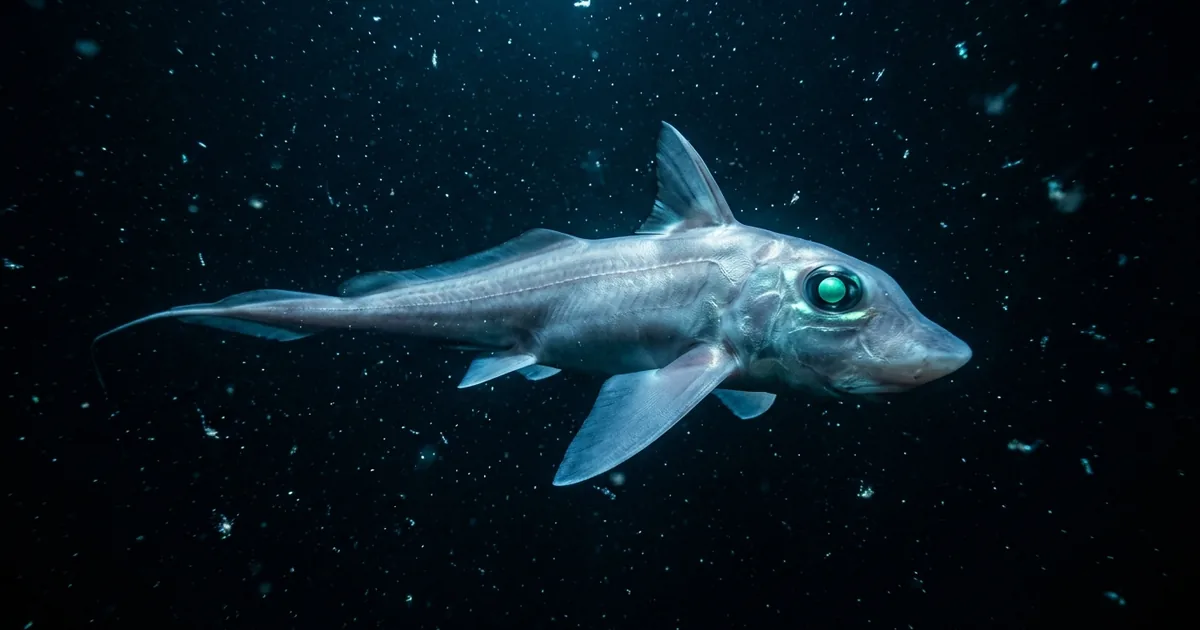
Somewhere between 1,000 and 3,000 feet below the surface of the Pacific Ocean off Costa Rica’s Puntarenas coast, a creature that looks like it was designed by a science fiction concept artist has been living undiscovered for millions of years.
Researchers have now formally identified it as Rhinochimaera costaricana, a new species of ghost shark, and the discovery is a reminder that the deep ocean remains the least explored frontier on the planet.
What Is a Ghost Shark
Ghost sharks are not actually sharks. They are chimaeras, a distinct branch of cartilaginous fish that split from sharks and rays roughly 400 million years ago, during the Devonian period. The name comes from their translucent, pale appearance and their tendency to haunt the deepest, darkest reaches of the ocean. They have smooth skin instead of scales, large iridescent eyes adapted to near-total darkness, and a long, pointed snout that gives them an otherworldly silhouette.
The newly described species belongs to the long-nosed chimaera group, and The Tico Times reported that it was identified from three specimens collected during deep-water surveys off the Pacific coast. The research was published in the journal Zootaxa on June 10, with a team from the University of Costa Rica, the Costa Rican Institute of Fisheries and Aquaculture, and the Federal University of Para in Brazil collaborating on the identification.
Why This Discovery Matters
Finding a new vertebrate species in 2026 is not routine. Most new species discoveries in the deep ocean are invertebrates, including the carnivorous sponge and glass-castle worm that were among more than 1,100 new marine species identified globally in a single recent census. A new chimaera is significant because these animals sit near the top of the deep-sea food web and because so few species of chimaera are known to exist.
Only about 50 species of chimaera have been described worldwide. Each new one expands the scientific understanding of how these ancient fish diversified and adapted to extreme environments. Rhinochimaera costaricana adds Costa Rica’s deep Pacific waters to the map of global chimaera biodiversity, a map that has enormous gaps because sampling the deep ocean is expensive, technically difficult, and dependent on research funding that is perpetually undersized.
The Exploration Problem
Humans have mapped the surface of Mars in greater resolution than the floor of Earth’s oceans. That is not a metaphor. The topographic data for the Martian surface is denser than the bathymetric data for most of the deep ocean. Ghost sharks, by virtue of living in one of the hardest environments on Earth to reach, are among the least studied vertebrates alive.
The discovery of Rhinochimaera costaricana happened because researchers were conducting fisheries surveys, not dedicated deep-sea exploration. The specimens were bycatch, pulled up in nets designed to assess commercial fish stocks. Much of what science knows about the deep ocean has come from exactly this kind of accidental discovery, which raises an uncomfortable question: how many species are down there that no net has ever reached?
Costa Rica’s Pacific margin is a biodiversity hotspot that includes cold seeps, hydrothermal vents, and deep submarine canyons. The OceanGate submersible disaster in 2023 temporarily put deep-sea exploration into the public conversation, but the sustained investment required to systematically survey these environments has not materialized.
A 400-Million-Year Survivor
Ghost sharks have survived every mass extinction event in Earth’s history. They outlasted the dinosaurs, the Permian die-off, and the ice ages. The fact that a species this ancient can still be unknown to science in 2026 says less about the ghost shark and more about the vast, dark, pressurized world it inhabits, a world that covers more than 60 percent of the planet’s surface and remains almost entirely unmapped.
Rhinochimaera costaricana did not need to be discovered. It was doing fine without us. But its discovery is a small, strange gift from the deep, proof that the ocean still has secrets worth finding.