
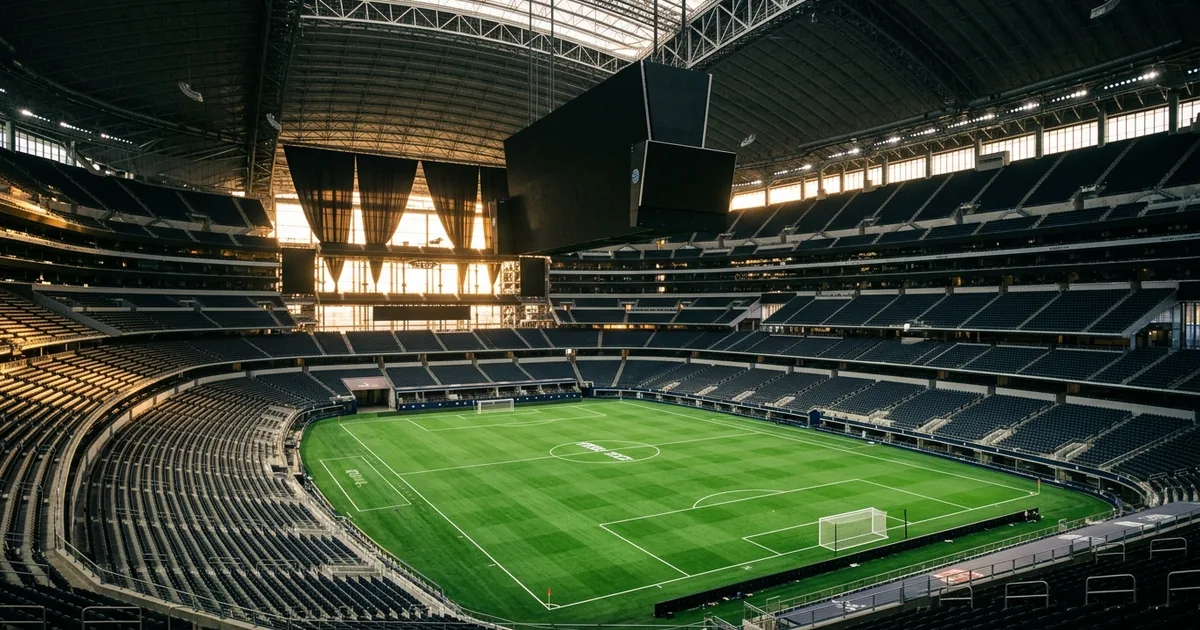
Curtains.
After years of complaints, memes, and one spectacularly defiant quote about tearing the whole stadium down, AT&T Stadium in Arlington finally got curtains to block the blinding west-end sunlight. It only took hosting the biggest sporting event on the planet to make it happen.
The Sun Problem That Would Not Go Away
If you have watched a Dallas Cowboys game in the late afternoon at AT&T Stadium, you know the drill. The venue’s massive west-end glass panels, a signature design feature that Jerry Jones personally championed, let sunlight pour onto the field at exactly the angle that blinds players, confuses camera operators, and turns one end zone into a solar oven.
This is not a new discovery. The stadium opened in 2009. The sun has been doing the same thing for 17 years. Players have complained. Coaches have strategized around it. Broadcast crews have adjusted camera angles to compensate. And every few years, someone publicly suggests the obvious solution: put up curtains.
Jerry Jones has historically responded to this suggestion with the enthusiasm of a man being asked to put a slipcover on his Picasso. In 2024, when the curtain question came up yet again, Jones delivered what might be his most perfectly Jerry Jones quote ever: “We do know where the damn sun is going to be in our own stadium. Let’s just tear the damn stadium down and build another one.”
Reader, they did not tear the stadium down. They put up curtains.
FIFA Made the Call
The curtains went up for Thursday’s Japan vs. Sweden group stage match, as AP reported. The timing of the match, combined with the sun’s angle, made the glare a genuine competitive issue rather than just an aesthetic annoyance. Earlier World Cup games at the venue had managed with tinted windows, but this particular matchup fell during the worst window of solar interference.
Dallas is hosting nine World Cup matches, more than any other venue in the tournament. That volume of games across different kickoff times meant the sun problem was eventually going to collide with a match window where tinted glass was not enough. Thursday was that moment.
What is telling is that FIFA, not Jones, effectively forced the decision. When you are hosting the world’s most-watched sporting event, and the governing body says the playing conditions need to meet international standards, the owner’s architectural preferences take a back seat. Jones could stiff-arm Cowboys fans and NFL broadcast partners for nearly two decades. He could not stiff-arm FIFA.
A Stadium Design Philosophy Meets Reality
The glass panels at AT&T Stadium are not an accident or an oversight. They are a deliberate design choice that reflects Jones’s vision for the venue as an architectural statement, not just a football stadium. The retractable roof and massive glass end walls were meant to blur the line between indoor and outdoor, letting natural light flood the space and giving spectators a visual connection to the outside world.
It is, genuinely, a cool design idea. The problem is that cool design ideas and functional sporting venues are sometimes in tension, and Jones has consistently prioritized the former over the latter. The glass panels create spectacular photographs and a distinctive visual identity. They also create a competitive disadvantage for whichever team is facing west in the second half of an afternoon game.
This tension between form and function is not unique to AT&T Stadium. SoFi Stadium in Los Angeles has dealt with similar solar issues. Allegiant Stadium in Las Vegas has its own light management challenges. But none of those venues have had an owner so personally invested in the design choice that he would rather joke about demolition than hang drapes.
The Cowboys Fan Reaction
The response from Cowboys fans has been exactly what you would expect: a mixture of vindication and exasperation. For years, the curtain suggestion was treated as a punchline, a sign that the person making it did not understand Jerry Jones’s vision for the building. Now that the curtains are actually up, the obvious question is: why did it take a FIFA mandate to do something that everyone has known was necessary since the Obama administration?
The answer, of course, is that Jerry Jones has never been particularly responsive to the preferences of people who are not Jerry Jones. The man built a $1.2 billion stadium (now valued considerably higher) as a monument to his own taste and ambition. Asking him to modify it because fans find the sun annoying is like asking an artist to repaint a corner of a mural because someone in the gallery is squinting.
FIFA, however, is not a fan in the gallery. FIFA is the client who commissioned the exhibition. When the client says the lighting needs to change, the lighting changes.
Meanwhile, the World Cup Delivers Drama
The curtain story is the kind of delightful sideshow that makes the World Cup special as a sporting event. While stadium logistics teams were solving 17-year-old sun problems, the tournament itself was delivering on the field. South Africa produced a stunning result that set up a knockout round matchup against Canada, the kind of David-vs.-Goliath narrative that gives the World Cup its emotional weight.
The tournament’s expansion to 48 teams has created more of these moments: smaller nations getting their chance on the biggest stage, playing in front of global audiences in state-of-the-art venues. That AT&T Stadium, the crown jewel of American sports architecture, needed a quick curtain fix to meet the moment is a reminder that even the grandest stages need practical adjustments when the stakes are high enough.
What This Tells Us About Jerry Jones
The curtain saga is, in miniature, the story of Jerry Jones’s entire tenure as Cowboys owner. He builds big, thinks big, and refuses to compromise on his vision, even when the compromise is obviously correct and everyone around him can see it. Sometimes that stubbornness produces greatness: the stadium itself, for all its quirks, is a genuinely spectacular venue that redefined what an NFL arena could be.
Other times, it produces absurdity: a billionaire refusing to hang curtains while his players squint into the sun and his fans watch home-field advantage literally evaporate in the glare. As Bleacher Report documented, the photos of the curtained stadium feel almost surreal, a pragmatic retrofit on a building designed to resist pragmatism.
The curtains will presumably come down after the World Cup, and the Cowboys will go back to playing afternoon games in a solar spotlight. Or maybe, just maybe, the experiment will prove that blocking the sun does not ruin the stadium’s aesthetic, and Jones will keep them up. Stranger things have happened.
But if the World Cup continues to deliver drama at the rate it has been, the curtains will be the least interesting story coming out of Arlington this summer. They are just the most perfectly Jerry Jones one.