
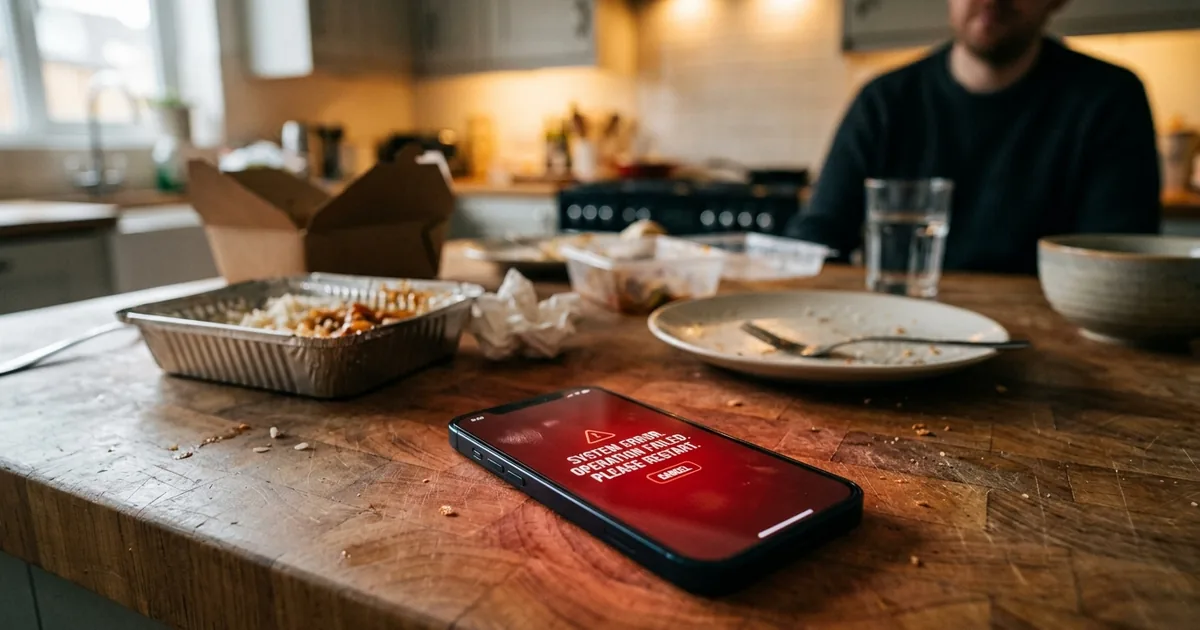
DoorDash went down for thousands of users across the United States on Sunday evening, with reports surging around 6:25 PM Eastern as customers hit “something went wrong” error screens while trying to complete food delivery orders.
The outage lasted roughly 13 minutes before services began recovering, but not before it exposed just how fragile the infrastructure is behind an app that millions of Americans now treat as essential household utility.
What Actually Broke
Around 6,000 users flagged problems on DownDetector during the peak of the outage, with 38% reporting the app as completely non-functional and 17% specifically unable to complete orders. The failure point was at checkout: users could browse menus and add items to their carts, but the transaction could not be processed. TechRadar reported that the outage appeared to affect DoorDash’s mobile app alongside other services, with Spotify also experiencing disruptions in the same window.
Users reported seeing “unexpected error try again” prompts when attempting to resubmit orders, and the Asbury Park Press documented the nationwide scope of the complaints. DoorDash did not issue an official statement during the outage, and its customer support account on X was not responding to inquiries while the system was down.
Why a 13-Minute Outage Matters
Thirteen minutes sounds trivial until you consider the economics. DoorDash processes an estimated $17 billion in gross order volume per quarter. At that scale, even a brief Sunday-evening outage during peak dinner hours represents thousands of lost orders, hundreds of Dashers sitting idle with no dispatches, and restaurants that prepped food for orders that never completed. The revenue impact is real, but the trust impact is harder to measure.
The broader pattern is that food delivery platforms have become single points of failure for a significant chunk of American dining. When Meta threatened to pull Facebook and Instagram from New Mexico rather than comply with child safety redesign requirements, it underscored how much power platform companies hold over users who have reorganized their lives around these services. DoorDash occupies a similar position: for time-constrained families, elderly users, people without transportation, and anyone in a food desert, the app is not a convenience. It is how dinner happens.
The Dasher Side
The outage hit gig workers hardest in ways that do not show up in DownDetector reports. Dashers who were mid-delivery when the app crashed could not confirm completions, which means they could not get paid for deliveries already in progress. Dashers who were waiting for orders during peak earning hours lost that time permanently, with no compensation structure for platform downtime. DoorDash’s contractor model means the company has no obligation to pay workers for lost time during system failures, even when those failures are entirely on the company’s side.
This is the structural tension baked into every gig platform: the company captures the efficiency gains of treating workers as independent contractors, but when the platform itself fails, those same workers absorb the downtime cost while the company’s fixed costs stay flat.
What DoorDash Has Not Said
As of Monday morning, DoorDash has not published a post-incident report, explained what caused the failure, or indicated whether affected orders will be refunded. The company’s status page showed systems as operational after the roughly 13-minute recovery window, but no root cause analysis has been shared publicly.
For a company valued at over $70 billion that is positioning itself as essential infrastructure for food delivery, the absence of transparency after a peak-hours outage is a choice. Users who had their Sunday dinner disrupted are left to wonder whether this was a one-off server hiccup or a symptom of deeper infrastructure underinvestment, and DoorDash is not giving them an answer either way.