
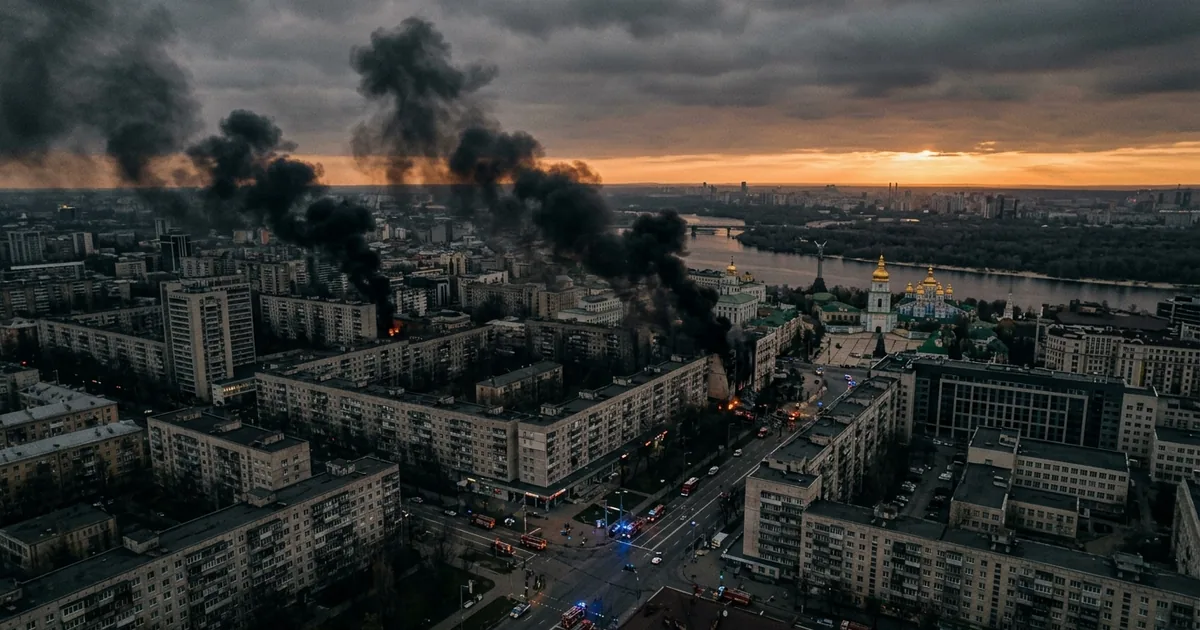
Hundreds of Russian drones and dozens of missiles hammered Kyiv for 11 straight hours overnight, collapsing apartment buildings and killing at least 13 people in what Ukrainian officials are calling the single most devastating combined strike on the capital since the full-scale invasion began.
The assault came less than 24 hours after President Volodymyr Zelensky publicly warned that Vladimir Putin had been “preparing a massive strike against Ukraine for some time,” a warning that proved grimly accurate by dawn.
Nearly 500 Drones and Dozens of Missiles Hit From Multiple Directions
Russia’s defense ministry confirmed it launched what it called a “massive strike using high-precision, long-range weapons,” combining ballistic and cruise missiles with waves of attack drones that targeted the capital simultaneously from different directions. Air raid sirens began around 8 p.m. local time Wednesday and did not stop until Thursday morning. Residents who have lived through more than four years of war described it as the worst night they could remember.
Kyiv Mayor Vitali Klitschko reported 13 dead and at least 86 injured across the city, with the toll expected to rise as rescue teams continued digging through rubble. A nine-story residential building in the Desnyanskyi district partially collapsed after a direct hit, trapping residents inside. Six floors of another apartment block in Darnytskyi were destroyed. A hotel and two five-story buildings in the Shevchenkivskyi district sustained heavy damage. An ambulance substation was struck, injuring several medical workers responding to the attack itself.
The Strategic Calculus Behind the Escalation
The timing tells the story. This was not a random barrage. Putin authorized the largest single attack on Kyiv precisely because Zelensky had been escalating pressure on Western allies to lift remaining restrictions on long-range weapons use, and Ukraine had recently struck deeper into Russian territory with Western-supplied munitions. The massive combined strike is the Kremlin’s answer: a demonstration that Russia retains the capacity to inflict catastrophic damage on Ukraine’s capital whenever it chooses, a message aimed as much at NATO capitals as at Kyiv.
Russia framed the attack as retaliation targeting “military and energy infrastructure,” but the damage pattern tells a different story. Residential apartment buildings, a hotel, an ambulance station. The infrastructure Moscow claimed to target is not located inside nine-story apartment blocks in residential districts. The gap between the stated targeting rationale and the actual impact zone is a pattern documented across every major Russian escalation since June, when a 656-drone and 73-missile barrage killed 22 people in a single night.
NATO Neighbors Forced to Respond in Real Time
The scale of the attack forced immediate responses beyond Ukraine’s borders. Poland scrambled fighter jets as the barrage moved westward, and Finland restricted its airspace as a precautionary measure. These are not symbolic gestures. When a NATO member state has to launch interceptors because a neighboring country’s airspace is saturated with hundreds of inbound weapons, the line between a regional war and a continental security crisis gets thinner with every salvo.
The incident underscores a reality that European defense planners have been warning about for months: Russia’s drone and missile production capacity has not merely survived Western sanctions, it has adapted and scaled. The ability to launch nearly 500 drones in a single operation reflects an industrial base that is outproducing the pace at which Ukraine’s partners are delivering air defense systems.
What the Casualty Pattern Reveals
Thirteen dead and 86 injured in a city that has spent years hardening its civil defense infrastructure is both a testament to Ukraine’s shelter systems and a measure of the attack’s ferocity. Kyiv’s metro stations served as shelters through the night, likely saving hundreds of lives. But the people who died were overwhelmingly in residential buildings, asleep or sheltering at home when the strikes hit.
The targeting of an ambulance substation is particularly significant. Striking first responders has a compounding effect: it degrades the medical response to every subsequent casualty and signals to civilians that even the rescue infrastructure is not safe. International humanitarian law classifies medical facilities as protected objects. The strike on medical workers responding to mass casualties will add to the growing dossier at the International Criminal Court.
The Air Defense Gap Is the Story That Will Not Go Away
Every major Russian escalation exposes the same structural problem. Ukraine’s air defense network, while significantly bolstered by Western Patriot, NASAMS, and IRIS-T systems, cannot cover every residential district of a city the size of Kyiv against a saturated attack involving hundreds of simultaneous inbound threats. The math is unforgiving: each interceptor missile costs orders of magnitude more than each Shahed-type drone, and the stockpiles are not infinite.
Western allies face a question that this attack makes harder to defer. The current pace of air defense deliveries is calibrated to a war of attrition, not to a conflict where Russia can mass nearly 500 aerial weapons against a single city in a single night. That gap between delivery pace and threat reality is measured in collapsed apartment buildings and dead civilians.
Zelensky’s warning before the attack was not vague intelligence. It was specific, public, and correct. The question now is whether the international response will match the scale of what just happened, or whether the next “most massive attack” will simply move the baseline again.